Horror tattoo ideas by subgenre, with style, size, and placement tips from Huntington Beach artist Nadine Harvey. Built to read clearly for years.
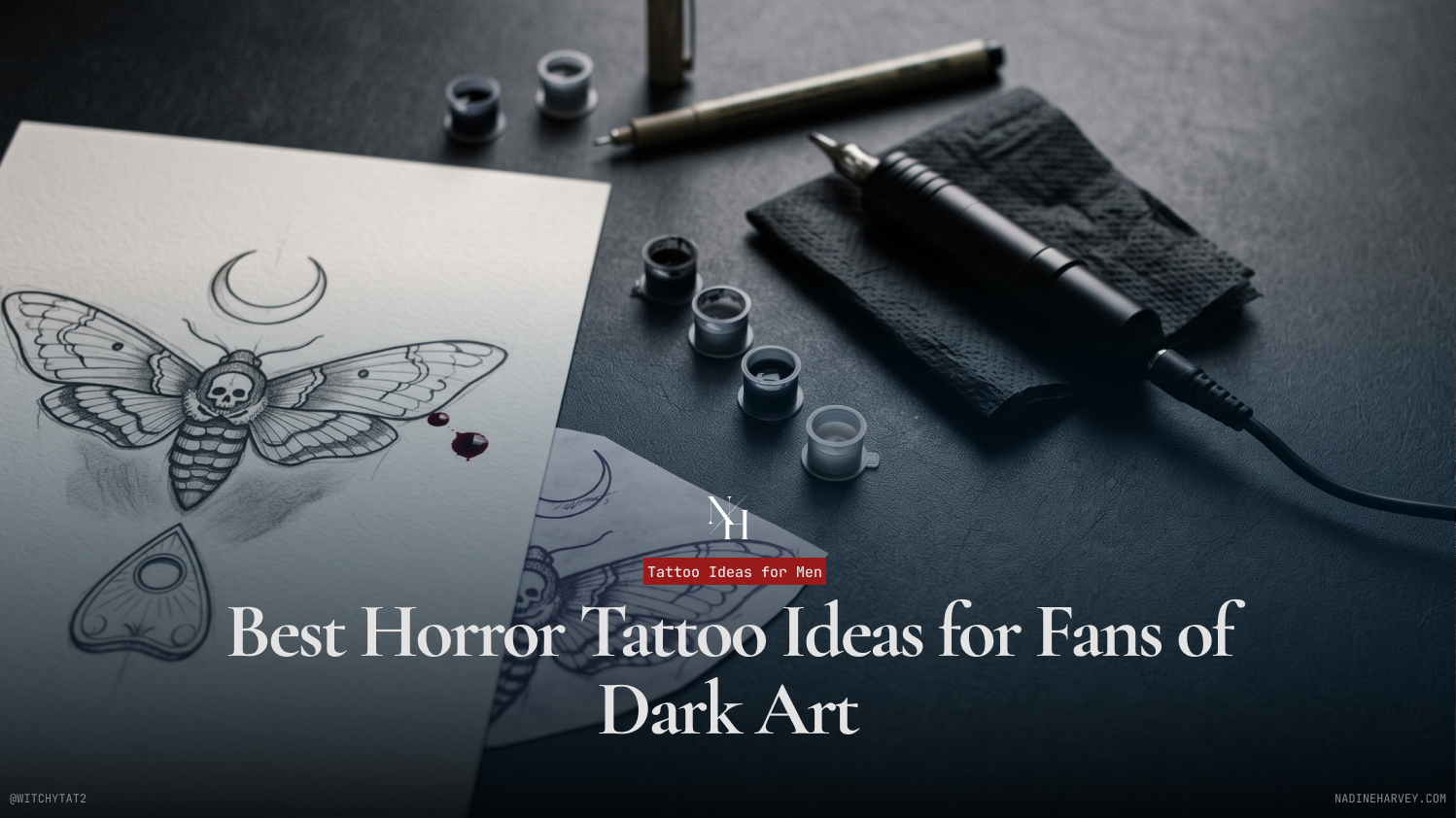
Not every horror image makes a good tattoo. A movie still can look sharp on a screen and blur on skin within a few years. Size, contrast, and style decide which ideas last.
This guide groups horror tattoo ideas by subgenre. You get a style, size, and placement note for each one. The guidance comes from Nadine Harvey, a Huntington Beach tattoo artist with eight years in horror, fine line, and black and grey work. Horror took a record share of U.S. box office ticket sales in 2025, and this guide shows you how to wear the genre well.
A horror idea works on skin when it has strong contrast, one clear focal point, and enough size for its detail. Bold shapes like masks, skulls, and silhouettes hold up at small sizes. Faces, teeth, and fine texture need more room. If a design depends on tiny detail to read, it needs to grow or simplify.
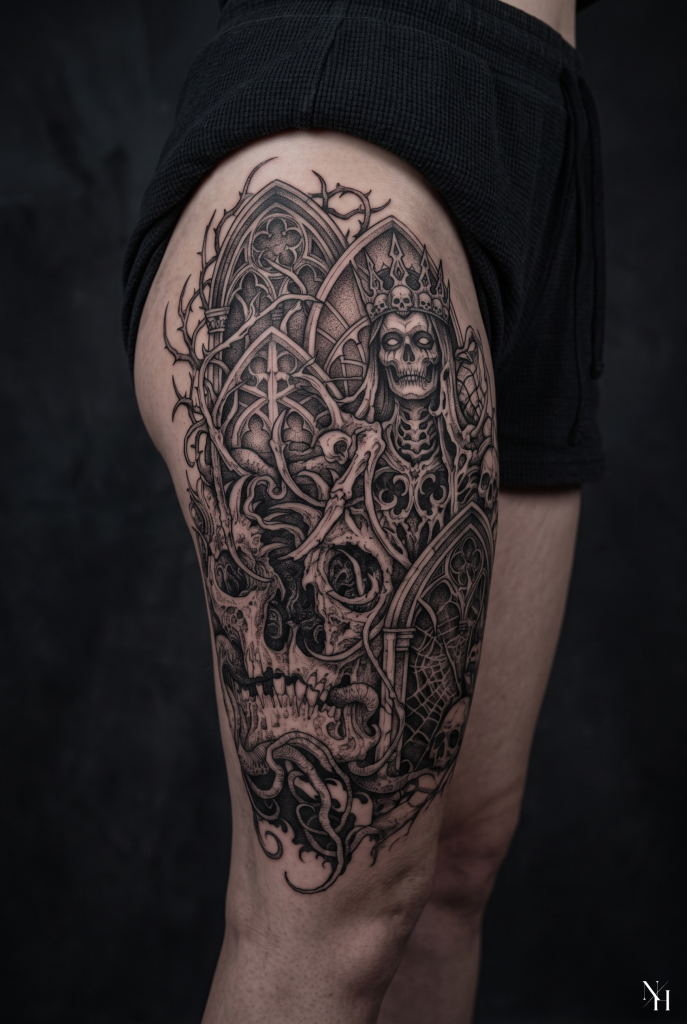
Ink spreads slowly in the skin over the years. Lines soften, and small gaps start to close. Tiny highlights disappear first.
Planning protects you from regret. Pew Research Center found 24% of tattooed adults regret at least one tattoo. Size and style choices made up front lower that risk.
Run every idea through three checks before you book.
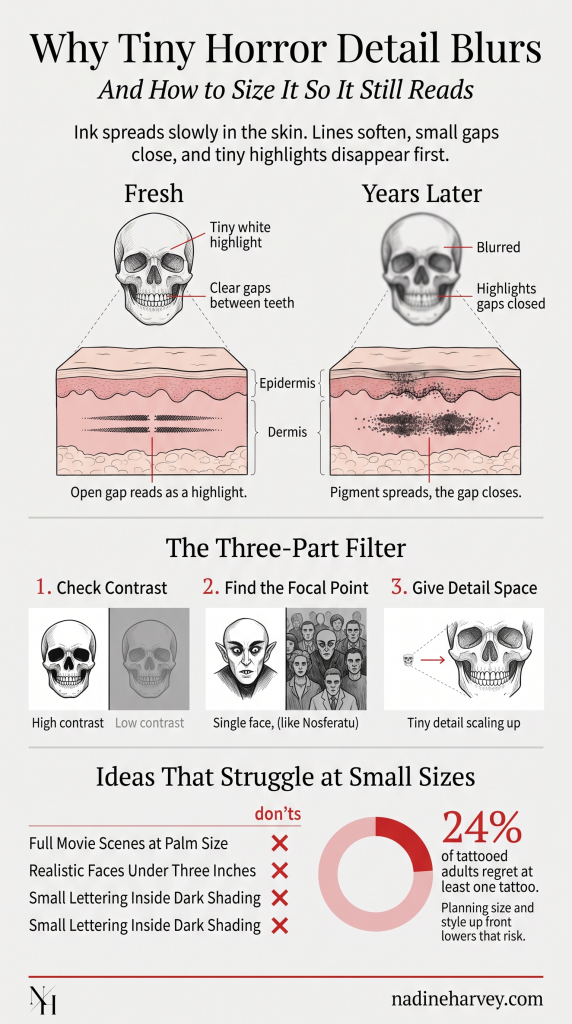
The strongest horror tattoo ideas come from six subgenres: classic monsters, slasher icons, occult symbols, body horror, anime horror, and gothic dark art. Each suits a different style and size. Classic monsters fit black and grey realism. Occult symbols work small in fine line. Body horror needs space to wrap around an arm or torso.
Use this table as a starting point. Sizes are rough guides. Your artist adjusts them to your body.
| Subgenre | Idea examples | Best style | Size guide | Placement | Aging note |
|---|---|---|---|---|---|
| Classic monsters | Dracula, Nosferatu, Frankenstein’s monster | Black and grey realism | Palm size or larger | Forearm, calf, thigh | Deep shadow ages well |
| Slasher icons | Michael Myers mask, Ghostface, Jason’s hockey mask | Black and grey or illustrative | 3 to 5 inches | Forearm, calf | Simple mask shapes stay clear |
| Occult and supernatural | Ouija planchette, ghosts, Lament Configuration | Fine line | 2 to 4 inches | Wrist, ankle, inner arm | Keep space between lines |
| Body horror | H.R. Giger textures, Xenomorph | Black and grey | Half sleeve or larger | Upper arm, ribs, back | Dense texture needs light breaks |
| Anime horror | Junji Ito spirals, Tomie portraits | Illustrative line with grey shading | 4 to 6 inches | Forearm, thigh | Clean lines hold if not crowded |
| Gothic dark art | Poe’s raven, ruined cathedrals, Goya-inspired figures | Black and grey realism or illustrative | Medium to large | Back, thigh, chest | Strong silhouettes last |
Classic monsters are the safest pick for a first large horror piece. Max Schreck’s Nosferatu from 1922 has a sharp silhouette that reads from across a room. Shadow carries the design, and deep shadow holds its shape for years.
Anime horror is a fresh direction for your collection. Junji Ito’s manga uses heavy black, clean lines, and repeating spirals. Those traits already match how a tattoo drawing works on skin.
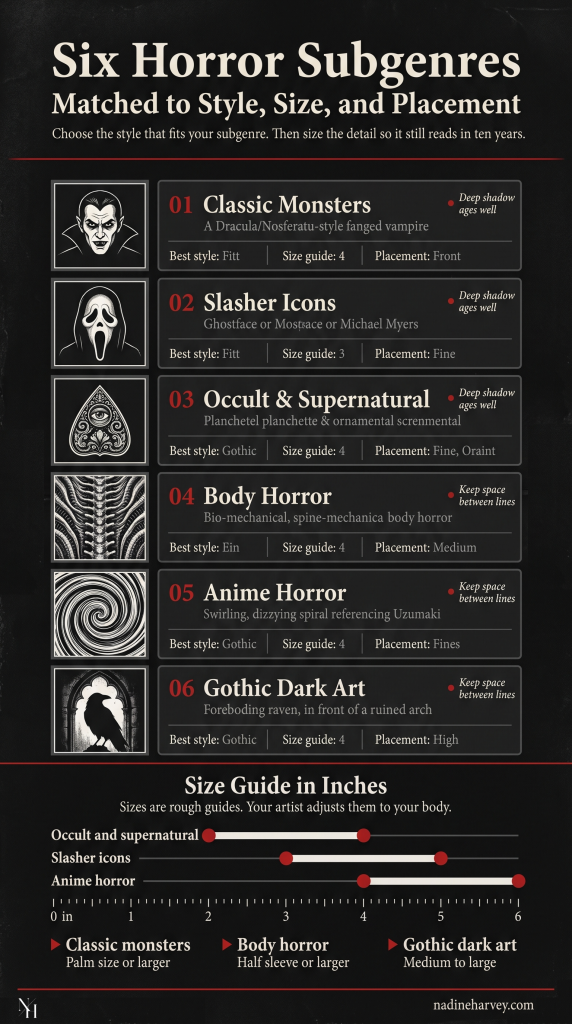
Black and grey realism is the best style for horror portraits, creatures, and scenes. It builds depth with soft shading and deep shadow. Fine line suits small symbols, outlines, and delicate occult designs. Fine line looks crisp when fresh but softens faster, so it needs more size and spacing than most people expect.
Nadine Harvey works in both styles and blends them in horror pieces. She named her favorites in a VoyageLA interview.
“My favorite styles are fine line horror, anime, and black and gray micro realism.” Nadine Harvey, Tattoo Artist
Her fine line realism guide covers that style in more depth.
| Style | Who it fits | Key strength | Watch out for |
|---|---|---|---|
| Black and grey realism | Portrait and creature fans | Depth, mood, lasting shadow | Needs size and often more than one session |
| Fine line | Minimalists and first-timers | Delicate, refined look | Lines soften over time |
| Micro realism | Collectors who want detail small | Detail in less space | Must be sized with care |
| Illustrative | Anime and comic fans | Bold lines stay readable | Less photo-real depth |
Each greywash step adds one more tone to a monster’s face. More tones give you more depth in the cheekbones, teeth, and eye sockets.
Use your favorite film as a reference, then let your artist draw something new. A good artist pulls the mood, shapes, and symbols from your references and builds a fresh composition by hand. The result fits your body, holds up over time, and belongs only to you. A traced film still rarely does any of that.
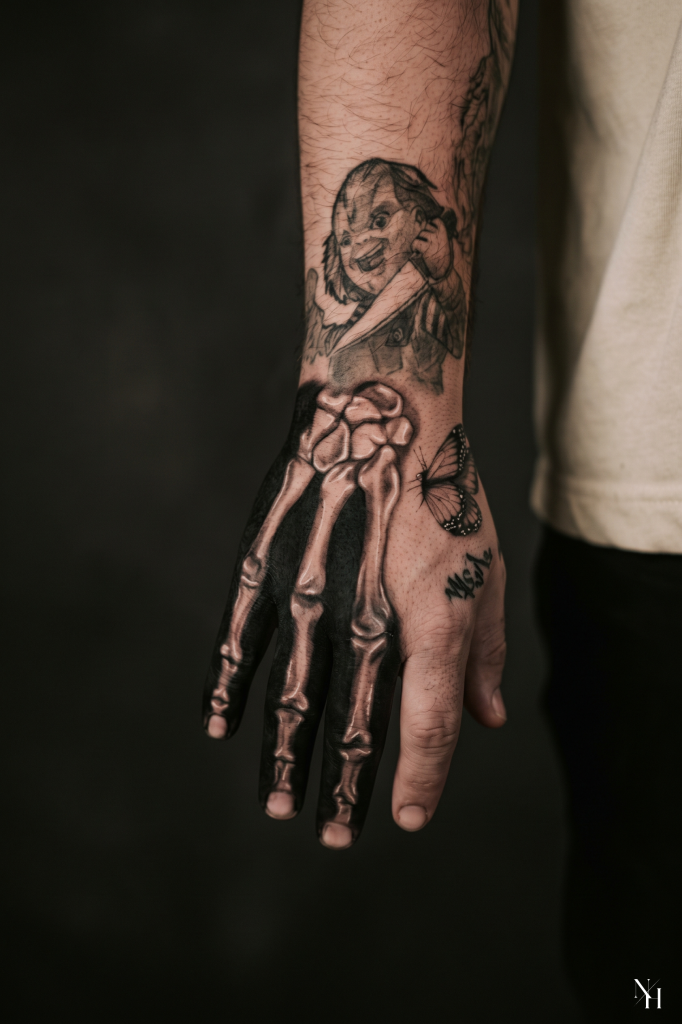
Nadine Harvey draws every piece before ink touches skin. Her homepage puts the process in four words.
“Drawn first, tattooed second.” Nadine Harvey, Tattoo Artist
Direct copies of film stills cause two problems. They often age poorly because film lighting is too dark and too detailed for skin. They can also raise copyright questions.
In 2024, a Los Angeles federal jury cleared a tattoo artist in a copyright case over a portrait drawn from a photo. The verdict turned on the facts of that one case. This is not legal advice. An original interpretation is the safer creative choice.
A client brings a screenshot of Michael Myers standing in a dark hallway. The scene is mostly black on black. On skin, it would read as a dark shape with no detail.
The fix takes three changes. Keep the white mask, add one strong light source, and drop the hallway. The mask becomes the focal point.
Plan a horror sleeve around one story, one style, and one light source. Pick a main subject, then add supporting elements that flow around the arm. A horror collage blends several films or symbols into one narrative composition. The result looks planned from shoulder to wrist instead of pieced together over time.
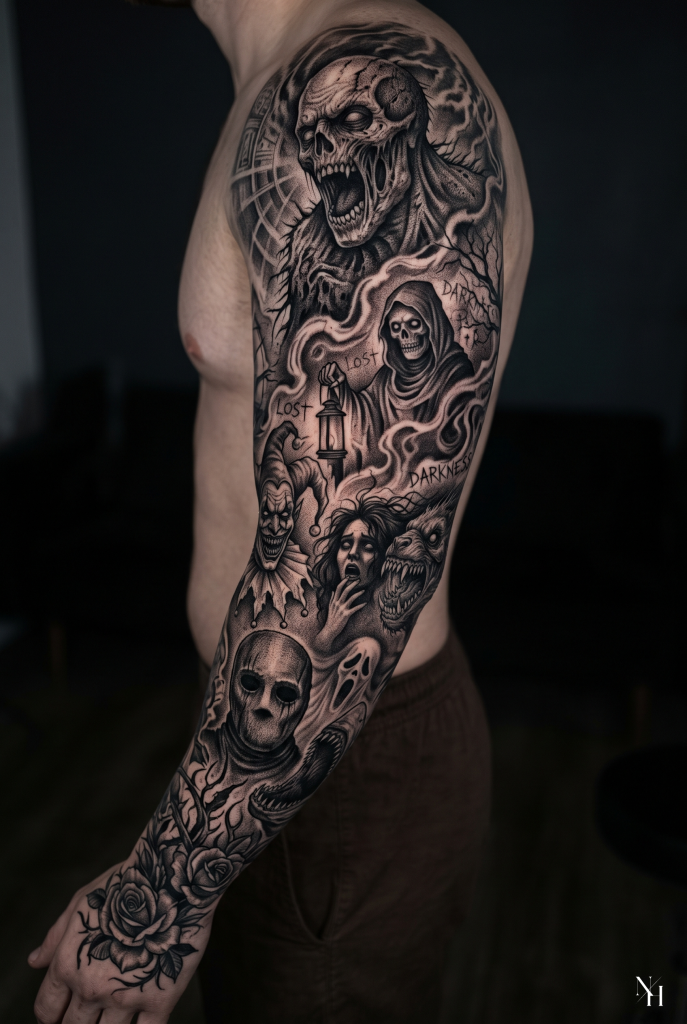
Nadine Harvey builds horror collages as single stories. Her Instagram bio describes the approach in three words.
“Carefully curated chaos.” Nadine Harvey, Tattoo Artist
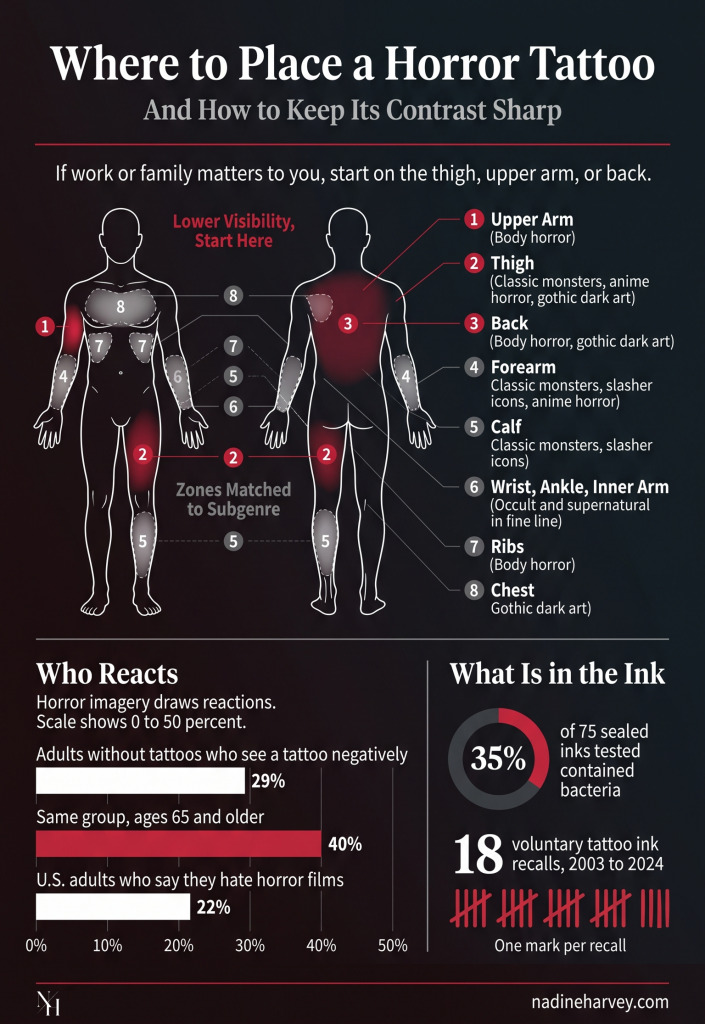
Horror imagery draws reactions. Pew Research Center found 29% of adults without tattoos see a tattoo negatively. Among adults 65 and older, that number rises to 40%.
Horror itself divides people. In a YouGov poll, 22% of U.S. adults said they hate horror films. If work or family matters to you, start on the thigh, upper arm, or back.
The tattoo placement guide covers pain and visibility for each area.
Choose a registered artist, ask about ink sourcing, and protect healed work from the sun. In Orange County, artists must register with the county and complete approved bloodborne pathogen training each year. After healing, wear broad-spectrum SPF 30 or higher outdoors. Black and grey horror depends on contrast, and UV light fades it.
California’s Safe Body Art Act sets the safety baseline for every studio in the state. The Orange County Health Care Agency requires artists to display current registration at their workstation. Look for that certificate during your consultation.
Ink quality matters too. In a 2024 study by FDA researchers, about 35% of 75 sealed inks contained bacteria. Firms issued 18 voluntary tattoo ink recalls between 2003 and 2024. Ask your artist which brands they use and where they buy them.
Southern California sun fades dark work faster than most people expect. The American Academy of Dermatology warns that UV light can fade some tattoo inks. Its guidance includes these steps.
For the first weeks, follow your aftercare instructions closely. Your artist may apply an adhesive film like Saniderm to protect the tattoo in the first few days.
The best horror tattoos share three traits. They have clear contrast, one focal point, and room for their detail. They also start as original drawings, not traced movie stills.
Start with the subgenre table to match your idea to a style and size. Then pick a placement that fits your work and family life. Protect the finished piece with SPF 30 or higher every time you head outdoors.
Browse Nadine Harvey’s tattoo portfolio for healed black and grey and fine line work. Her editorial modeling shapes how she frames each piece on the body.
When your references are ready, request a consultation. Nadine takes a limited number of bookings each month, so each design gets her full attention.
Yes, when your artist sizes and spaces them well. Fine lines soften over the years. Leave gaps between details and wear SPF 30 or higher outdoors.
Plan on palm size or larger for a realistic face. Smaller faces lose eyes, teeth, and texture first. Your artist will size it to your body.
Nadine draws an original interpretation instead of a direct copy. An original design ages better and feels personal. Copyright outcomes vary by case, so this is not legal advice.
Bring three to five references, a placement idea, and a rough size. Describe the mood you want, such as dread or grief. Mood shapes the design more than any single image.
Yes, if you start simple. A bold mask or a fine line planchette makes a strong first piece. Read the first tattoo checklist before you book.