Learn what irezumi really means, how tebori differs from machine work, what classic motifs symbolize, and what to expect before booking a Japanese-style tattoo.
You want a Japanese-style tattoo. Maybe a dragon, a koi, or a full sleeve. But you keep seeing terms like irezumi, tebori, and horimono, and none of the guides explain what they actually mean for you.
This guide breaks down the history, the technique, and the real commitment behind this style. I have spent eight years tattooing black and grey, fine line, anime, and horror work. I bring that same design thinking to Japanese-influenced pieces. By the end, you will know what you are actually asking for.
Irezumi means “inserting ink.” It is the general Japanese word for tattoo, and outside Japan it usually points to one specific style. That style uses large, connected designs. Dragons, koi, tigers, and other classic figures show up most often, tied together by a background of wind, water, or clouds.
The word itself is neutral. But it carries history. For centuries it was also the term for punishment tattoos. That history is part of why some artists prefer other words for their work.
Two other terms come up often.
You do not need to use these terms perfectly. Knowing the difference helps you talk to your artist with more precision.
Irezumi looks the way it does because of woodblock prints, not because of a fixed rulebook. Around 1827, artist Utagawa Kuniyoshi published prints of tattooed outlaw heroes from the Suikoden. The series was a hit, and demand for large, pictorial tattoos followed almost immediately.
That link between print and skin never went away. The heavy outlines, the graded shading, and the flowing backgrounds all come from that same visual world.
The politics around irezumi shifted hard over the next two centuries.
Even during the ban years, Japanese tattoo artists built a reputation abroad. Nippon.com’s history of irezumi notes two royal visitors who got tattooed in Meiji-era Japan. Prince George, later King George V, and Nicholas Alexandrovich, later Tsar Nicholas II, both received irezumi during their visits. That was while the practice stayed illegal for Japanese citizens at home.
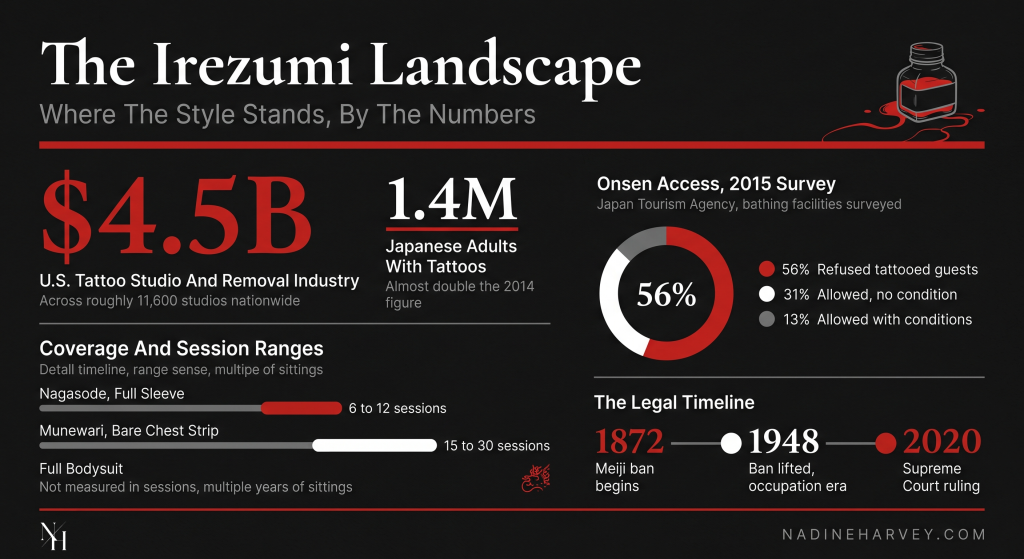
Attitudes are shifting inside Japan too. The Boston Globe reported that around 1.4 million Japanese adults now have tattoos, almost double the number from 2014.
Public spaces have not fully caught up. A 2015 Japan Tourism Agency survey found that 56 percent of bathing facilities refused tattooed guests outright. Only 31 percent allowed them without any condition. Another 13 percent allowed them under conditions like a cover patch, according to reporting on the survey.
Tebori is the traditional hand-poked method. An artist binds needles to a rod and works ink into the skin by hand, with no motor. Most artists today combine tebori with machine outlining. Plenty of excellent irezumi is done entirely by machine.
Tebori takes longer per session. It can produce smoother gradients in shading, especially in bokashi, the soft graded technique that gives Japanese tattoos their depth. That is studio experience, not settled clinical fact.
“I combine machine outlines with tebori shading on most large pieces. The blend gives cleaner linework and still keeps that soft, hand-worked gradient in the background.” Nadine Harvey, Tattoo Artist
Here is what actually matters for you as a client.
Do not assume tebori is required for a design to count as real irezumi. The style is defined by composition and meaning, not by which tool touched your skin.
Coverage terms describe how much of the body a design fills. Each term carries a different time and cost range. A sleeve covers an arm. A bodysuit covers most of the torso and limbs. Knowing these words before your consultation helps you and your artist agree on scope fast.
Traditional irezumi has specific names for common coverage levels.
| Term | What It Covers | Rough Session Range |
|---|---|---|
| Nagasode | Full sleeve to the wrist | 6 to 12 sessions |
| Munewari | Torso, with a bare strip down the chest | 15 to 30 sessions |
| Full bodysuit | Torso, arms, and legs as one design | Multiple years |
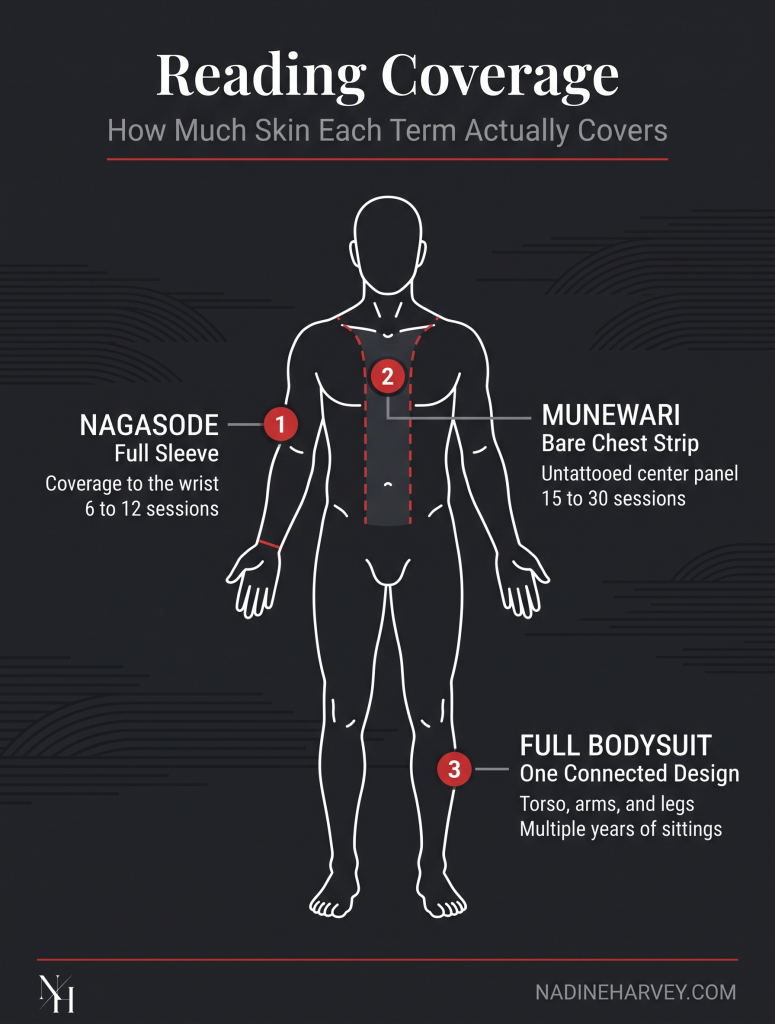
I once worked with a client who asked for “a small Japanese dragon.” Once we talked through scale and background, he realized he actually wanted a half sleeve. Naming the coverage level early saved us both months of confusion.
Classic irezumi motifs carry specific, long-standing meanings. Pair one with the wrong background or season, and it can look like a mistake to anyone who knows the style. A dragon means wisdom and protection. A koi means perseverance. A hannya mask means transformation through consuming emotion.
Here are five figures that show up constantly.
Do not pick a motif from a meaning chart alone. Season and pairing matter. Cherry blossoms and autumn maple rarely share one panel, because the seasons do not overlap.
“I’ve turned down cherry blossom and maple combinations more than once. Mixing spring and fall in one panel breaks the read of the piece, even when a client likes both images on their own.” Nadine Harvey, Tattoo Artist
A good artist will catch this before it becomes permanent.
A Japanese-style sleeve typically takes six to twelve sessions. A full bodysuit can take several years of regular sittings. Size, color depth, and your pain tolerance for long sessions all affect the real timeline.
This is the number one thing clients underestimate. A design that looks simple in a reference photo often needs a full background to read correctly. That background adds sessions.
A realistic planning framework looks like this.
Budget accordingly. The U.S. tattoo studio and removal industry is valued at $4.5 billion, across roughly 11,600 studios. Large custom work sits well above walk-in flash pricing in that market.
Wearing irezumi as a non-Japanese person is not automatically disrespectful. Treating the motifs as decoration with no meaning attached often reads as careless. Learning what a symbol means, and choosing an artist who understands the tradition, is the difference.
Respect here is mostly about effort, not ancestry.
This is a living art form with real practitioners still working in it today, in Japan and abroad. Treat it like any other serious design tradition. Ask questions. Expect real answers.
A good Japanese-style artist explains composition. Drawing motifs well is not enough by itself. Ask to see full backgrounds in their healed work, not fresh outlines. Healing quality is where technique actually shows.
Portfolio review should go beyond single images.
Safety standards matter regardless of style. In the U.S., tattoo studios are regulated at the state and local level, with no single federal license. The FDA issued guidance in 2023 on tattoo ink contamination. The agency found pathogens in sealed, sold ink. Dr. Bruce Brod is a dermatology professor at the University of Pennsylvania. He said infections he has treated often come from organisms that thrive in damp, liquid environments. Ask any artist, in any style, how they source and store their ink.
Horiyoshi III is one of the most recognized living irezumi masters. He has described how his own client base has changed over four decades of work. In an interview with his English-language publisher, he said his clients were once mostly yakuza and laborers. Today, he said, “my clients are more regular people who just like tattoos.”
Speaking at a press event covered by the Japan Subculture Research Center, he put a number on the shift. He said he now sees roughly 90 percent non-yakuza clients, up from a much smaller share ten years earlier.
A large color or black and grey piece heals in stages, not all at once. Expect two to three weeks of surface healing per session, with the deeper skin settling over several months. Follow your artist’s specific plan over generic advice you find online.
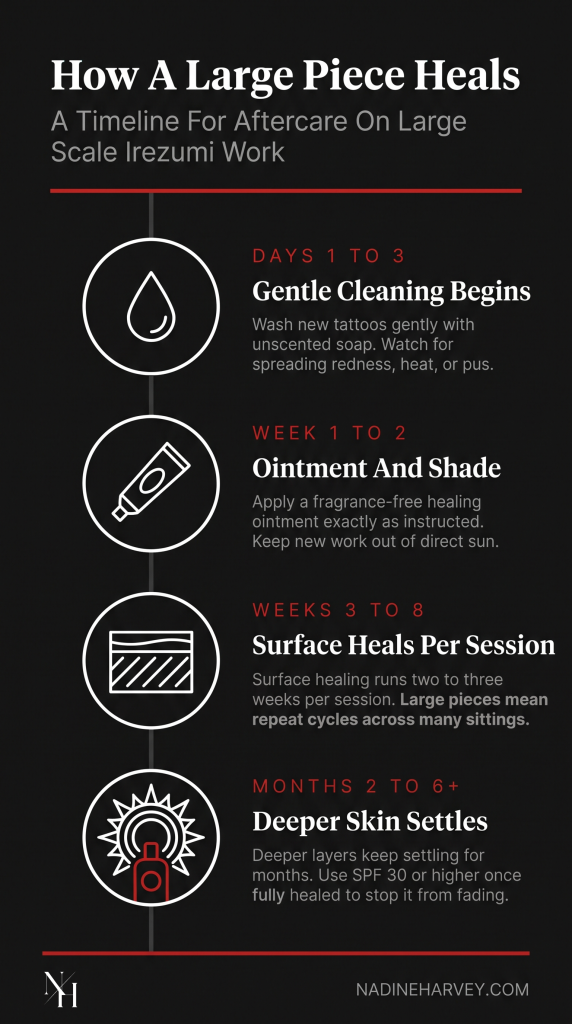
Every studio has its own aftercare preferences. Mine centers on a few non-negotiables.
“I tell every client to skip scented lotion for the first two weeks. Fragrance-free ointment and SPF 30 once it’s healed are the two products I actually stand behind.” Nadine Harvey, Tattoo Artist
A large piece also means repeated healing cycles across many months. Build your calendar around sessions, not around one finish date.
Irezumi rewards patience more than any other style I work in. It asks you to think in years, not weekends. Treat the design as one connected piece, not a collection of images.
Start with the meaning you want, then find the artist who can explain how to build it properly. If you want to see how this thinking shows up in real work, browse the tattoo portfolio or read more about my background before you reach out. When you are ready to talk specifics, booking a consultation is the next step.
Irezumi means “inserting ink.” It is the general Japanese word for tattoo, and outside Japan it usually refers to the large, traditional Japanese style.
No. Machine work and hybrid methods are both legitimate. The style is defined by composition and meaning, not the tool.
Most sleeves take six to twelve sessions, spaced weeks apart for healing between each one.
Yes, if you learn the meaning behind your design and work with an artist who understands the tradition. Treating the motifs as pure decoration is where it goes wrong.
Ask to see healed full pieces, not just fresh work. Ask how they handle background and flow, and how they source their ink.