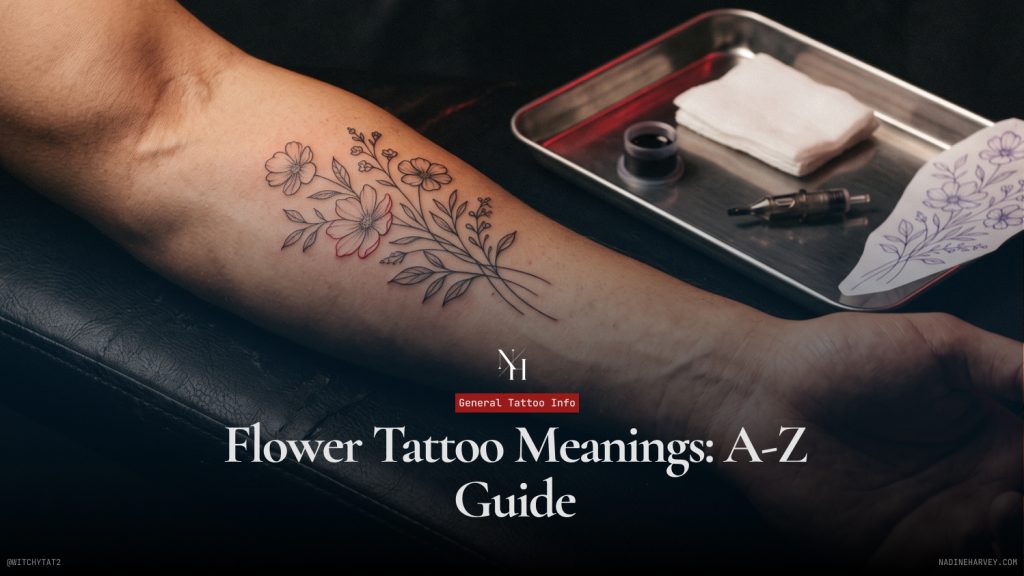
A flower tattoo meanings guide from A to Z, covering color, birth months, and the tattoo style that keeps fine line florals sharp for years.
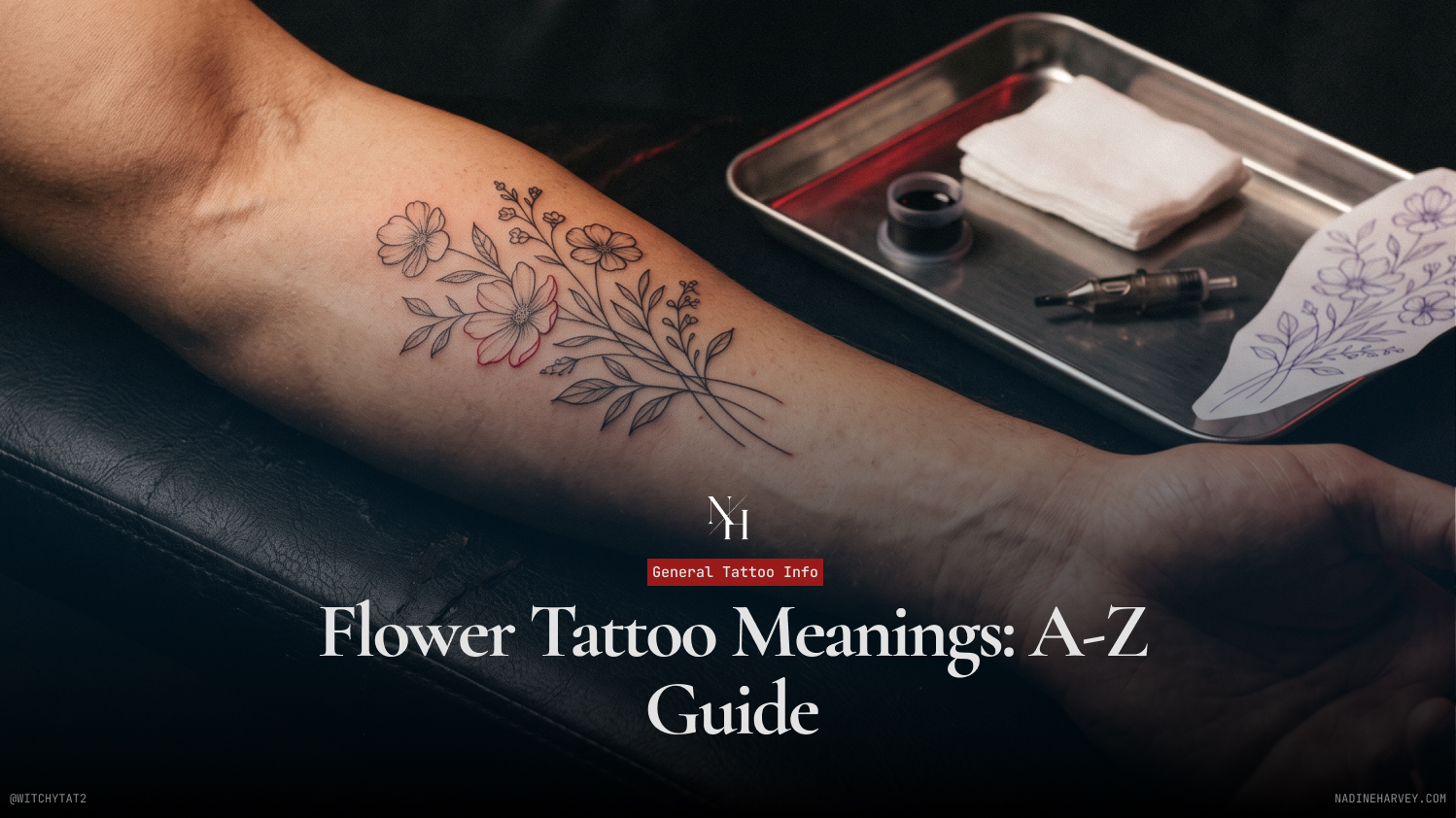
You want a flower tattoo that means something real. Nearly one in three American adults has a tattoo, according to Pew Research Center, and flowers are one of the most requested designs. Most lists give you a single meaning and move on, without saying where it came from or whether other sources even agree.
This guide covers flower meanings by letter, by color, and by birth month. It also does something most guides skip. It shows which tattoo style holds up best for each flower, based on eight years of hands-on studio work.
Flower tattoo meanings come from centuries of tradition, mostly the Victorian language of flowers. These meanings were never fixed by any single authority. Different books from the same era gave the same flower different meanings. Your flower tattoo carries that history, but you get to decide what it means for you.
This matters because most articles present a meaning as settled fact. It rarely is. The Cornell University Library traces the tradition mostly to French floral dictionaries from the 1800s, not the older Turkish origin story many sites repeat.
By the late 1800s, interest in the practice had faded. What we use today is only a small piece of that older system.
“I tell every client the meaning is real, but the reason is theirs.” Nadine Harvey, Tattoo Artist
Iowa State University Extension points out that the same flower can carry several traditional meanings. It depends on which historical source you check. That is not a flaw in the tradition. It is simply how floriography always worked.
A guide from Kate Greenaway’s 1884 book is often seen as the last major work of this genre. After that, the tradition faded fast. Everything since has been a smaller, looser version of it.
Color often changes a flower’s meaning more than the flower itself. A red rose means romantic love. A white rose means purity or remembrance. A black rose usually means grief or loss. Pick your color as deliberately as you pick your flower.
Most readers only look up the base meaning. They miss this second layer entirely. Here is how color tends to shift the message across common flowers.
| Color | Common Meaning |
|---|---|
| Red | Love, passion, respect |
| White | Purity, remembrance, new beginnings |
| Pink | Grace, gratitude, gentle affection |
| Yellow | Friendship, joy |
| Purple | Wisdom, dignity, mysticism |
| Black | Grief, permanence, a bold graphic look |
A yellow rose is a good example of how much color can flip a meaning. Today it reads as friendship and joy. Older lists tied the same yellow rose to jealousy.
If a specific reading matters to you, choose the color with real intention. Do not leave it to chance.
Every flower on this list carries a traditional meaning, plus a note on how it actually works as a tattoo. Some flowers hold fine detail well. Others need bold lines to survive decades on skin. Use this table as a starting point, then bring your own reason into the design.
Treat the meaning column as tradition, not law. Use the style note to guide a real conversation with your artist.
| Letter | Flower | Common Meaning | Best Style Note |
|---|---|---|---|
| A | Acacia | Pure, hidden love | Fine line suits its small blooms |
| B | Bluebell | Humility, gratitude | Black and grey shows the bell shape well |
| C | Carnation | Love, fascination | Illustrative style handles layered petals |
| D | Daffodil | New beginnings | Fine line works for a single stem |
| E | Edelweiss | Courage, devotion | Black and grey brings out its texture |
| F | Forget Me Not | A bond loss cannot break | Fine line suits small tribute pieces |
| G | Gladiolus | Strength, integrity | Bold traditional suits its tall stem |
| H | Hibiscus | Delicate beauty | Illustrative or soft color work |
| I | Iris | Faith, wisdom | Black and grey for layered petals |
| J | Jasmine | Grace, sensuality | Fine line for vine-like compositions |
| L | Lily | Purity, renewal | Illustrative style for lush, large petals |
| M | Magnolia | Dignity, perseverance | Black and grey for a classic look |
| N | Narcissus | Self-reflection | Fine line for a single, clean bloom |
| O | Orchid | Luxury, strength | Illustrative color work for exotic detail |
| P | Peony | Prosperity, honor | Bold traditional or Japanese Irezumi |
| Q | Queen Anne’s Lace | Quiet sanctuary | Fine line for its lace-like detail |
| R | Rose | Love, secrecy | Any style, the most flexible flower |
| S | Sunflower | Loyalty, positivity | Bold traditional or realism |
| T | Tulip | Perfect love | Fine line or illustrative |
| V | Violet | Modesty | Fine line for its small, soft petals |
| W | Wisteria | Devotion, longevity | Illustrative for a trailing vine effect |
| Z | Zinnia | Lasting affection | Illustrative with bright color |
A birth flower ties a tattoo to a specific month, yours or someone else’s. It turns a general flower choice into a personal one. Most people use it to mark their own birth month or to honor a parent, partner, or child.
This is one of the most common reasons clients pick a specific bloom. The meaning becomes personal the moment it connects to a real date.
| Month | Birth Flower | Meaning |
|---|---|---|
| January | Carnation | Love, fascination |
| February | Violet | Modesty, faithfulness |
| March | Daffodil | New beginnings |
| April | Daisy | Innocence, loyal love |
| May | Lily Of The Valley | Sweetness, return to happiness |
| June | Rose | Love, beauty |
| July | Larkspur | Positivity, an open heart |
| August | Gladiolus | Strength, integrity |
| September | Aster | Wisdom, faith |
| October | Marigold | Creativity, passion |
| November | Chrysanthemum | Joy, optimism |
| December | Poinsettia | Celebration, success |
Many clients pair two birth flowers into one piece. This often marks a relationship, a parent and child, or a close friendship. A small gladiolus next to an aster can hold two people in one design without crowding it.
Style does not change a flower’s meaning. It changes how long the design holds up and how it reads from a distance. Fine line suits delicate detail but needs careful aftercare. Bold traditional style lasts for decades with less upkeep. Choose your style based on the look you want in ten years, not just today.
Almost no other guide connects flower choice to style choice. That gap matters, since the wrong style can blur fine detail within a few years.
| Style | Best For | Key Strength | Watch Out For |
|---|---|---|---|
| Fine Line | Delicate, detailed blooms | Reads like a botanical sketch | Needs steady aftercare to stay crisp |
| Black And Grey | Classic, tonal depth | Ages well with proper shading | Needs contrast to avoid blur over time |
| Illustrative | Bold botanical detail | Looks like hand drawn art | Needs enough space for full detail |
| Bold Traditional | First tattoos, larger scale | Holds sharp lines for decades | Less room for fine, small detail |
| Japanese Irezumi | Large pieces, deep symbolism | Rich history, strong visual flow | Needs a full composition plan |
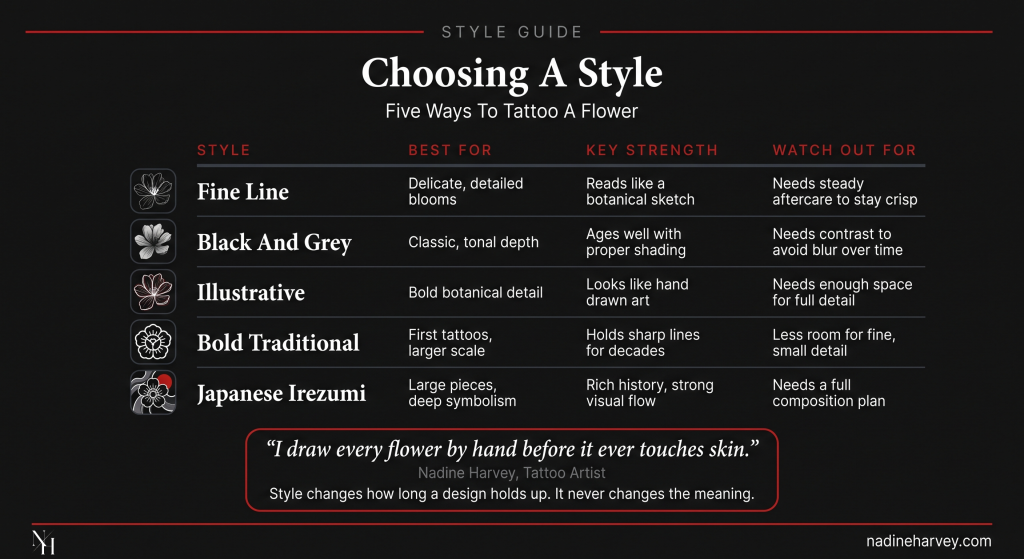
Every design should start as a drawing, not a stencil pulled from a folder. That drawn-first process is how a flower actually earns its place on skin.
“I draw every flower by hand before it ever touches skin.” Nadine Harvey, Tattoo Artist
Eight years across black and grey, fine line, anime, and horror styles builds a real sense of which lines survive and which ones fade. You can see that range across the tattoo portfolio.
Certain flowers are chosen again and again to mark a loss or a hard period. The lotus reads as rising above hardship. The poppy reads as remembrance. The forget-me-not reads as a bond that distance cannot break. These are not random choices. They follow decades of shared symbolic use.
A large share of tattoos exist for exactly this reason. Pew Research Center found that 69 percent of tattooed adults got a tattoo to honor or remember someone. That same research puts overall tattoo prevalence at 32 percent of American adults.
Clients marking early recovery often choose a lotus. Many pair it with a small line of script or a birth flower for someone they lost. Flower symbolism can sit naturally next to other meaningful imagery, the way it does in a sacred heart tattoo.
Placement controls who sees your tattoo and how big the story can be. A forearm or hand piece is meant to be seen. Ribs, spine, or inner arm pieces stay private. Size follows the same logic. A small single bloom marks one moment. A larger, trailing piece can hold a longer story.
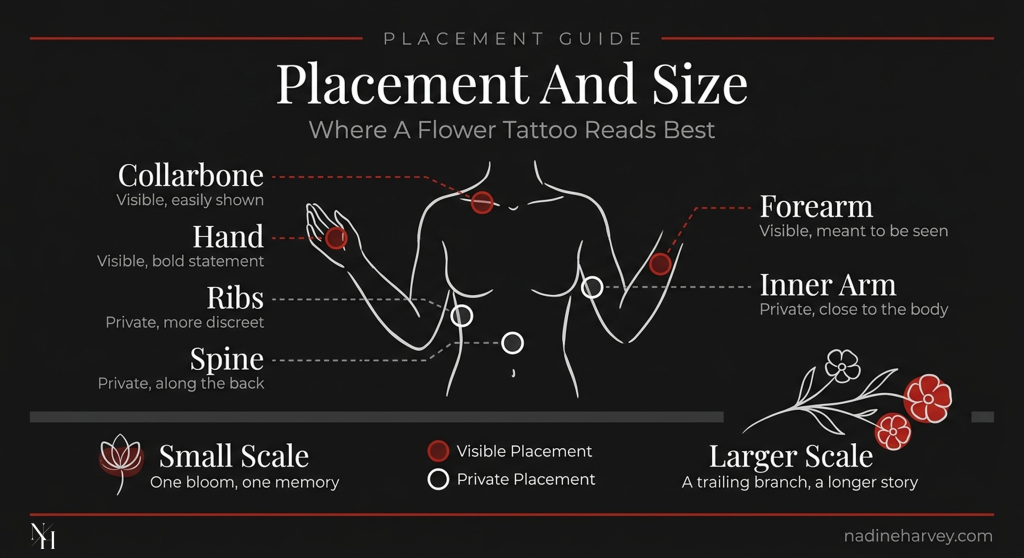
This is rarely mentioned in flower meaning guides, but it shapes the whole experience of wearing one.
Fine line and delicate floral tattoos need more careful aftercare than bold designs. Thin lines blur faster if the skin is not treated right during healing. Wash gently, moisturize lightly, and protect the area from sun for the long term.
Follow these steps during the first few weeks.
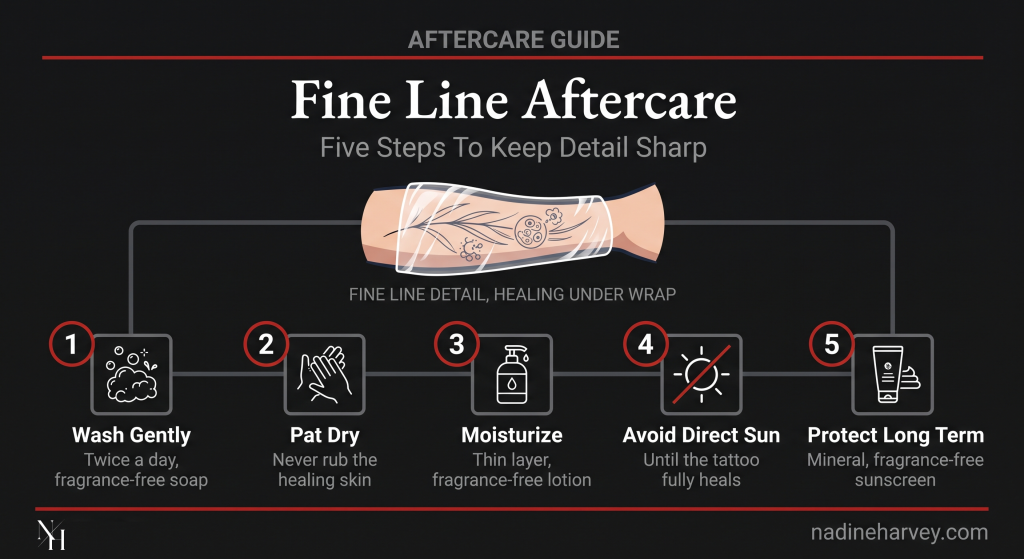
Cleveland Clinic recommends using mild, fragrance-free, antibacterial soap without perfumes or dyes. Full healing can take several months, even when the surface looks fine much sooner.
“Fine line work rewards patience. Rushed aftercare is the fastest way to lose the detail.” Nadine Harvey, Tattoo Artist
Tattoo ink is regulated as a cosmetic product under the Modernization of Cosmetics Regulation Act. The FDA issued new guidance in October 2024 to address microbial contamination in tattoo ink.
California adds its own layer of protection. California’s Safe Body Art Act requires every practitioner to register annually and use pre-sterilized, single-use needles. A studio that follows these standards protects your healing process. It also earns real trust with every client.
Flower tattoo meanings are real, but they are traditions, not rules. The flower carries history. You carry the reason. Pick the one whose story actually feels like yours.
Style and placement decide how well that story holds up on skin. A fine line rose and a bold traditional rose mean the same thing. They age very differently.
If you want a design built around your own story, drawn by hand before it ever touches skin, you can book a consultation directly. You can also read more about her process, including her editorial modeling work, which shares the same eye for composition.
Yes. Victorian floral dictionaries often disagreed with each other. Treat any single meaning as tradition, not a fixed fact.
The rose remains the most requested and most flexible flower. Its meaning shifts heavily by color.
Almost always. Even one flower, like the rose, carries several different meanings depending on its color.
Surface healing often looks done within a few weeks. Full healing can take several months underneath.
Yes. Many clients pair a birth flower with another meaningful symbol or a second birth month for someone close to them.