Can your name tattoo be covered? Nadine Harvey explains which designs hide letters, when to laser fade first, and what cover-ups cost in time and money.
An old name on your skin can be hard to look at. It might belong to an ex, a friend, or someone you lost. Most of these names can be covered for good.
I am Nadine Harvey, and I have tattooed for eight years in a private studio in Huntington Beach. This guide shows you how to judge your name, pick a route, and choose designs that hide letters. It also gives you real laser timelines and costs.
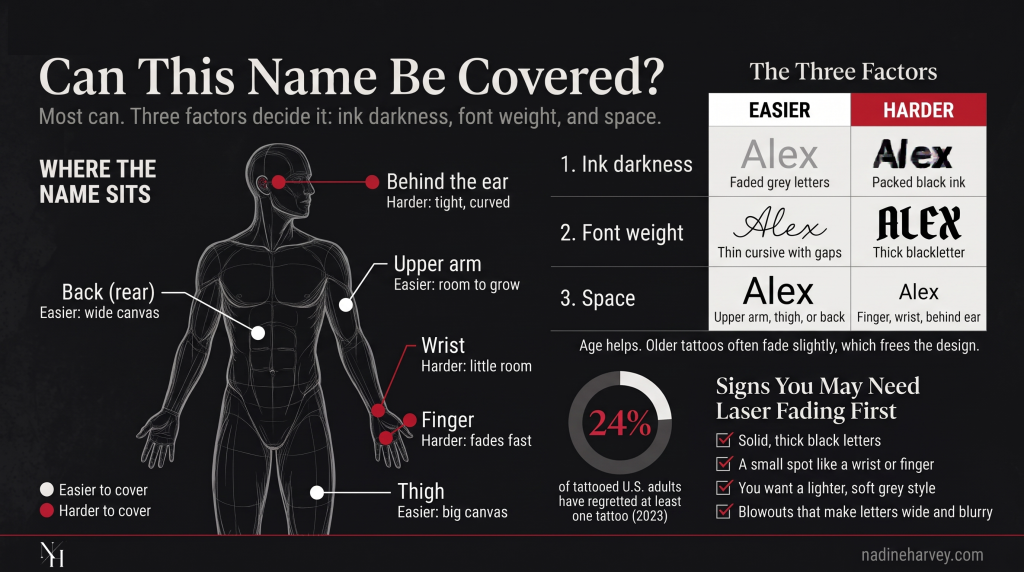
Yes, most name tattoos can be covered. Three factors decide it: ink darkness, font weight, and how much skin the new design can use. Thin script on an upper arm is usually simple to hide. Thick blackletter on a finger often needs laser fading first.
Name regret is common. A 2023 Pew Research Center survey found that 24% of tattooed Americans have regretted at least one tattoo. In a 2018 University of Portsmouth survey, a person’s name was the most regretted design.
Removal clinics see the same pattern. Jeff Garnett, co-founder of InkLess Tattoo Removal, told NewsNation in 2025 that his team removes a lot of names.
| Factor | Easier to Cover | Harder to Cover |
|---|---|---|
| Ink darkness | Faded grey letters | Packed black ink |
| Font weight | Thin cursive with gaps | Thick blackletter |
| Space | Upper arm, thigh, or back | Finger, wrist, or behind the ear |
Age matters too. Older tattoos often fade slightly, which gives the new design more freedom.
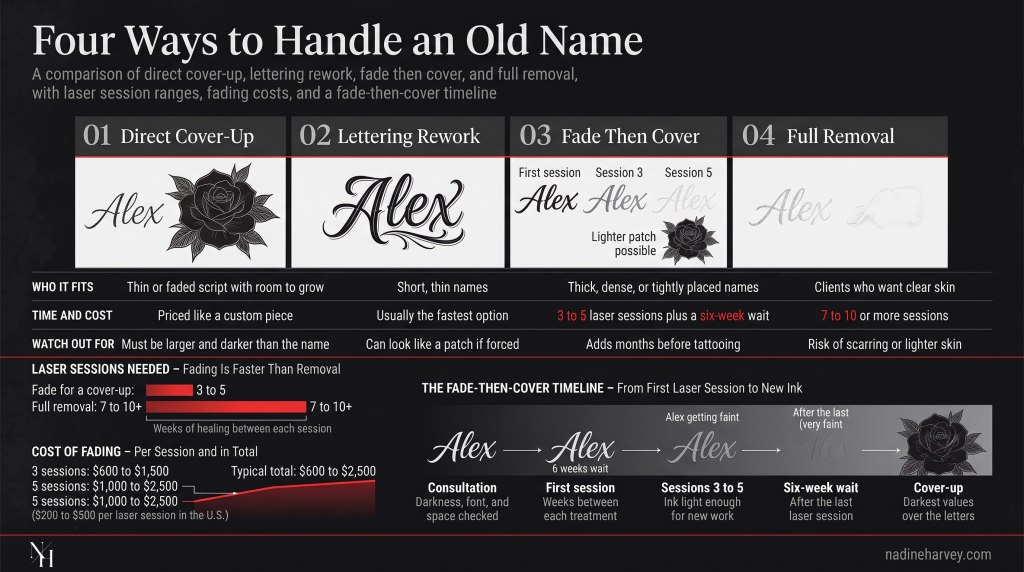
There are four routes. A cover-up hides the name under a larger design. A rework turns the letters into part of a new image or word. Fade then cover uses a few laser sessions to lighten the ink first. Full removal clears the skin but takes the longest. Your ink, placement, and goals decide the best fit.
| Route | Who It Fits | Time and Cost | Watch Out For |
|---|---|---|---|
| Direct cover-up | Thin or faded script with room to grow | Priced like a custom piece | Must be larger and darker than the name |
| Lettering rework | Short, thin names | Usually the fastest option | Can look like a patch if forced |
| Fade then cover | Thick, dense, or tightly placed names | 3 to 5 laser sessions plus a six-week wait | Adds months before tattooing |
| Full removal | Clients who want clear skin | 7 to 10 or more sessions | Risk of scarring or lighter skin |
Fading is much faster than full removal. Removery reports that the average tattoo is ready for new work after 3 to 5 sessions. It advises waiting at least six weeks after the last session.
Full removal usually takes at least 7 to 10 sessions, according to GoodRx Health. Laser sessions typically cost $200 to $500 each in the U.S. The FDA warns that full removal without scarring may not be possible.
The American Academy of Dermatology notes that removal takes many treatments, with weeks between each one. Book laser work with a trained provider. The FDA has not approved any at-home removal creams or kits.
A rework turns a name into a new word or shape with little added ink. One TikTok artist gained over 72,000 followers doing this, as Bustle reported.
A rework holds up when the name is short and thin. It works best when the new word shares letter shapes with the old one, such as a loop or a tall stroke. A forced rework heals looking like a patch.
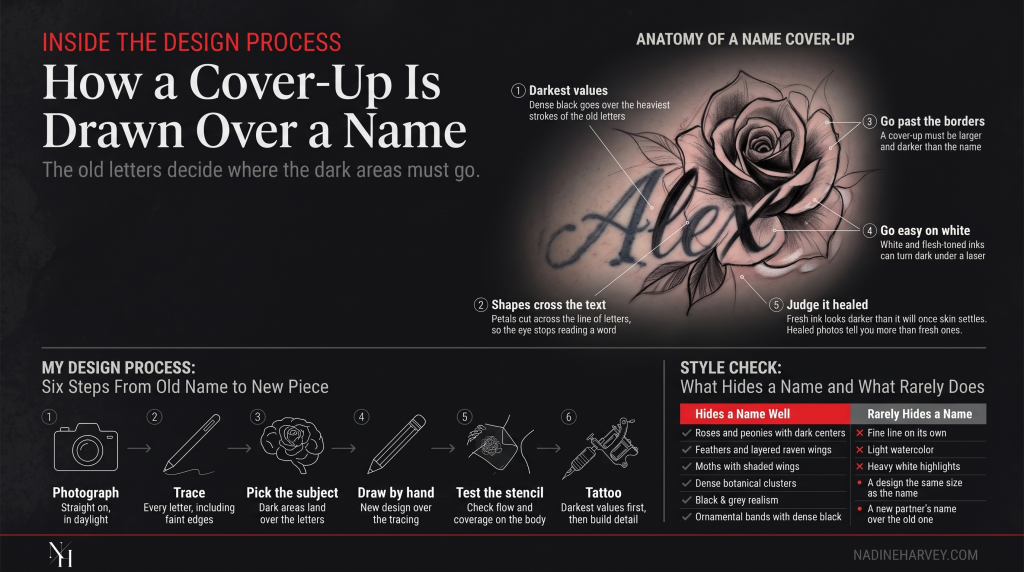
A strong cover-up is drawn around the old letters. I map where the darkest strokes sit. Then I place the darkest parts of the new drawing over them. The new shapes run across the direction of the text, so the eye no longer reads a word.
Every cover-up starts on paper. The old letters decide where the dark areas must go.
“I draw every piece by hand before any needle touches skin.” Nadine Harvey, Tattoo Artist
A good artist tells you what is possible before you book. I explain what to look for in my guide to choosing a fine line tattoo artist.
“I would rather talk a client out of a rushed idea than fix a blurred line two years later.” Nadine Harvey, Tattoo Artist
The best ideas have dark centers, dense texture, and shapes that break up straight lines of text. Roses, peonies, feathers, ravens, moths, and botanical clusters all work well. Match the idea to your name’s size and placement. A wrist name and a chest name need different solutions.
Plan to extend past the old borders. A small name rarely hides under an equally small design. Fingers also fade fast, so expect touch-ups there.
Larger areas suit black and grey realism. Deep shadow hides old letters well. A raven with layered wings, a horror illustration, or a dense floral piece all fit. See how I use shadow in my tattoo portfolio.
Not every name belongs to an ex. Pew found that 69% of tattooed adults got at least one tattoo to honor someone or something. A birth flower or a meaningful object keeps the memory without the letters.
Fine line and light watercolor rarely cover dark letters. They do not hold enough ink to block what sits below. Fine line is one of my specialties, and I still would not use it alone over a name. Read more in my fine line realism guide.
Keep white highlights to a minimum. The FDA notes that white and flesh-toned inks can turn dark under a laser. Once that happens, the laser can no longer treat that ink.
No, if the cover-up has enough size and darkness. A fresh tattoo looks darker than it will once healed. As the skin settles, thin spots can let old letters show through. I add extra coverage over the heaviest strokes for this reason. Healed photos tell you more than fresh ones.
Judge the result after the skin fully heals, not in the first week. If a letter edge shows, a touch-up session can darken that spot. Ask any artist for healed cover-up photos before you book.
“When a client asks how their piece will age, I pull up healed photos from seven or eight years back.” Nadine Harvey, Tattoo Artist
Check the studio too. California’s Safe Body Art Act requires artists to complete bloodborne pathogens training, plus two hours of updates every year. In Orange County, artists register with the Health Care Agency. You can ask to see a current registration.
Most name tattoos can be covered. Check ink darkness, font weight, and space first. Fade the letters when they are thick or dense. Then choose a design with deep shadow and judge it once healed.
I build every cover-up for the long version, not the next trend. The goal is a piece you would want even with nothing underneath.
Ready to talk through your name? Send clear daylight photos through my booking page. I take a limited number of pieces each month, so each consultation gets real time.
Most tattoos need 3 to 5 fading sessions. Wait at least six weeks after the last one before tattooing.
Expect about $200 to $500 per session in the U.S. Across 3 to 5 sessions, most people spend roughly $600 to $2,500.
Rarely on its own. Fine line does not hold enough ink to hide dark letters. It can work after laser fading.
I would not. A new name carries the same risk as the old one. A design with meaning only to you will age better.