Greek mythology tattoo ideas with god meanings, symbols, Medusa’s two myths, style tips, and aftercare from Huntington Beach tattoo artist Nadine Harvey.
Greek mythology tattoos are easy to find and hard to choose. Most lists give one line per god. They rarely explain which myth version you wear, how a design ages, or what to bring to a consult.
This guide covers all of that. I tattoo in Southern California, and I will show you how to pick a figure, read the symbols, and choose a style. You will also learn how to plan with an artist and protect the tattoo for years.
Start with the reason, not the god. Write one sentence about what the tattoo should say, such as protection, patience, or loss. Then pick the Greek figure whose myth matches that sentence. A Pew Research Center survey found that 69% of tattooed US adults got a tattoo to honor or remember someone or something.
I draw every design by hand before ink touches skin. That drawing starts with your story, not a trend board.
“Client backstories for each tattoo is what really motivates me to push myself.” Nadine Harvey, Tattoo Artist
Answer these in order.
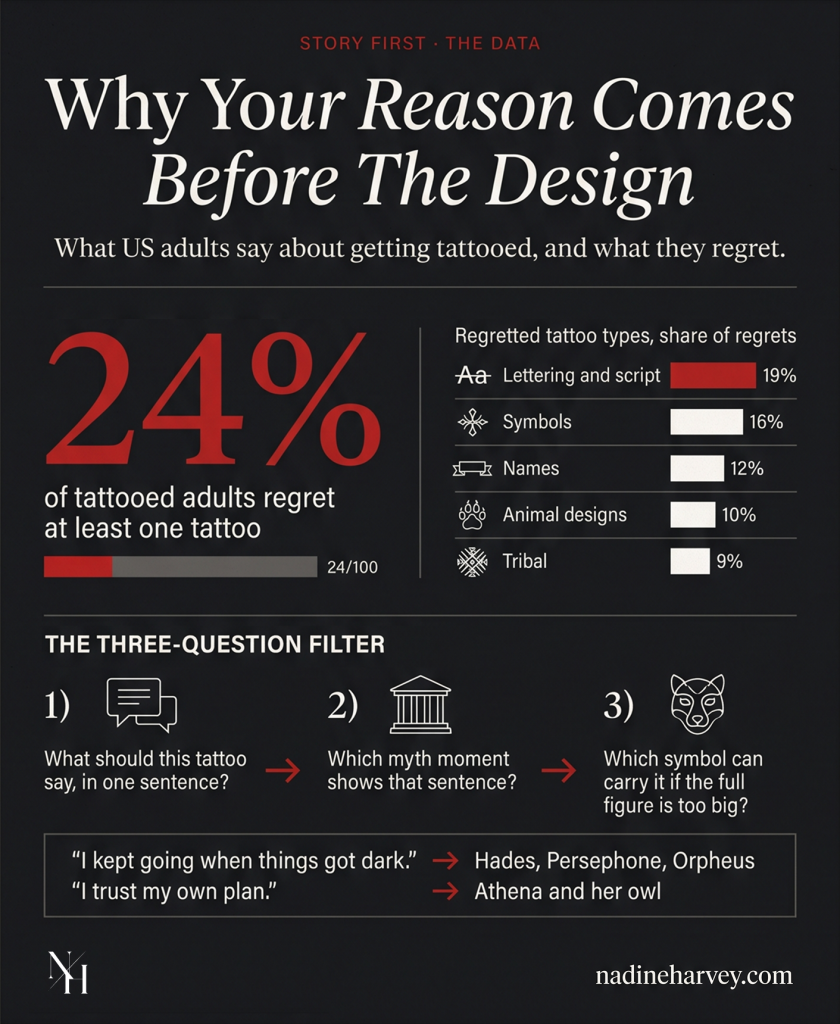
Here is how it works. A client says, “I kept going when things got dark.” That points toward Hades, Persephone, or Orpheus. A client who says, “I trust my own plan,” points toward Athena and her owl.
| Your Sentence Is About | Figures To Consider | Symbols To Consider |
|---|---|---|
| Strength and authority | Zeus, Heracles | Thunderbolt, lion skin |
| Wisdom and planning | Athena, Odysseus | Owl, helmet |
| Protection | Medusa, Athena | Gorgon head, aegis |
| Loss and endings | Hades, Persephone, Orpheus | Bident, pomegranate, lyre |
| Love and beauty | Aphrodite, Eros | Dove, shell, bow |
| Freedom and ambition | Icarus, Pegasus | Wings |
Pew also found that 24% of tattooed adults regret at least one tattoo. Good planning is how I help clients avoid that. These choices lead to regret:
One 2023 consumer survey reported by iHeart put symbols at 16% of regretted tattoos. The report does not name the pollster. Treat the number as a rough guide.
Greek myth tattoos are a modern idea. According to Antigone Journal, Greeks learned tattooing from the Persians. By the 5th century BC, they regularly tattooed criminals, slaves, and prisoners of war as punishment.
Your tattoo honors the stories. It does not copy an ancient custom.
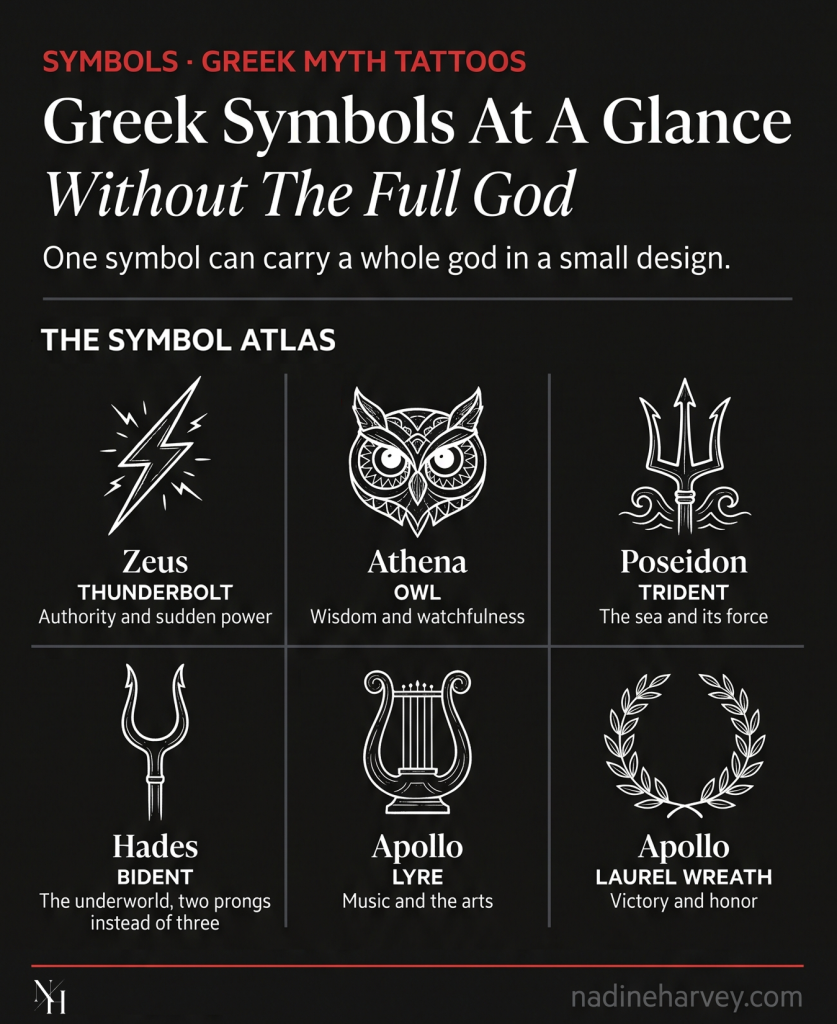
Zeus stands for authority and Athena for wisdom and strategy. Poseidon stands for the sea, Hades for the underworld, and Aphrodite for love. These are modern readings of old myths. Each god has louder and quieter meanings, so choose the angle that fits your own story.
| Figure | Common Symbols | Common Modern Meaning | Style Note |
|---|---|---|---|
| Zeus | Thunderbolt, eagle | Authority, leadership | Bold black and grey with strong contrast |
| Athena | Owl, helmet, spear, aegis | Wisdom, strategy, protection | Statue realism or a fine line owl |
| Poseidon | Trident, waves, horse | Emotion, force of nature | Flowing water suits large pieces |
| Hades | Bident, Cerberus, helm | Endings, transformation, the unseen | Black and grey with a horror lean |
| Aphrodite | Dove, shell | Love, beauty, desire | Soft shading with delicate detail |
| Apollo | Lyre, laurel, sun | Art, light, healing | Fine line lyre or laurel |
| Artemis | Bow, moon, stag | Independence, the wild | Small linework or moonlit realism |
| Hermes | Winged sandals, caduceus | Travel, messages, change | Small fine line symbols |
Hades is not a devil. In myth, he rules the dead and keeps order in the underworld. A Hades tattoo can mean endings, order, or grief.
Zeus is the father of the Olympian gods, so his tattoo can honor a father. A Poseidon tattoo can honor a sailor in your family. The meaning belongs to you.
Not every myth tattoo shows a god. These figures suit a story about effort or cost:
I never tell clients what a tattoo says about them. An Athena tattoo does not make you a leader, and a Hades tattoo does not make you dark. Your reason sets the meaning.
A single symbol can carry a whole god in a small design. The owl points to Athena, the trident to Poseidon, the bident to Hades, the thunderbolt to Zeus, and the lyre to Apollo. The laurel wreath marks victory and honor. Small symbols suit first tattoos and fine line work.
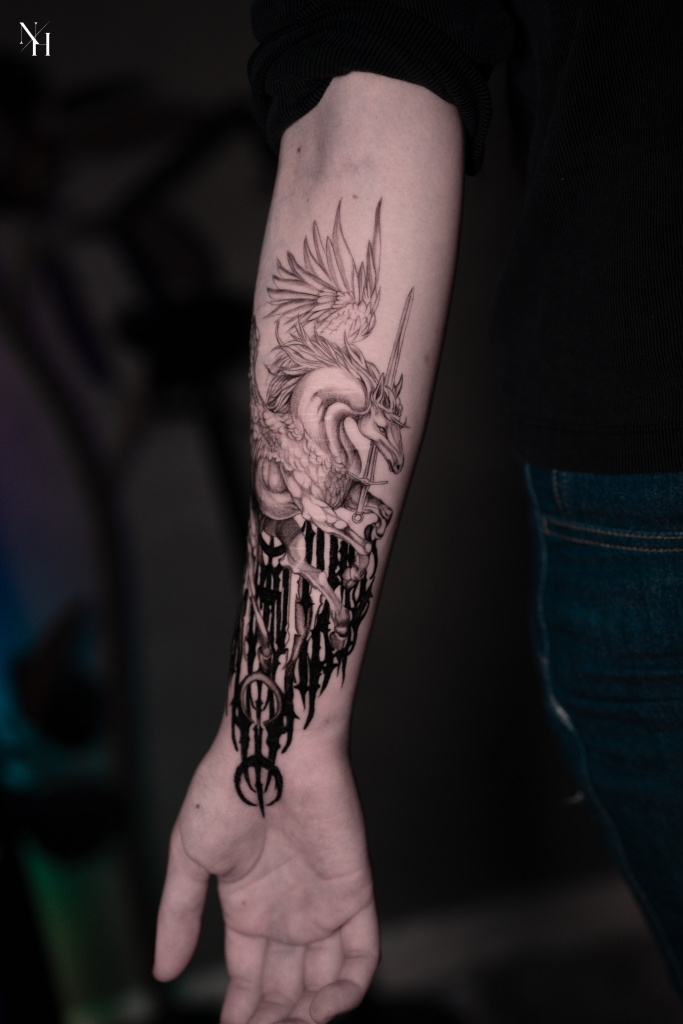
Two snake staffs look alike, and they mean different things. Hermes carries the caduceus, which has two snakes. Asclepius, the god of healing, carries a rod with one snake.
The rod of Asclepius is the more common medical symbol. Choose it if you work in healthcare.
You can pair two symbols around one idea. An owl and an olive branch point to Athena and her gift of the olive tree to Athens. A trident with a wave points to Poseidon without a full figure.
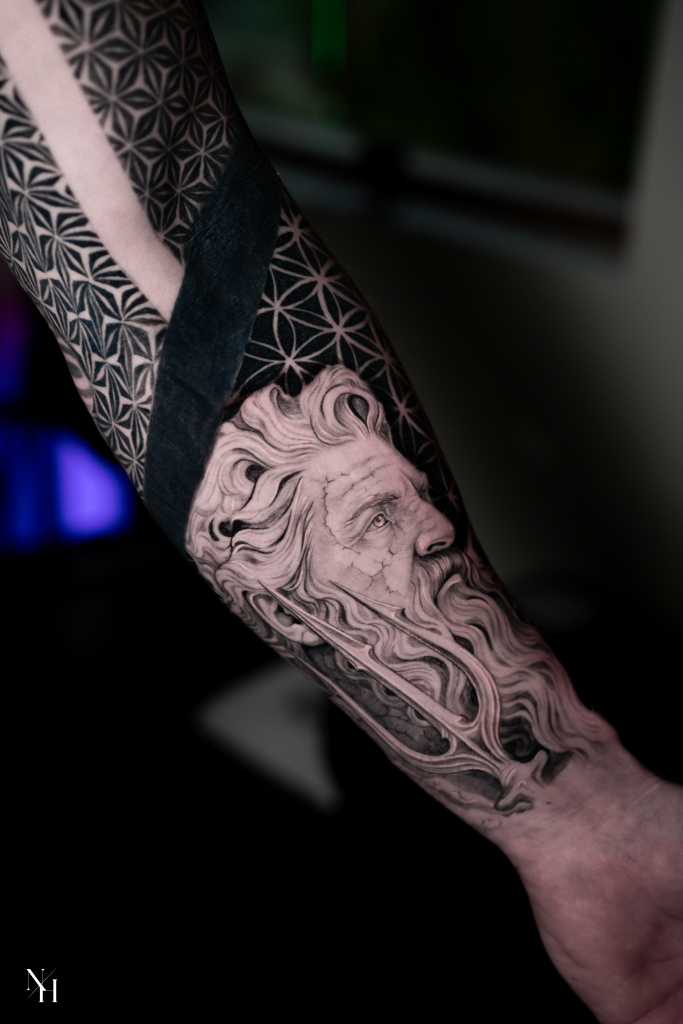
Keep it to two or three elements. Then each one stays clear.
Small designs need enough line weight to heal clearly. Very thin lines soften first. For a tiny owl or lyre, I use a slightly heavier single needle line so it stays readable as the skin ages.
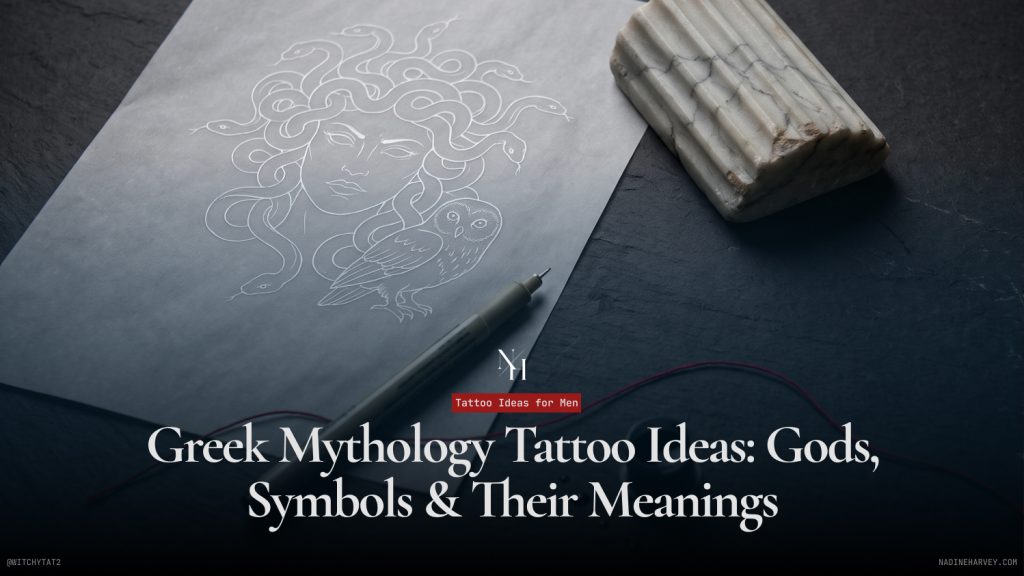
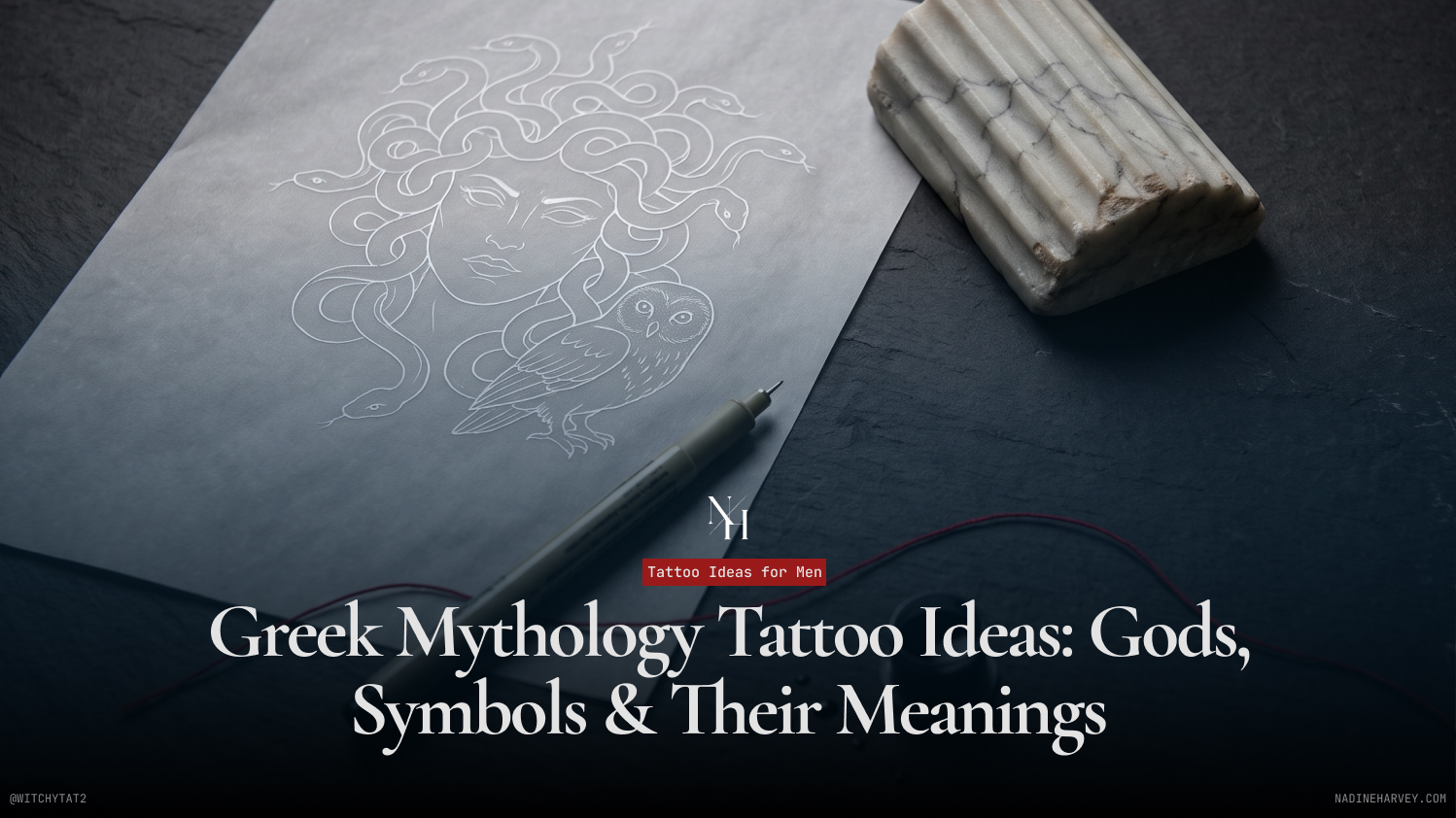
Medusa has two main story versions, so her tattoo has two main meanings. According to Talking Humanities, Hesiod, about 700 BCE, describes her as one of three Gorgons. Ovid, about 8 CE, describes a beautiful woman who is assaulted and then punished. Modern survivor meanings come from Ovid.
Ovid was Roman. He wrote in Latin and used the names Neptune and Minerva. I use the Greek names, Poseidon and Athena, in this guide.
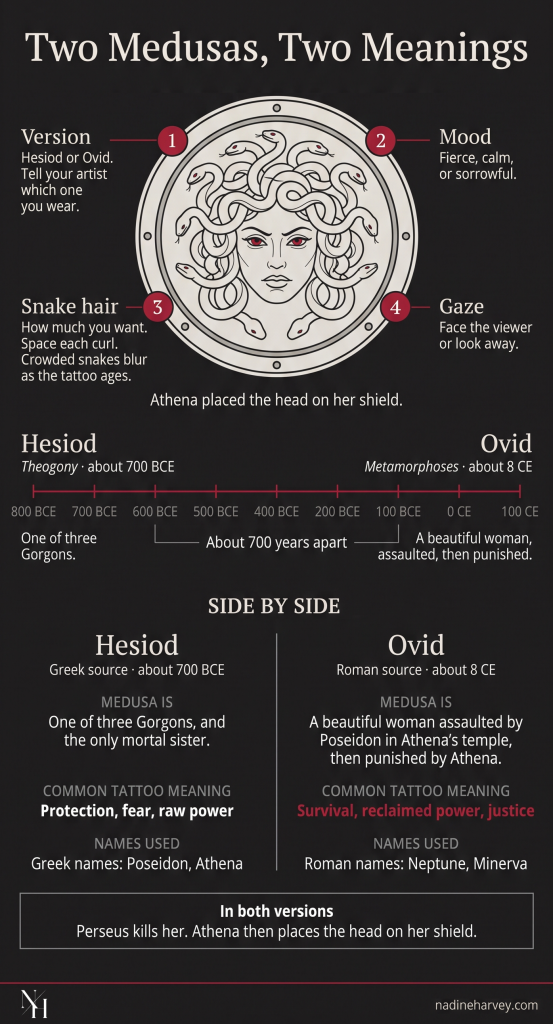
| Source | Date | Medusa | Common Tattoo Meaning |
|---|---|---|---|
| Hesiod, Theogony | About 700 BCE | One of three Gorgons, and the only mortal sister | Protection, fear, raw power |
| Ovid, Metamorphoses | About 8 CE | A beautiful woman assaulted by Poseidon in Athena’s temple, then punished by Athena | Survival, reclaimed power, justice |
In both versions, Perseus kills her. Britannica says Athena then placed the head on her shield.
Dr Emma Bridges of the Institute of Classical Studies describes Ovid’s Medusa. He “represents her as initially a beautiful woman, the object of male desire.” That version made Medusa a symbol for survivors. A University of St. Thomas thesis traces her path from vilified figure to symbol of empowerment for sexual assault survivors.
I handle this story with care. Anyone can choose Medusa. Know which version you wear, and tell your artist why.
Medusa suits black and grey realism and fine line horror. Fine line horror is my favorite style to work in. Snake hair needs space between each curl. Crowded snakes blur as the tattoo ages.
Black and grey realism gives the classic marble statue look. Fine line suits symbols and small figures. Illustration suits story scenes and labyrinths. Horror styles fit Medusa, Hades, and the Minotaur. Choose a style based on size and aging first, then mood. In my experience, larger and higher-contrast work keeps its detail longest.
I work in black and grey realism, fine line, anime, illustration, and horror. After eight years of tattooing in Southern California, I know where each style performs best. You can read more about my background.
| Style | Best For | Key Strength | Watch Out For |
|---|---|---|---|
| Black and grey realism | Statue portraits, Athena, Zeus | Depth and lifelike detail | Soft grey can flatten with sun and time |
| Fine line | Owls, laurel, lyres, small figures | Delicate, clean look | Very thin lines soften sooner |
| Illustration | Myth scenes, the labyrinth | Story and composition | Needs clear space between elements |
| Horror | Medusa, Hades, the Minotaur | Mood and drama | Dark detail needs room to read |
A statue tattoo uses soft grey wash and sparing white highlight ink for light on marble. Smooth shading builds the form. Ask your artist how white highlights heal and how they hold up over time.
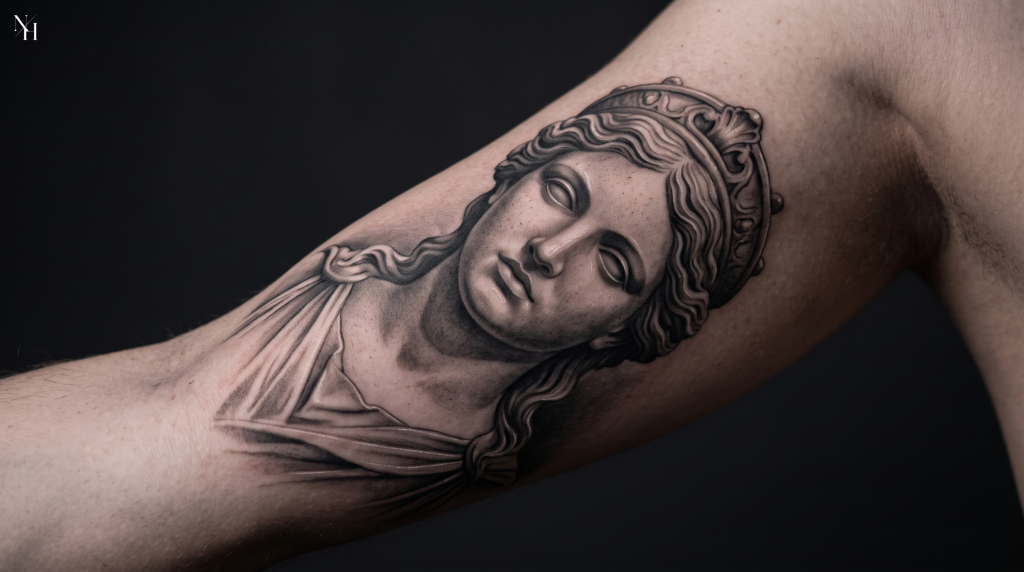
Picture a client who wants Athena on the forearm for her mother’s strategic mind. I would suggest black and grey realism with a helmet, a soft face, and a small owl. I would keep the deepest darks near the face. That value contrast keeps the portrait readable as the tattoo ages.
Give a detailed face room. Faces, drapery, and fine symbols stay readable when the artist has space to separate tones. The forearm, upper arm, thigh, calf, and back offer the most space. Small symbols fit wrists, ankles, and behind the ear. Pick the size first, then the placement.
| Placement | Best For | Key Strength | Watch Out For |
|---|---|---|---|
| Forearm | Portraits, single figures | Easy to see and share | Daily sun exposure |
| Upper arm or shoulder | Statue figures, half sleeves | Smooth, steady canvas | Needs a clear flow plan |
| Thigh | Full figures, scenes | Large, flat space | Healing near clothing seams |
| Back | Large scenes, Pegasus, wings | Biggest canvas | Hard to see your own work |
| Calf | Tall figures like Athena | Long vertical space | Friction from socks and shoes |
| Wrist or ankle | Small symbols | Quiet and subtle | Thin lines can blur |
Text carries extra risk. The same iHeart-reported survey lists lettering and script at 19% of regretted tattoos. If you want words, keep them large and personal.
I also model, so I think about how a design moves with the body. A figure can look right standing still and bend oddly at the elbow.
“I put the stencil on, then ask the client to bend the arm and turn the wrist. If a face stretches, I redraw it before any needle touches skin.” Nadine Harvey, Tattoo Artist
The American Academy of Dermatology suggests placing new tattoos on mole-free skin. Tattoos can make early signs of skin cancer harder to see. Show your artist any moles in the planned area.
Bring your one-sentence story, two or three reference images, and the placement you want. Ask to see healed work in your chosen style. Expect a hand-drawn design, a stencil check, and time to adjust. A good consult ends with a clear plan, a price range, and a written aftercare sheet.
My process runs from your first message to a consultation, then a hand-drawn design, then the tattoo. I reply to messages within 24 hours. You can see my work in the tattoo portfolio.
Bring AI images only as loose references. London artist Klaudia Kempa warned Dazed that AI designs may not heal well. Her advice: “If people are unsure, they should speak to a tattoo artist with experience.”
California law requires body art practitioners to register each year. Health and Safety Code section 119306 lists bloodborne pathogen training and proof of hepatitis B vaccination or immunity. The certificate must be on display.
Orange County registers practitioners through its Health Care Agency. Its body art guide explains the process.
Ink matters too. The FDA regulates tattoo inks as cosmetics. It has not approved any pigment for injection into the skin. Sealed inks can still be contaminated.
The FDA counts 18 voluntary recalls of contaminated inks from 2003 to 2024. It also issued a May 2025 alert about contaminated Sacred Tattoo Ink products. Ask any artist which inks they use.
Follow the aftercare sheet your artist gives you, then protect the healed tattoo from sun. The American Academy of Dermatology says UV light can fade ink. It advises a broad-spectrum, water-resistant sunscreen of SPF 30 or higher. Use water-based lotion on dry skin and skip petroleum jelly. Soft grey statue work needs this most.
“Soft grey wash shows sun damage first. I tell every client to wear SPF 30 or higher on a healed tattoo, every day it is outside.” Nadine Harvey, Tattoo Artist
Aftercare advice differs between studios. A review in Dermatology studied 700 aftercare sheets from all 50 states and Washington, D.C. It found 70 different moisturizers. The authors said content and advice “vary tremendously.”
The review also flagged missing guidance on hygiene and on when to seek care. Pick one trusted sheet and follow it.
Some redness, swelling, and warmth are normal early on. Call your artist and your doctor if the area is not healing. Do the same if you get a rash or a fever. High fever, shaking, chills, and sweats can signal a serious infection.
Sun and time soften every tattoo. Once it heals, return to your artist for a check. A small touch-up can restore grey wash and fine lines.
Start with your one-sentence story. Pick the figure or symbol that matches it. Check which version of the myth you plan to wear, especially for Medusa. Choose a style and size that age well, and place it where it stays readable.
Then plan with a registered artist. Ask about inks, healed work, and aftercare. Protect the tattoo from the sun for life.
I work from a private studio and take a limited number of bookings each month. If you want to talk through an idea, book a consultation. For more planning guides, browse the blog.
Yes, but pick one reason, even a small one. A clear reason helps me design the piece. It also helps you like the tattoo later.
No. Hesiod’s Medusa is a Gorgon, and many people read her as protection or power. Ovid’s version adds the survivor meaning. Choose the version that fits you.
The owl, trident, bident, lyre, laurel wreath, and thunderbolt read clearly at small sizes. Keep the lines a little bolder than you think you need. Ask your artist to test the stencil size.
Use the Greek names for Greek myth. Zeus, Athena, and Poseidon become Jupiter, Minerva, and Neptune in Roman retellings. Ovid used the Roman names, so check which names a source uses.
Bring it as a loose reference only. Your artist should redraw it for real skin. Designs made without skin in mind may not heal well.
Book a consult with a registered artist. Ask about inks, healed work, and aftercare. Then follow one clear plan.