Stomach tattoo ideas for women, sorted by zone. Learn which designs fit each area, how much it hurts, and how to plan for pregnancy and healing.
Stomach tattoos are a common choice for women, but they are hard to get right. Pew Research Center found that 38% of U.S. women have a tattoo, compared with 27% of men. Yet your stomach bends when you sit. It stretches with pregnancy and shifts with weight.
The short answer is simple. Pick the zone first, then a design shape that follows it. This guide sorts ideas by placement and covers pain, style, healing, and timing. It draws on Nadine Harvey’s eight years of hand-drawn custom work in Huntington Beach, California.
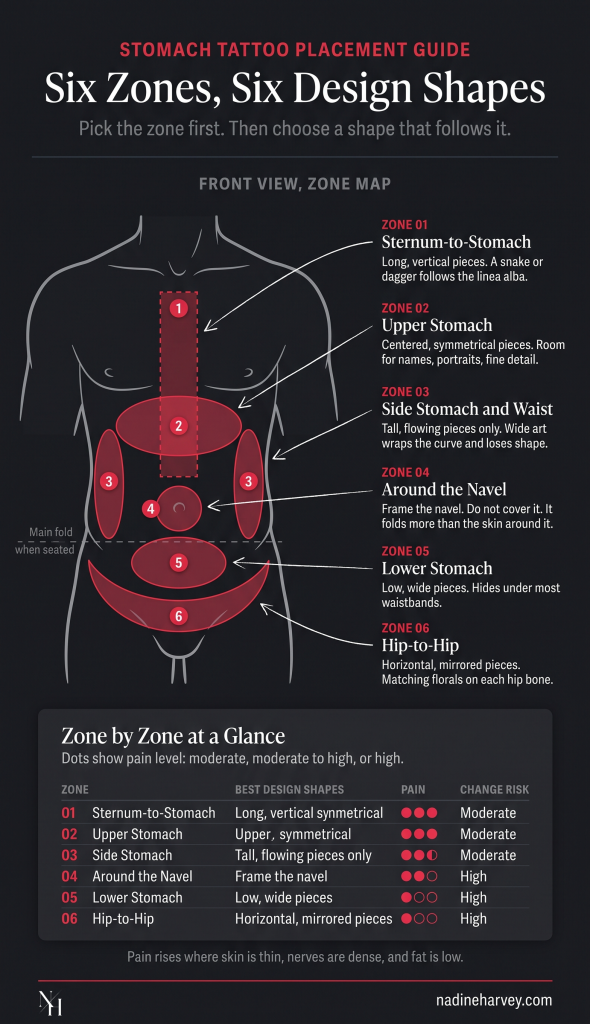
The stomach has six main zones. They are the upper stomach, sternum-to-stomach, navel, lower stomach, hip-to-hip, and side stomach. Each zone favors a shape. Tall designs follow the center line or the waist. Round designs sit best around the navel. Wide designs suit the lower stomach and hips. Matching shape to zone helps the tattoo move with you.
Your stomach folds in the same places every day. The biggest fold sits near the navel when you sit or bend. A design that ignores that fold can look bent or cut in half.
| Zone | Best design shapes | Pain level | Change risk |
|---|---|---|---|
| Upper stomach | Centered, symmetrical pieces | Moderate to high | Moderate |
| Sternum-to-stomach | Long, vertical pieces | High near the bone | Moderate |
| Around the navel | Round or framing designs | Moderate to high | High |
| Lower stomach | Low, wide pieces | Moderate | High |
| Hip-to-hip | Horizontal, mirrored pieces | High at the hip bones | High |
| Side stomach and waist | Tall, flowing pieces | High near the ribs | Moderate |
“It’s built around your body, designed to last, and made by hand.” Nadine Harvey, Tattoo Artist
The strongest stomach tattoo ideas are built for one zone. Try a moth centered on the upper stomach or a snake running from sternum to navel. Frame the belly button with florals. Trace the hip line with botanical linework. Run an anime panel or a tall horror piece down the side. Each idea below explains why it works where it sits.
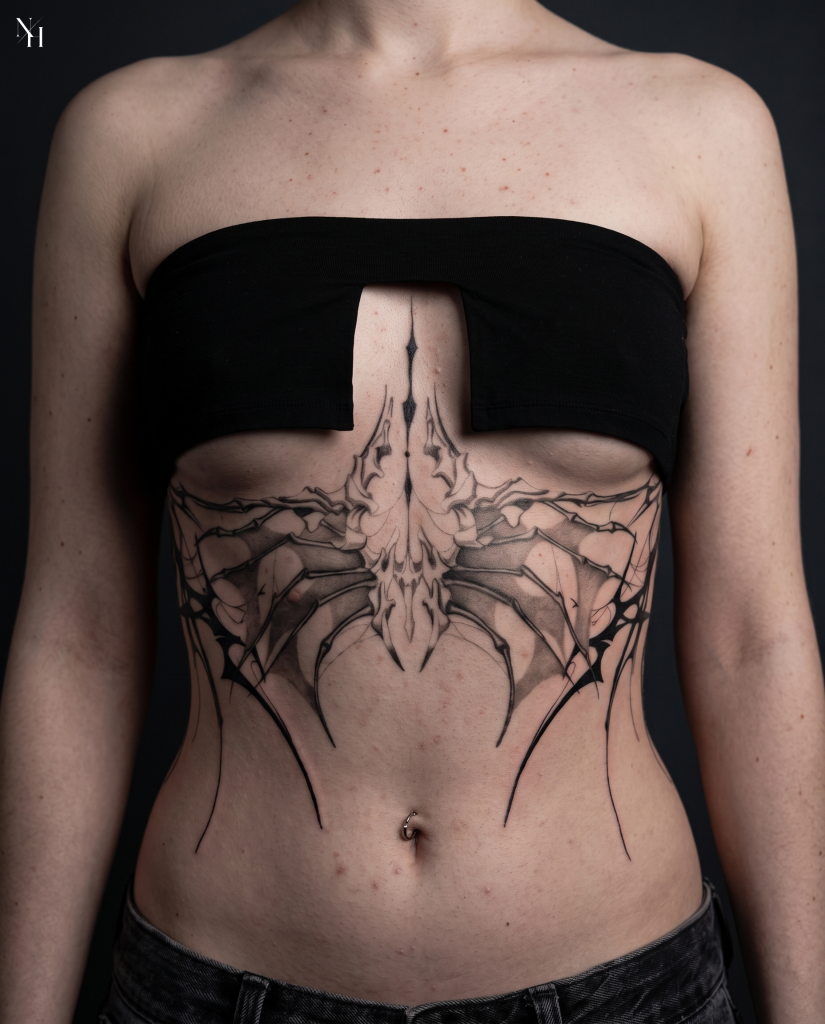
Framing works better than placing art over the navel. The navel folds more than the skin around it.
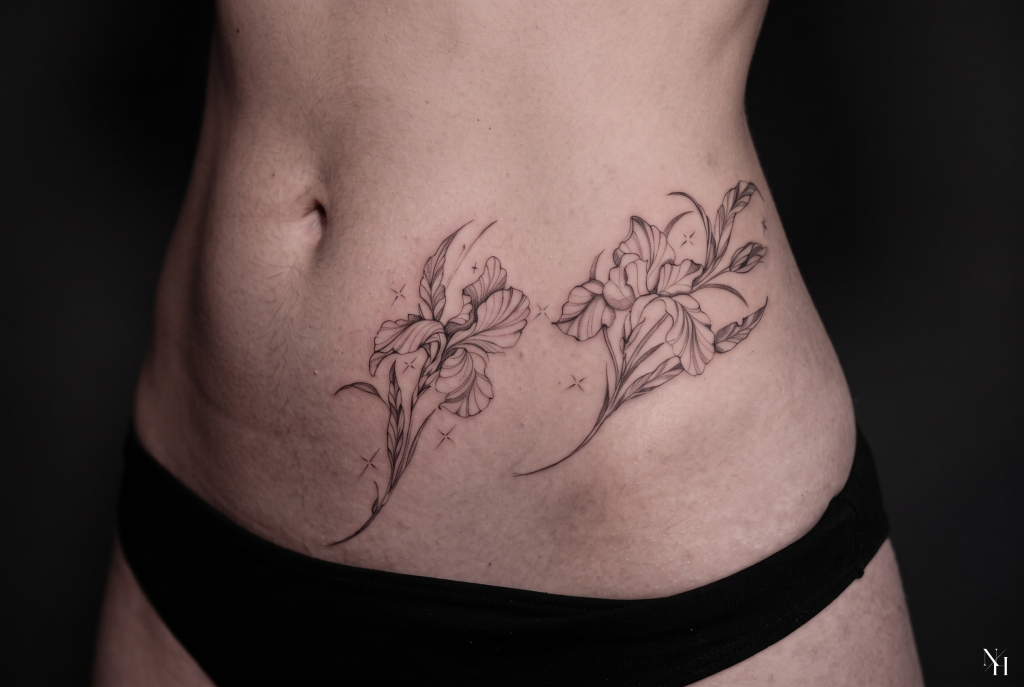
The side curves in two directions. Tall designs follow that curve. Wide designs on the side wrap around and lose their shape.
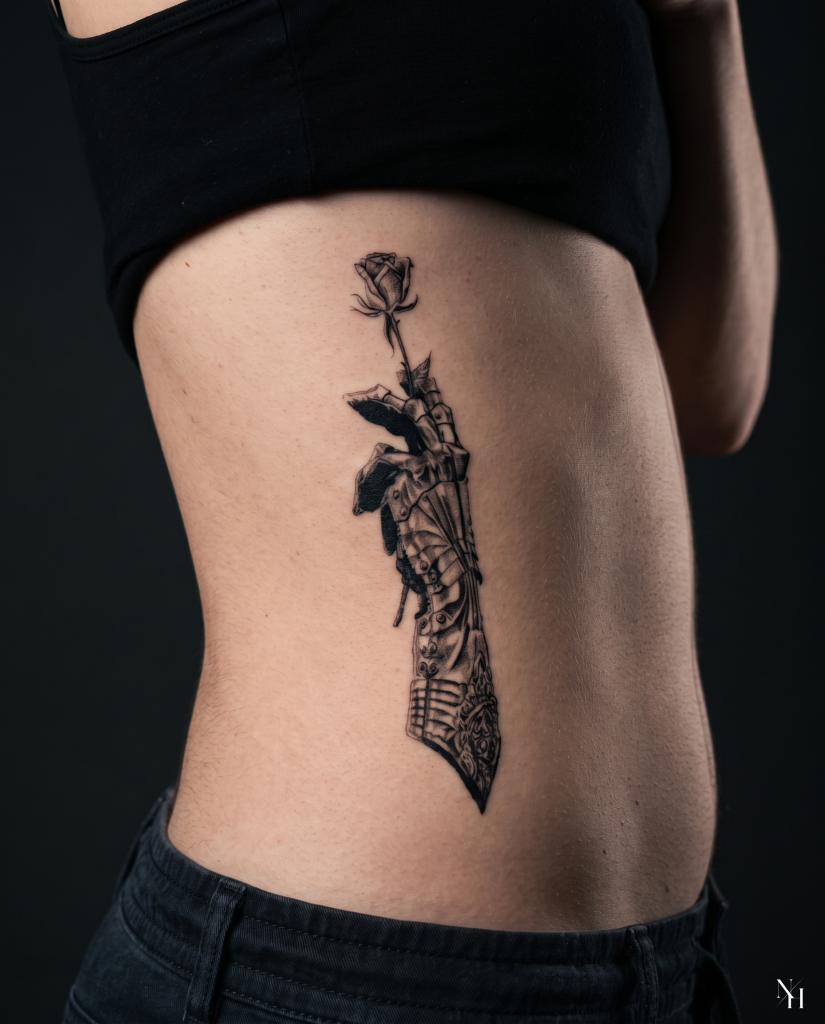
The same Pew survey found 73% of tattooed women got a tattoo to honor someone or something. A name, a birth flower, or a portrait fits well on the upper stomach. That zone has room for fine detail.
Black and grey realism, illustration, and fine line all work on the stomach when they are sized well. Black and grey shading softens gently as skin moves. Illustration keeps its shape through clear outlines. Fine line needs more size and space. Very small, tight details can blur on skin that stretches. Scale matters as much as style.
| Style | Who it fits | Key strength | Watch out for |
|---|---|---|---|
| Black and grey realism | Clients who want depth and texture | Soft shading ages gently | Needs room for detail |
| Fine line | Clients who want a light look | Clean and airy | Tiny details can blur |
| Anime and illustration | Fans of characters and bold art | Clear outlines read from a distance | Panels need a tall zone |
| Horror and dark art | Clients drawn to skulls, snakes, Medusa | Strong contrast | Heavy black can crowd small pieces |
Nadine Harvey draws every design by hand before ink touches skin. On the stomach, that means sizing art to each client’s curves. A design drawn for a forearm will not fit a waist.
“No flash, no shortcuts. One piece at a time.” Nadine Harvey, Tattoo Artist
You can see this approach across nadineharvey.com. For more on delicate linework, read the fine line realism guide.
Stomach tattoos hurt more than most idea lists suggest. Healthline’s medically reviewed pain chart lists the stomach among areas where pain may be high to severe. Pain changes by zone. The soft lower stomach is easier to sit through. Skin near the ribs, the hip bones, and the navel hurts more.
The Healthline tattoo pain chart explains the pattern. Thin skin, many nerve endings, and little fat raise pain. Bony areas hurt more too.
The side stomach near the ribs has thin skin over bone. The hip bones work the same way. The same chart cites research that people with tattoos may have a higher pain threshold. A first-timer will likely feel a stomach piece more than a returning client.
For a full body map, see the tattoo placement guide for women.
A stomach tattoo stretches when the skin stretches. Pregnancy and fast weight change can widen a design, soften its lines, or add stretch marks through it. Not every tattoo changes much. Family history, weight gain, and placement all play a part. Planning for these changes helps you choose a design that still looks right later.
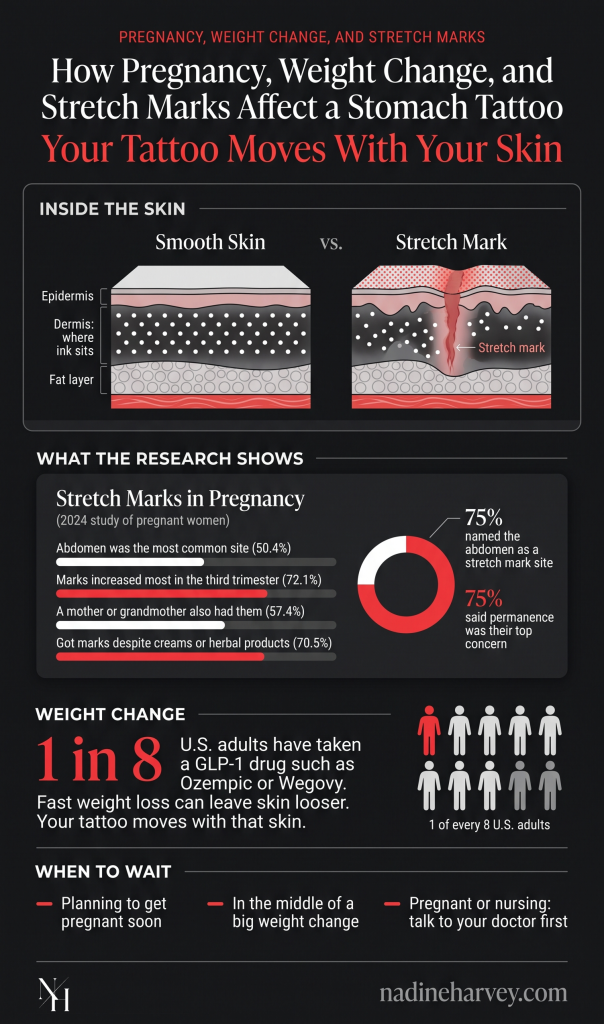
A 2024 study in the Cyprus Journal of Medical Sciences tracked stretch marks in pregnancy.
Family history is one of your best clues. If the women in your family got stretch marks, plan for them.
Weight change is now a bigger factor. A 2024 KFF poll found about 1 in 8 U.S. adults have taken a GLP-1 drug such as Ozempic or Wegovy. Fast weight loss can leave skin looser. Your tattoo moves with that skin.
Yes, many stretch marks and healed scars can be tattooed, but the skin acts differently there. Stretch marks are a form of scarring, so ink may settle unevenly. Fresh marks are still changing. Wait until they fade from red or purple to white. A good design works with the marks instead of hiding every line.
Consultant dermatologist Dr. Anjali Mahto explains that stretch marks form when the dermis scars as it stretches. Tattoo ink sits in that same layer. Scarred skin takes ink less evenly than smooth skin.
Mahto notes that new marks start pink, red, or purple. Over time they fade to white streaks.
In a survey of 116 pregnant women reported by The Hospitalist, 75% named the abdomen as a stretch mark site. For 75%, permanence was the top concern. University of Michigan obstetrician Timothy Johnson has said stretch marks were long treated as a subject to avoid.
Heal a stomach tattoo by keeping it clean and free from rubbing. Wash your hands before you touch it. Wear loose clothes that sit away from the tattoo. Sleep on your back for the first few nights. Follow your artist’s written aftercare, and know when to call your artist or a doctor.
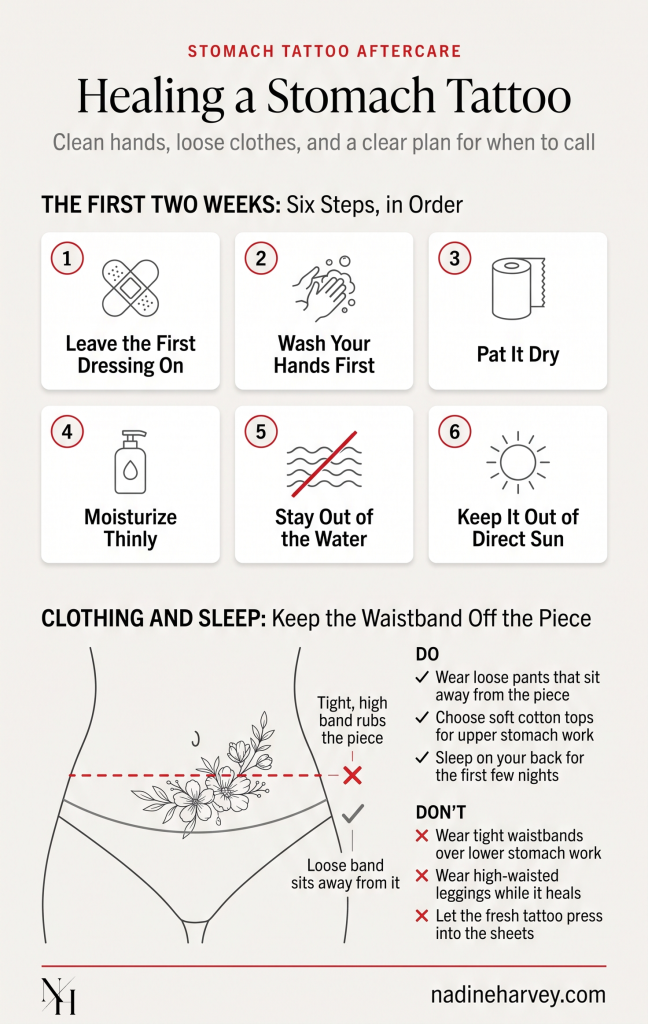
Clear aftercare is rarer than it should be. A Dermatology study of 700 U.S. aftercare sheets found only 49.9% said when to contact the tattooist. Just 19.4% said when to see a doctor. Few told clients to wash their hands first.
Choose a registered artist with healed stomach work in their portfolio. California’s Safe Body Art Act requires every tattoo artist to register each year with the local health agency. Look for single-use needles and a stencil check while you stand, sit, and bend. Ask to see healed photos. Fresh photos hide how ink settles over time.
In Orange County, the Health Care Agency’s body art program handles registration. Artists need bloodborne pathogen training and proof of hepatitis B immunity. Studios need a valid facility permit.
Ink quality matters too. An FDA study reported in 2024 found bacteria in 26 of 75 sealed inks. A later FDA review of 259 unopened inks found contamination in 35.4%. That included 30.5% of inks labeled sterile.
A client wants a large moth on her upper stomach. The artist draws it by hand to fit her rib line. The stencil goes on while she stands.
She then sits and bends. The artist checks the wings at each pose. If a wing folds oddly, the stencil moves up an inch before any ink goes in.
“I truly care about every tattoo my clients want.” Nadine Harvey, Tattoo Artist, in an interview with VoyageLA
You can see her healed work in the tattoo portfolio.
Start with the zone, then choose a shape that follows it. Pick a style and size that will hold up as your skin moves. Plan around pregnancy and weight change. Heal with clean hands and loose clothes at the waistband.
Long-term planning matters. About 24% of tattooed adults regret at least one tattoo, according to Pew data reported by The Washington Times. A design fitted to your body lowers that risk.
Nadine Harvey’s editorial modeling work, featured in i-D, Dazed, Nylon, and Paper, shapes how she reads art on a moving body. Learn more on her model page and about page.
Nadine takes a limited number of bookings each month. If you are planning your first large piece, read the first tattoo checklist, then request a consultation. For another placement that follows the body’s line, see the spine tattoo ideas for women guide.
Often, yes. Healthline lists the stomach among higher pain areas. The soft lower stomach is easier than skin near the ribs or hip bones.
It may. Skin stretches during pregnancy, and the tattoo stretches with it. A family history of stretch marks is a useful clue for how much.
Often, yes. Wait until the marks fade to white. Scarred skin takes ink less evenly, so choose a design that works with the marks.
Wear loose, soft clothes that sit away from the tattoo. Avoid tight waistbands and high-waisted leggings while it heals.
Yes, if the design has enough size and space. Very small, detailed fine line work can blur as the skin moves and stretches.