Hip tattoo ideas for women, matched to each hip zone. Tattoo artist Nadine Harvey covers styles, pain, healing under waistbands, and designs that last.
Most hip tattoo galleries show finished photos with no context. They don’t say which part of the hip each design fits. The right answer starts there. Choose your hip zone first, then pick a design and style that fit it.
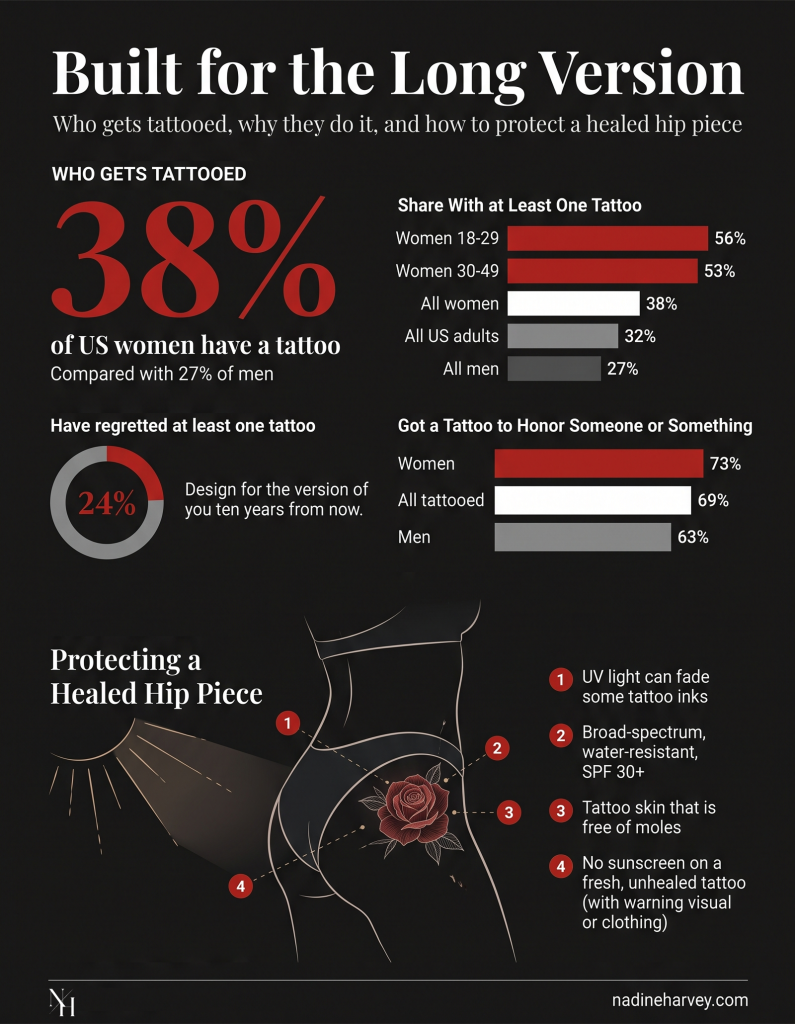
Hip tattoos are a common choice. A Pew Research Center survey found 38 percent of US women have a tattoo, including 56 percent of women ages 18 to 29. This guide comes from Nadine Harvey, a Huntington Beach tattoo artist with eight years of experience. You’ll learn the six hip zones, ideas for each one, and how to heal and protect your piece.
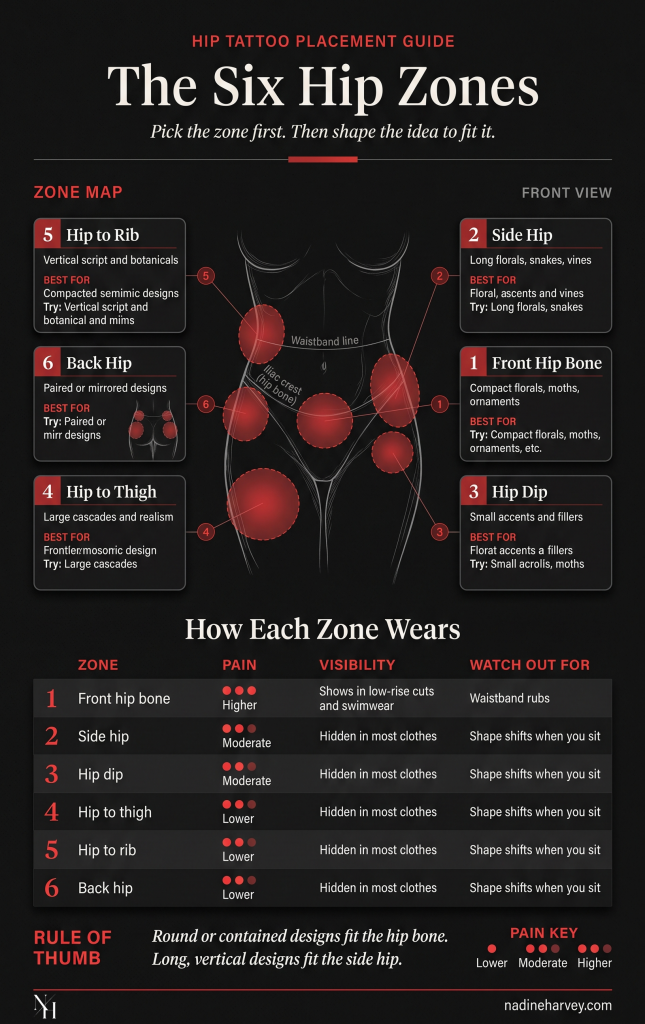
The right spot depends on your design’s shape. Round or contained designs fit the front hip bone. Long, vertical designs fit the side hip and can flow toward the thigh or ribs. Softer areas like the hip dip are easier to sit for. Pick the zone first. Then shape the idea to fit that zone, not the other way around.
| Zone | Best Design Shapes | Pain Level | Visibility | Watch Out For |
|---|---|---|---|---|
| Front hip bone | Compact florals, moths, ornaments | Higher, close to bone | Shows in low-rise cuts and swimwear | Waistband rubs the top edge |
| Side hip | Long florals, snakes, vines | Moderate | Hidden in most clothes | Legging seams |
| Hip dip | Small accents and fillers | Lower, more padding | Mostly hidden | Shape shifts when you sit |
| Hip to thigh | Large cascades and realism | Moderate, higher near bone | Shows in shorts and swimwear | Often needs several sessions |
| Hip to rib | Vertical script and botanicals | Higher over the ribs | Hidden in most clothes | Ribs add sensitivity |
| Back hip | Paired or mirrored designs | Moderate | Mostly hidden | Hard to see while healing |
A design that looks flat on paper changes on a curve. Your hip bends when you sit, walk, and climb stairs. Nadine Harvey draws each piece to follow that movement, so the lines stay balanced as you move.
“It’s built around your body, designed to last, and made by hand.” Nadine Harvey, Tattoo Artist
The iliac crest is the bony ridge you can feel at your waist. Designs that cross it need extra planning for pain and line placement. Designs beside it have more flat skin to work with.
The front hip bone suits designs with a clear center and a contained edge. Think a single rose, a moth, a small ornament, or a fine line botanical cluster. Keep the top edge a few inches below where your jeans sit. This zone is close to bone, so it is one of the more sensitive spots on the hip.
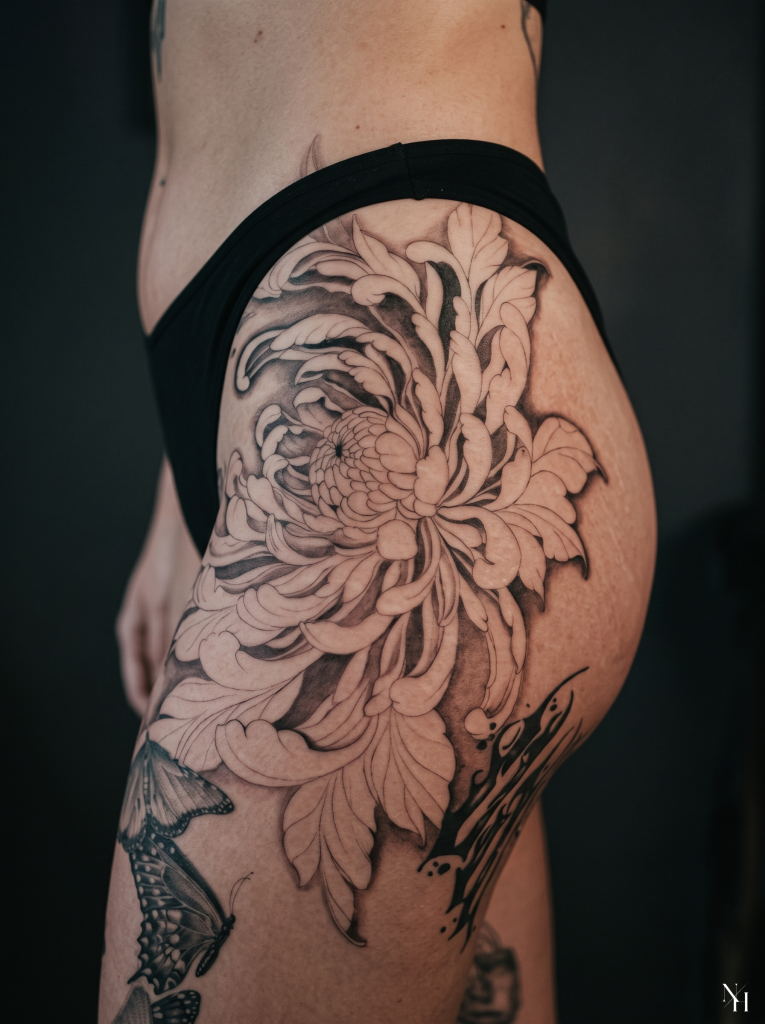
The side hip is the best zone for long pieces. It runs from your waist down past the hip into the upper thigh. Vines, snakes, cascading florals, and large realism pieces all fit here. It also works as a starting point. A side hip piece can grow down the thigh or up the ribs later without a hard stop.
If you like long, vertical placements, Nadine Harvey’s spine tattoo ideas for women follow the same flow principles.
Small first pieces often turn into larger work. In a VoyageLA interview, Nadine described how her client base grew this way.
“Some of my clients started with getting a small tattoo from me.” Nadine Harvey, Tattoo Artist
Some of those clients now have nearly full sleeves. Here is how that works on the hip. A client books one peony on the upper side hip. Nadine leaves open stems at the lower edge, so the peony can later extend into a full hip to thigh piece.
These three zones suit quieter or connected designs. The hip dip fits small accents and fillers. Hip to rib suits vertical script and botanicals. The back hip suits paired designs that mirror each side. All three are easy to hide. That makes them good picks if you want a private piece.
The hip dip is the soft inward curve below the hip bone. Extra padding makes it one of the easier hip spots to sit for. Small florals, a crescent moon, or a single star fit well here.
This area folds when you sit. Simple shapes hold up better than dense detail.
This placement runs up from the hip toward the ribcage. It suits tall designs like a line of script or a climbing botanical. The upper part sits over ribs, so expect more sensitivity there.
The back hip sits just above the glutes and near the lower back. Mirrored designs work well here, such as matching moth wings or two roses. You can’t see this area easily while healing. Use a hand mirror or ask someone to check it.
Black and grey realism and bold illustrative work hold up well on the hip. Fine line works too when the lines have space and sit away from waistbands. Micro realism needs the most care. Tiny detail can soften over time on skin that stretches and rubs. Size the design to the zone, not to the reference photo.
| Style | Best Hip Zone | Key Strength | Watch Out For |
|---|---|---|---|
| Fine line | Hip bone, side hip | Light and elegant | Lines placed too close together |
| Black and grey realism | Side hip, hip to thigh | Depth holds over time | Needs room to show texture |
| Horror | Hip bone, side hip | Strong, readable shapes | Dense dark areas near seams |
| Anime | Side hip | Clean outlines read well | Small faces lose detail |
| Illustration | Any zone | Clear lines and bold shapes | Busy backgrounds crowd the curve |
| Micro realism | Hip bone, at a larger size | Fine detail up close | Detail softens with friction |
Fine line is one of Nadine Harvey’s core styles. On the hip, she spaces each line so it stays clean as skin moves. She keeps the finest work away from friction zones like the waistband line.
For more on the style, read Nadine’s guide to fine line realism.
Hip tattoo pain depends on how much padding covers the bone. The front hip bone and the area near the ribs tend to hurt most. The hip dip and outer thigh tend to hurt least. Outlining usually feels sharpest. Your tolerance, sleep, and stress level also change how the session feels.
Healthline notes that areas close to bone hurt more than fleshy areas. It adds that hip pain depends on how much padding covers your hip bones. Healthline also reports that many people find outlining the most painful stage.
For a full body comparison, see Nadine Harvey’s tattoo placement guide for women.
Every hip piece starts as a hand drawing sized to your body. Nadine Harvey sketches the design, maps it to your hip zone, and places the stencil while you stand. You check it in the mirror and move before any ink goes in. This keeps the design aligned with how your body looks in daily life.
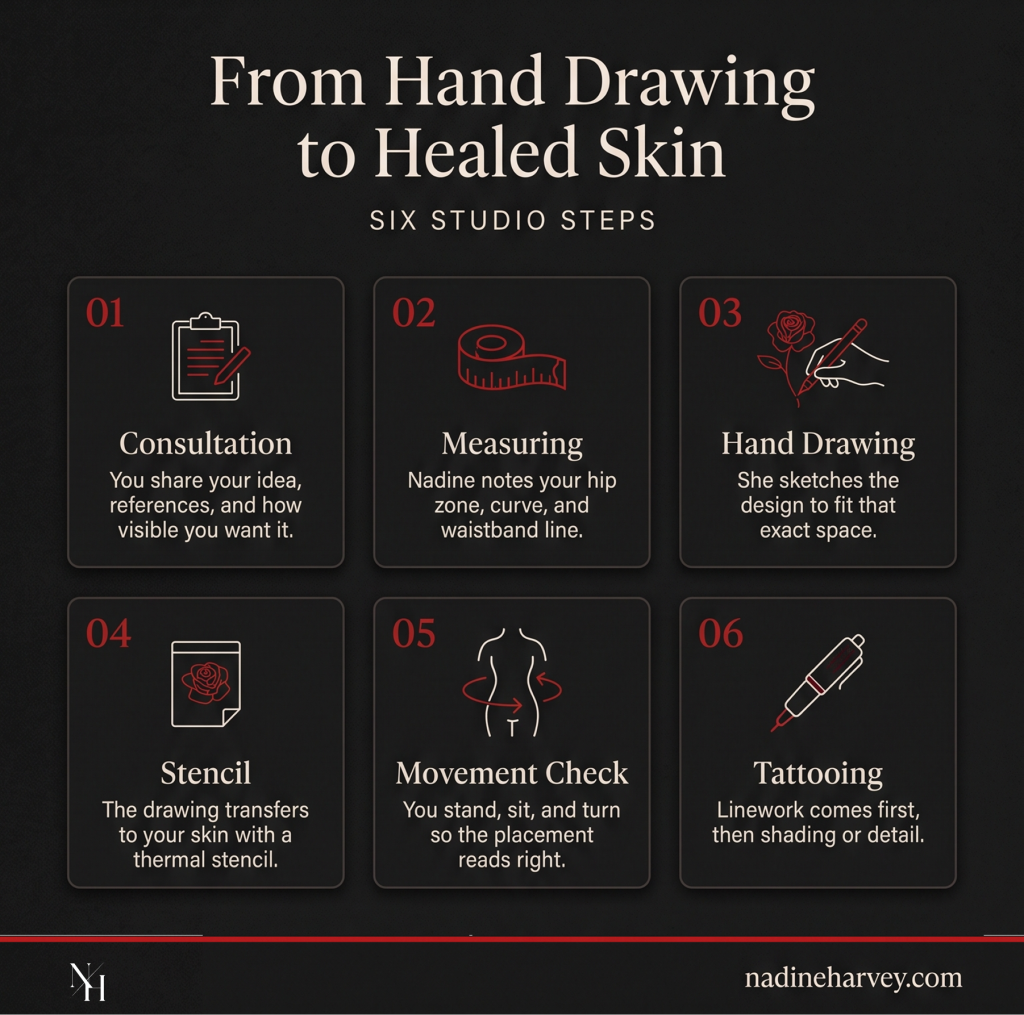
Your hip changes shape when you lie down. A stencil placed lying flat can tilt once you stand up. Checking it while standing keeps the design straight in the posture you live in.
Nadine also works as an editorial model, with press in i-D, Dazed, Nylon, and Paper. On her Model page, she explains how the two jobs connect.
“The same eye that draws a tattoo composes a frame.” Nadine Harvey, Tattoo Artist
Modeling trains her to judge how a hip piece looks in swimwear, in motion, and on camera. She uses that same check when she places your stencil.
The main healing risk for a hip tattoo is friction. Waistbands, underwear seams, and leggings rub fresh skin. Wear loose, soft clothing for the first two weeks. Follow your artist’s aftercare plan exactly. Skip pools, tight jeans, and sleeping on that side until the surface has settled.
Adhesive film bandages like Saniderm or Tegaderm can shield a fresh hip piece from rubbing. Use them only as your artist directs.
Ointment choice matters too. AAD dermatologist Dr. Bruce Katz advised water-based lotion for dry tattooed skin. He also said petroleum-based products such as petroleum jelly can fade ink.
Ask your artist which product they use and why. Then follow one plan from start to finish. Nadine Harvey’s full tattoo aftercare guide walks through each healing stage.
The FDA tattoo fact sheet says allergic reactions to tattoo pigments have been rare. It also advises telling your radiologist about tattoos before an MRI. Don’t skip the scan.
It can. The hip is one of the most common places for stretch marks. Pregnancy and weight change can stretch skin and shift how a design sits. That isn’t a reason to avoid the hip. It is a reason to plan size, placement, and style with future changes in mind.
Cleveland Clinic lists the hips and thighs as common places for stretch marks. It says they generally take six to 12 months to fade. Medical News Today reports that over half of women get stretch marks during pregnancy.
Settled stretch marks can become part of a design. Petals, smoke, and vines can work around or across them.
Mature marks are easier to plan around than new marks that still change color. Bring this up at your consultation so the drawing accounts for it.
Sun is the biggest long-term threat to a healed hip tattoo. Hip pieces see a lot of sun at the beach and pool. Use a broad-spectrum, water-resistant sunscreen with SPF 30 or higher. Apply it 15 minutes before you go out. Reapply every two hours. Good design choices up front matter just as much.
The American Academy of Dermatology says UV light can fade some tattoo inks. In Huntington Beach, that means sunscreen on every beach day.
Never apply sunscreen to a fresh, unhealed tattoo. Keep it covered with loose clothing until it heals.
The AAD also recommends tattooing skin that is free of moles. A tattoo can hide early signs of skin cancer.
Pew found that 24 percent of tattooed Americans have regretted at least one tattoo. Pew also found 69 percent got a tattoo to honor someone or something. Choose an idea with real meaning, then size it to fit your body.
The FDA’s tattoo safety guide notes that permanent tattoos are meant to last a lifetime. They are also hard to remove. Design for the version of you ten years from now.
California law requires every tattoo artist to register with their county. They must also complete bloodborne pathogens training before registering and update it every year. In Orange County, artists display their current registration at their station. Look for it before your session starts. Ask about needles and ink too.
The California Safe Body Art Act requires at least two hours of bloodborne pathogens training specific to body art. Artists must complete a two-hour update every year. The Orange County Health Care Agency also requires body art facilities to hold a permit to operate.
Ink safety matters as well. An FDA study summarized by Crowell found bacteria in over 30 percent of tested tattoo and permanent makeup ink samples. The FDA now regulates tattoo ink under the Modernization of Cosmetics Regulation Act of 2022.
New to the process? Nadine Harvey’s first tattoo checklist covers what to ask and bring. You can also learn more about Nadine and her private studio.
A strong hip tattoo starts with the zone, not the photo. Match compact designs to the hip bone and long designs to the side hip. Choose a style that suits movement and friction. Heal it with loose clothing, protect it from sun, and plan for future changes. Then work with a registered artist who draws for your body.
Nadine takes a limited number of bookings each month. When you have a zone and an idea, you can request a consultation to start the drawing.
Usually, yes. The hip bone sits close to the skin, while the outer thigh has more padding. The hip dip and outer hip feel closer to thigh-level pain.
The surface usually settles within a few weeks. Deeper skin keeps healing for longer. Waistband friction can slow it down, so wear loose clothing.
Yes. Pregnancy can stretch hip skin and cause stretch marks. The outer side hip and organic shapes like florals help a design hold up through those changes.
Yes, when the lines have room. Keep the finest detail off the waistband line and groin crease. Size the design so the lines don’t crowd each other.
Wear loose pants, a skirt, or a dress that gives easy access to your hip. Bring soft, loose clothes to wear home over the fresh tattoo.