Black and grey tattoos age better than color because black pigment is more stable and reads through contrast. See the science, sun care, and how to choose a lasting piece.
You want a tattoo that still looks good in twenty years. That is a fair concern. A tattoo is permanent, and your skin will change.
This article explains why black and grey tattoos tend to age better than color. You will learn the science, the role of sun exposure, and how to choose a piece that lasts.
Yes, black and grey tattoos usually age better than color tattoos. Black ink uses a dense carbon pigment that fades slowly. Color inks use pigments that break down faster under light. Black and grey also depends on contrast, so it stays readable as it softens. Color depends on bright hues holding true, which is harder over time.
This matters because tattoos are now mainstream. A 2023 Pew Research Center survey found 32 percent of US adults have a tattoo. Among women ages 18 to 29, that number rises to 56 percent. Millions of people now live with aging ink.
A tattoo does not vanish. It softens. Lines blur a little and tones settle.
Black and grey settles in a way that still looks intentional. Color can fade unevenly, which makes a piece look tired.
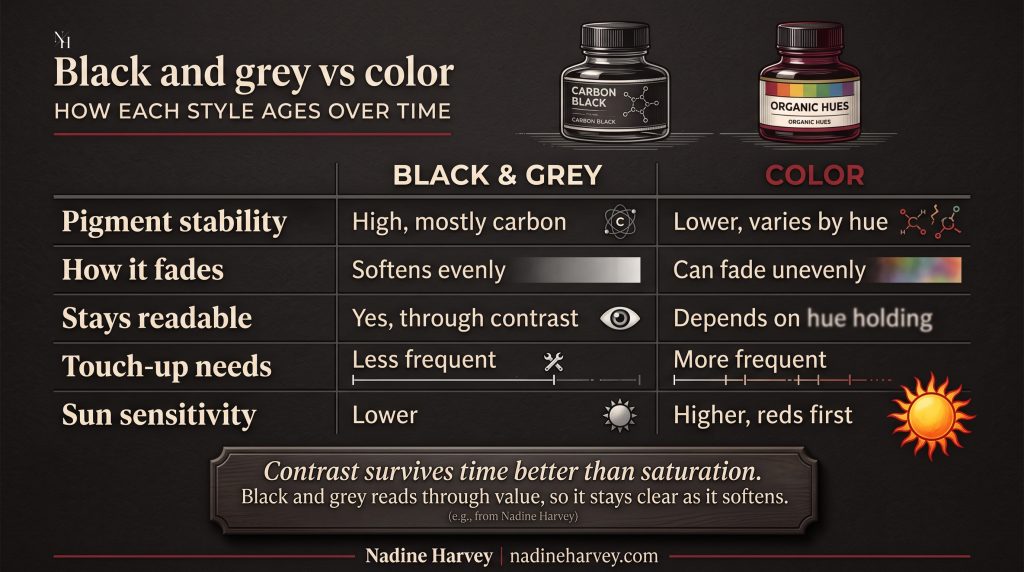
| Factor | Black and grey | Color |
|---|---|---|
| Pigment stability | High, mostly carbon | Lower, varies by hue |
| How it fades | Softens evenly | Can fade unevenly |
| Stays readable | Yes, through contrast | Depends on hue holding |
| Touch-up needs | Less frequent | More frequent |
| Sun sensitivity | Lower | Higher, reds and light tones first |
People often call this style black and white, but that name is not accurate. Artists rarely use white ink as a base. We build the whole range from black. We thin black ink with distilled water to make greys, from dark to soft. White ink mostly shows up in small highlights. So a “black and white” tattoo is really black and many shades of grey.
The name matters because it explains how the style ages. The tone comes from one pigment family, black. That is a big reason the work stays consistent over time.
I start with black ink. I add distilled water to thin it. That gives me a range of greys, from deep shadow to soft haze.
Artists call this a grey wash. Some use pre-mixed wash sets in light, medium, and dark values. Every tone still traces back to black.
White ink plays a small role. I use it for highlights, like a catchlight in an eye or a soft shine on metal. It sits on top of the greys, not underneath them.
White is also one of the first tones to fade. That is another reason it works as an accent, not a base.
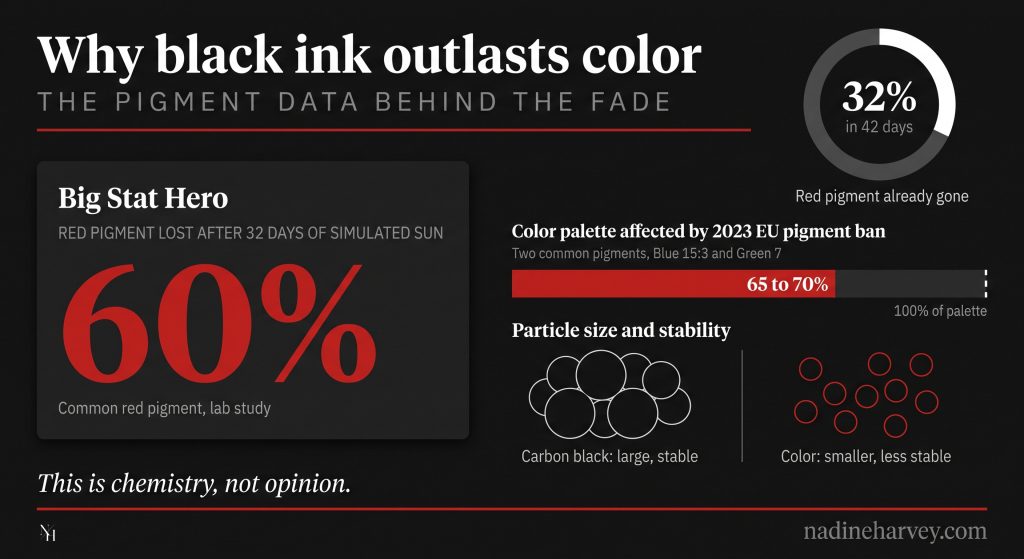
Black ink lasts longer because carbon black pigment is dense and stable. Its particles are large and hard for the body to break down. Color pigments are often smaller or less stable. Light and your immune system wear them down faster. This is chemistry, not opinion.
Black ink is mostly carbon. Carbon is one of the most stable pigments used on skin. Your body struggles to break it apart, so it stays put.
That density is why artists trust black for fine detail. It holds a crisp line for years.
Color inks fade through light. A peer-reviewed medical review in the Journal of the European Academy of Dermatology and Venereology explains that pigment molecules can decompose under UV, visible, or infrared light.
Red is a clear example. Red azo pigments are the most common color pigment after black. In one mouse study cited in dermatology research, a common red pigment dropped about 32 percent in 42 days. Simulated sun exposure cut it by about 60 percent.
Color ink also faces tighter rules. In 2023, the European Chemicals Agency banned two common pigments, Blue 15:3 and Green 7, for tattoo use. Reports at the time estimated these appeared in 65 to 70 percent of color palettes.
This does not mean color is unsafe. It means color chemistry is harder to keep both stable and clean.
Black and grey relies on contrast, the play between light and dark. Color relies on saturation, the brightness of each hue. As skin ages, both soften. But a faded grey still reads as shadow. A faded color can look washed out or shift to the wrong tone. Contrast survives time better than saturation.
I draw every piece by hand before any ink touches skin. When I build a black and grey design, I plan the contrast to hold as it settles.
I push the darkest values a little darker than the reference. The piece eases back during healing and stays balanced for years. You can see this approach across my black and grey tattoo work.
“I build a black and grey piece to hold its contrast for years. I push the darkest values a little deeper than the photo, so the design still reads after it settles.” Nadine Harvey, Tattoo Artist
Some choices age a tattoo faster than the ink ever would. Watch for these.
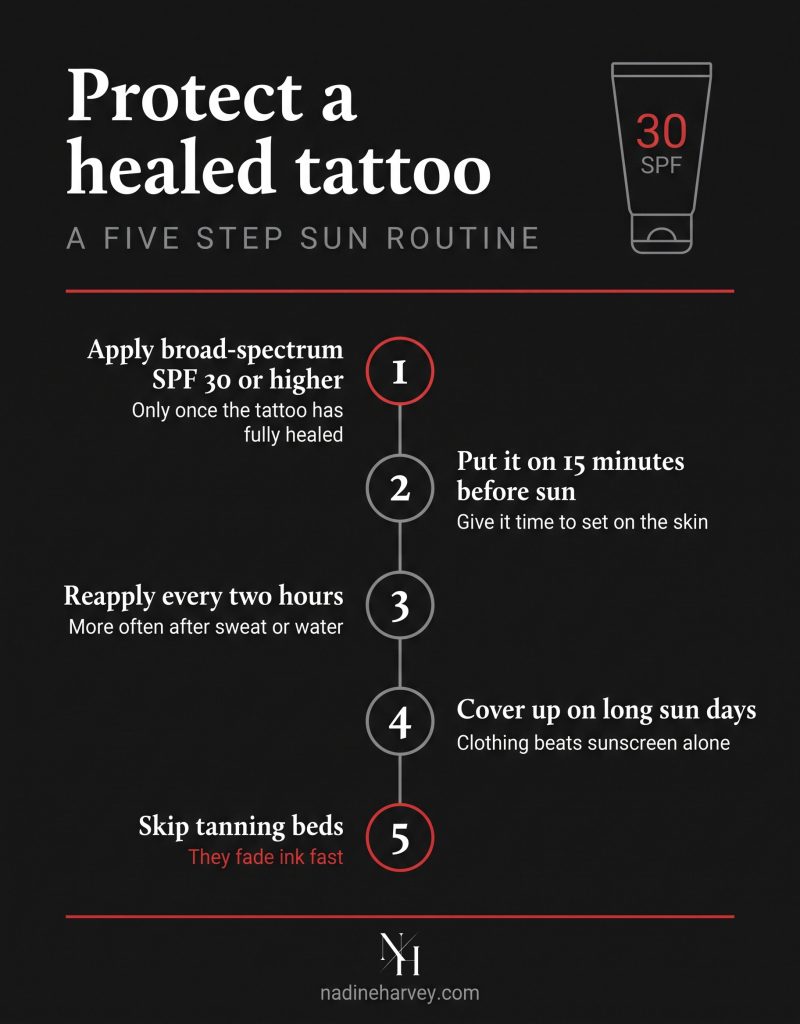
Sunlight is the biggest cause of tattoo fading for any style. UV light breaks down pigment in the skin over time. The American Academy of Dermatology confirms UV light “can fade some tattoo inks.” Color fades first, but black and grey fades too. Sun care protects your whole investment.
Living near the beach makes this real. I work in Huntington Beach, where the sun is strong most of the year. Sun habits matter here more than ink choice alone.
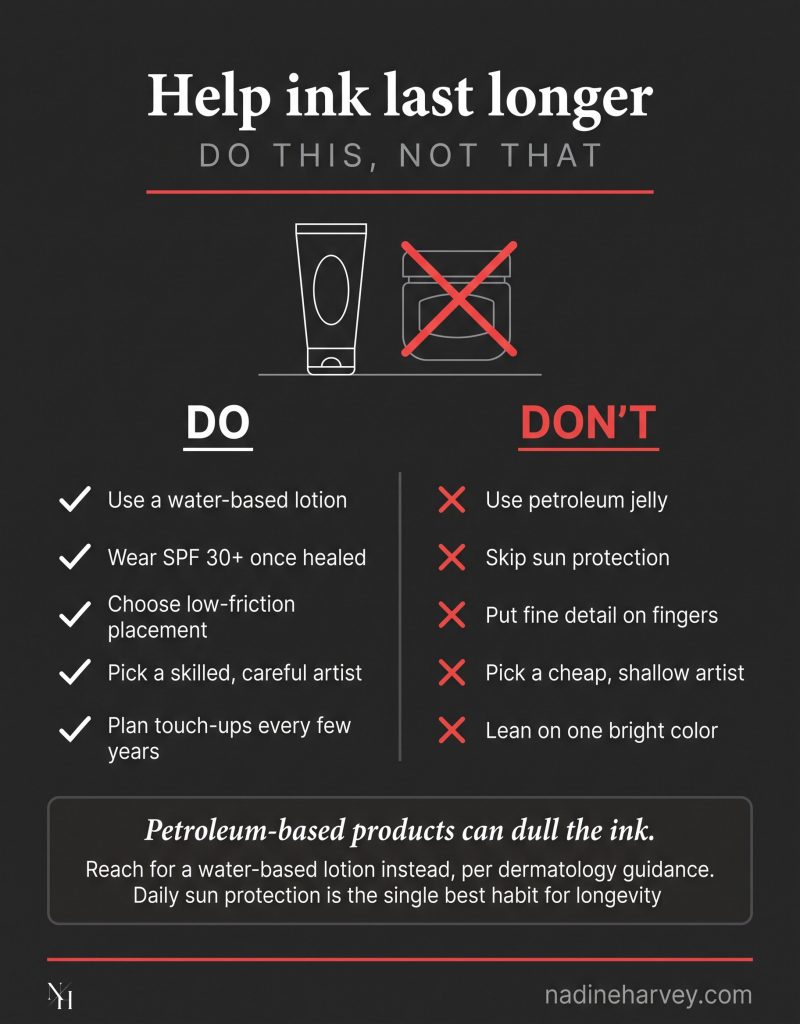
Wait until your tattoo fully heals before using sunscreen. Then build a simple routine.
Use a water-based lotion to keep tattooed skin hydrated. The AAD notes that petroleum-based products, like petroleum jelly, can cause ink to fade.
A board-certified dermatologist, Dr. Jeremy Fenton, has said sun exposure “can also cause tattoos to fade.” Daily protection is the single best habit for longevity.
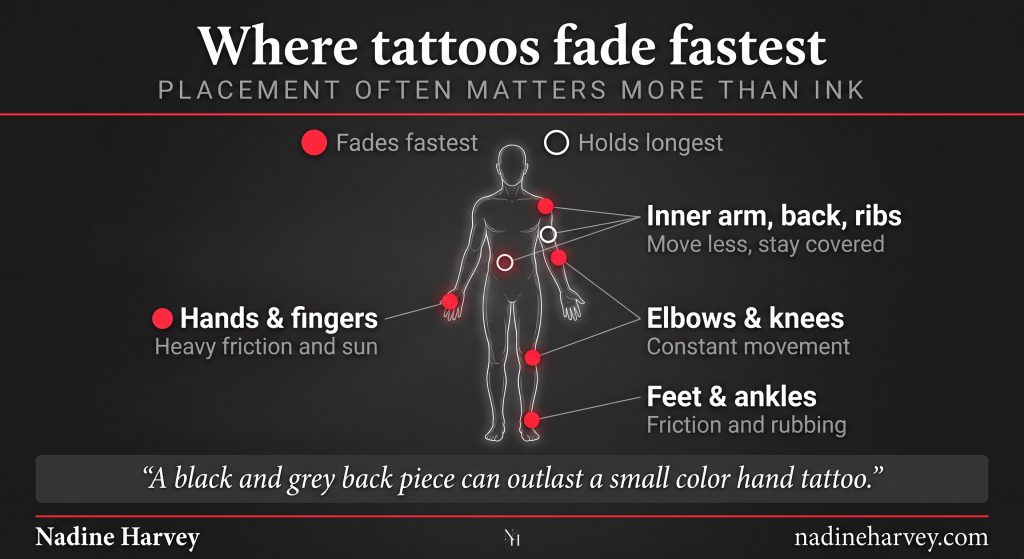
Placement often matters more than ink color. Tattoos on hands, fingers, and feet fade fastest. These areas see heavy friction and constant sun. Tattoos on the inner arm, back, or ribs last longer because they move less and stay covered. A large black and grey back piece can easily outlast a small color tattoo on a hand.
Some spots wear ink down quickly. Friction rubs ink, and sun breaks it down.
Clients often ask me about finger tattoos. I am honest about them. Fine color work on a finger will not hold the way the same idea would on a forearm.
“I tell clients the truth about finger tattoos. Fine work there fades fast, so I move a design that needs to last to the forearm or inner arm.” Nadine Harvey, Tattoo Artist
When a piece needs to last, I steer the design toward a protected spot. That single choice can add years of clarity.
Color can be a great choice when you plan for it. A bold, well-placed color tattoo on a protected area can age well. Skilled artists use dark outlines and heavy saturation to help color hold. If you love color and care for it, do not rule it out. Just go in with clear expectations.
Color rewards smart placement and care. Pick a spot with low friction and low sun.
Darker shades like deep blue and dark green hold better than yellows and pastels. A black or grey base under color adds depth and longevity.
“When a client wants color that lasts, I lay a black or grey base underneath. It gives the color depth and holds the shape as it ages.” Nadine Harvey, Tattoo Artist
All tattoos fade to some degree. A histological study of tattooed skin found older tattoos show less free pigment as the body moves particles deeper. Color simply asks for more upkeep than black and grey.
Choose for the long version, not just the first week. Weigh the ink, the placement, and your sun habits together. Black and grey gives you the most forgiving path. But a well-planned color piece can also age well. The goal is a design that still looks like itself in twenty years.
Use this simple framework before you book.
If you want help weighing these choices, you can book a consultation. I will walk you through what fits your body and your goals.
Black and grey tattoos age better because the pigment is stable and the design reads through contrast. Color is not off the table, but it asks for more care and smarter placement. Either way, daily sun protection makes the biggest difference.
The best tattoo is one built for the long version. Plan the style, the spot, and the care together. You can learn more about my approach on my about page, or see how the same care carries into my editorial and modeling work.
No. All tattoos fade a little over time. Black and grey fades more slowly and more evenly, so it stays clear longer than most color work.
Only a little. Artists build the tones from black, thinned with water to make grey. White ink is mostly for highlights, like a catchlight in an eye. That is why the style is called black and grey, not black and white.
Light colors fade fastest. Yellow, white, and pastels break down first. Reds dull and can fade toward pink. Dark blue and dark green hold up better than bright shades.
Yes. Sunscreen is the best habit for longevity. Use a broad-spectrum SPF 30 or higher on healed tattoos, and reapply every two hours in the sun.
It depends on placement, sun exposure, and ink. Black and grey often needs fewer touch-ups than color. Many pieces benefit from a refresh every several years.