Behind the ear tattoo ideas for women, sorted by style and zone. Learn what fits, what blurs, how much it hurts, and how to heal it, from artist Nadine Harvey.
The skin behind your ear is one of the most requested spots for a small tattoo. You can show it with your hair up and hide it with your hair down. Yet popular galleries on Byrdie and Women.com show pictures without explaining what fits this spot.
This guide sorts ideas by style and matches each one to a zone. Nadine Harvey has spent eight years drawing custom tattoos by hand in Southern California. Her rule for this placement is simple: pick the zone, keep the shape clean, and plan for hair and sun.
A behind the ear tattoo sits in one of three zones. The first is the soft skin just behind the lobe. The second runs up the mastoid bone along the back curve of the ear. The third flows down toward the side of the neck. Each zone sets the size limit, how visible the tattoo is, and how much detail it holds.
Nadine Harvey starts every behind the ear consult with the zone, not the image. The zone sets the size. The size sets how much detail the design can carry.
| Zone | Typical Size | Visibility | Best For |
|---|---|---|---|
| Behind the lobe | Under 1 inch | Hidden with most hairstyles | Single symbols, tiny initials |
| Up the mastoid | 1 to 2 inches tall | Shows when hair is tucked or up | Vertical florals, script, small realism |
| Toward the neck | 2 inches or more | Shows with hair up or short | Vines, snakes, flowing linework |
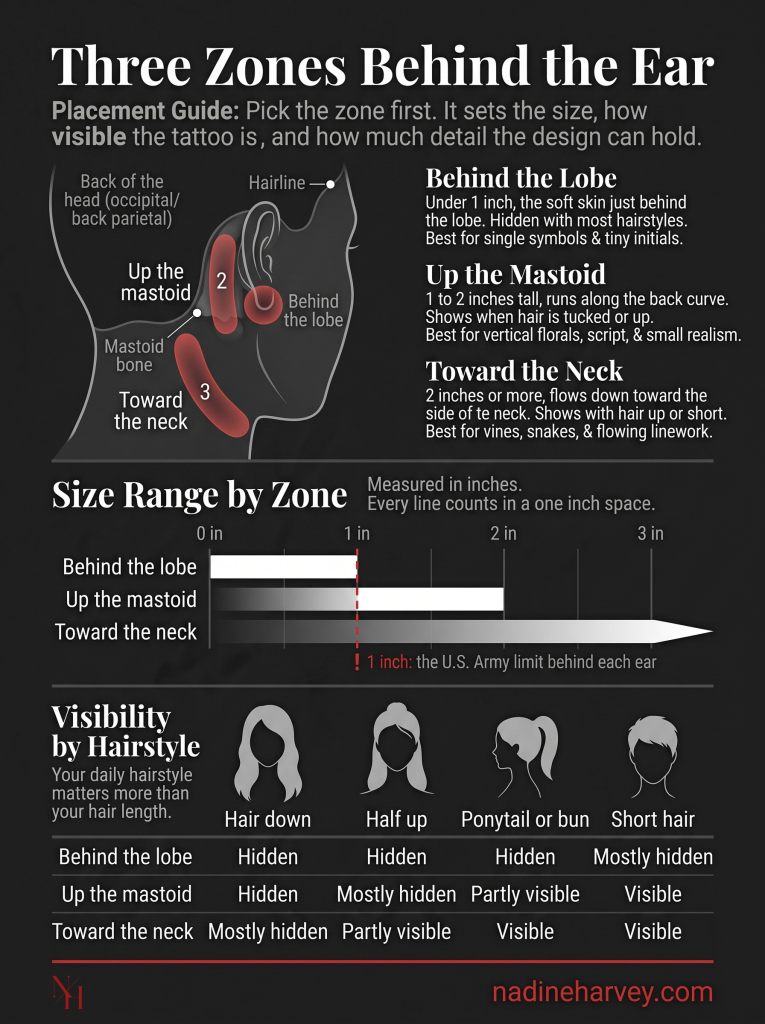
A one inch space leaves no room for extra lines. A design that reads well at three inches turns into a blur at one inch.
For scale, the U.S. Army allows one tattoo behind each ear, up to one inch in all directions, under its 2022 tattoo policy update. That limit is a useful benchmark for a truly discreet piece.
The best ideas have a clear outline, a shape that curves with the ear, and open skin between the lines. Fine line flowers, moons and stars, short script, small black and grey realism, and tiny horror or anime accents all work. Choose your style first. Then match the idea to your zone.
Each idea below lists the best zone and the detail level it can handle.
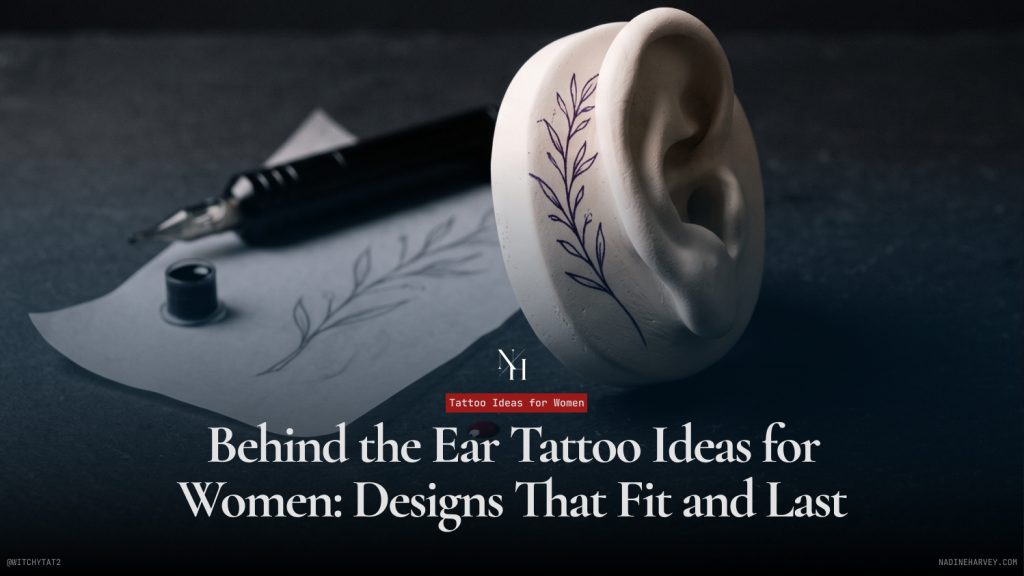
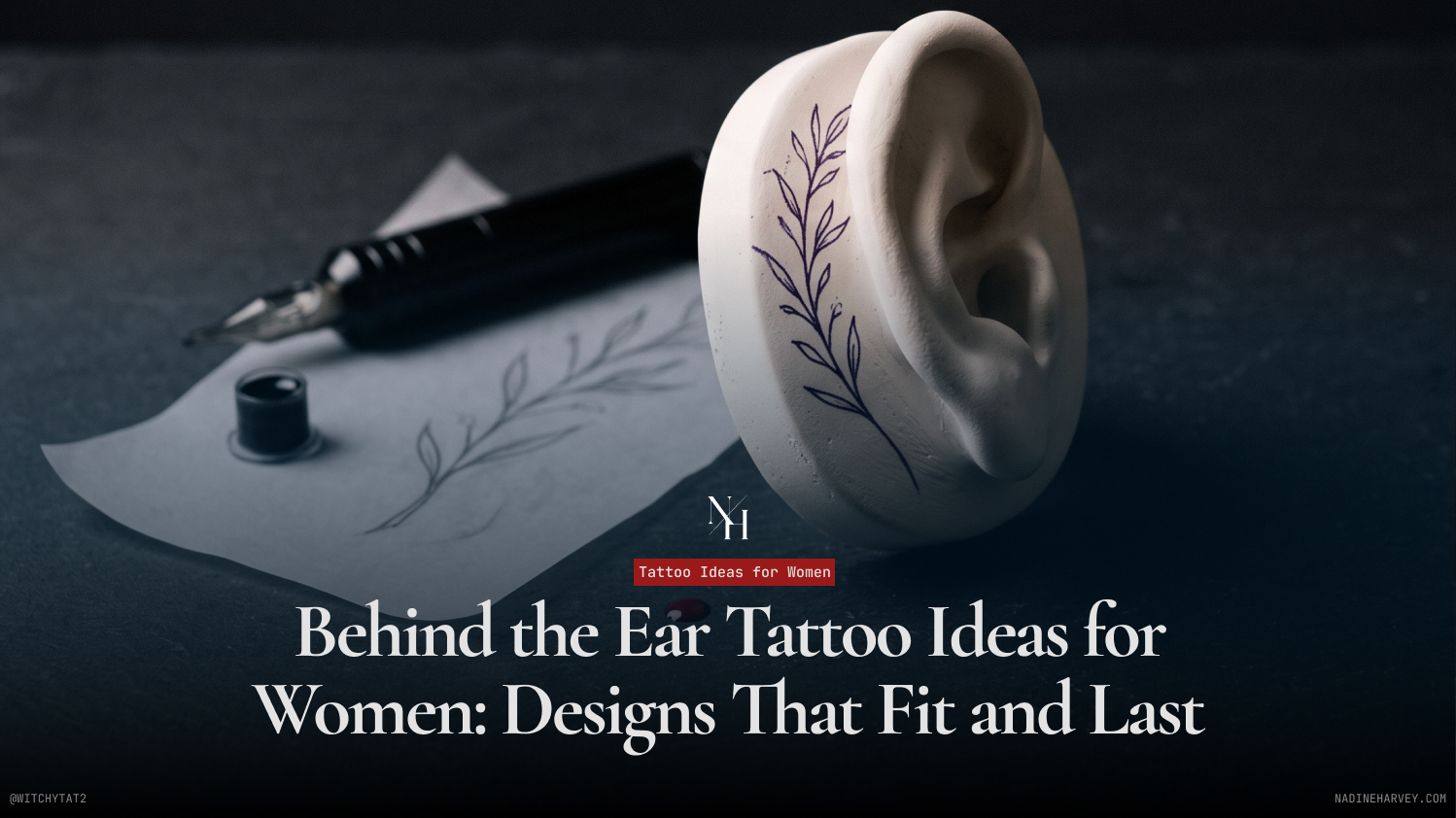
A single stem, a lavender sprig, or a small rose works because plants already curve. Nadine draws the stem along the back edge of the ear. The design then follows your natural shape.
Her fine line work relies on a single needle for the thinnest, cleanest lines.
“Single-needle precision. Built to hold for decades.” Nadine Harvey, Tattoo Artist
A crescent moon, a three-star cluster, or a small sun holds its shape well. These simple outlines suit the tight lobe zone.
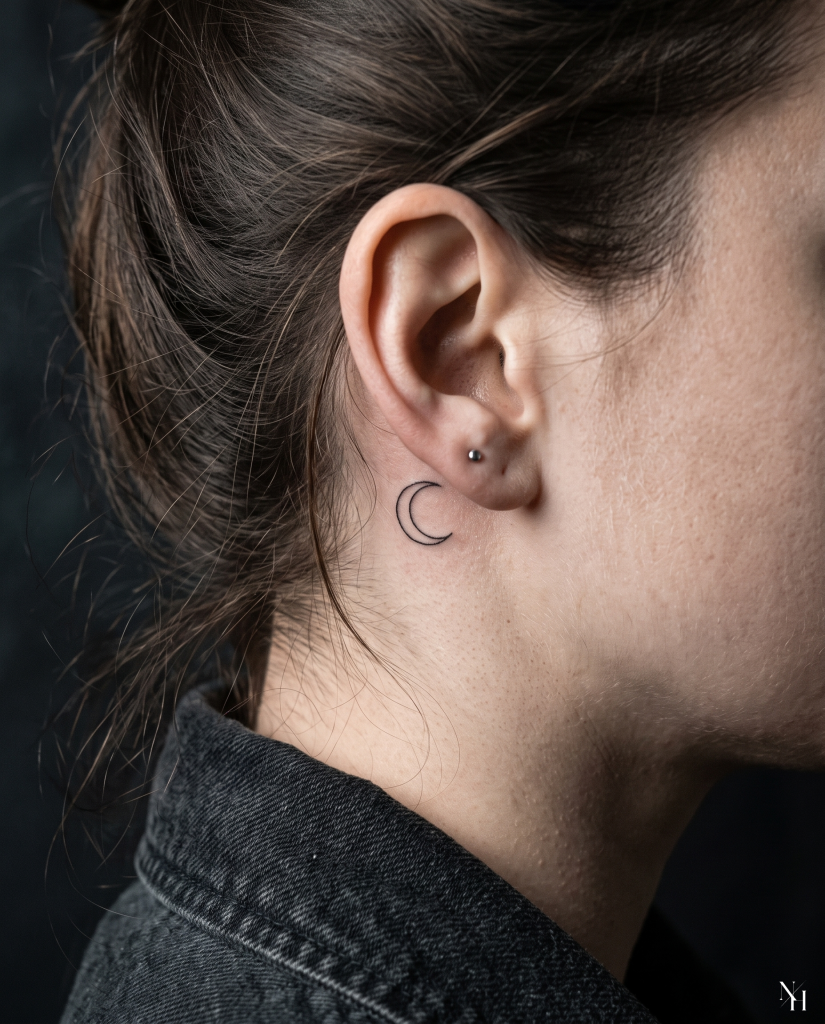
One word, a date, or a single initial reads clearly when the letters have room. Vertical script that runs up the ear fits the space better than a flat line.
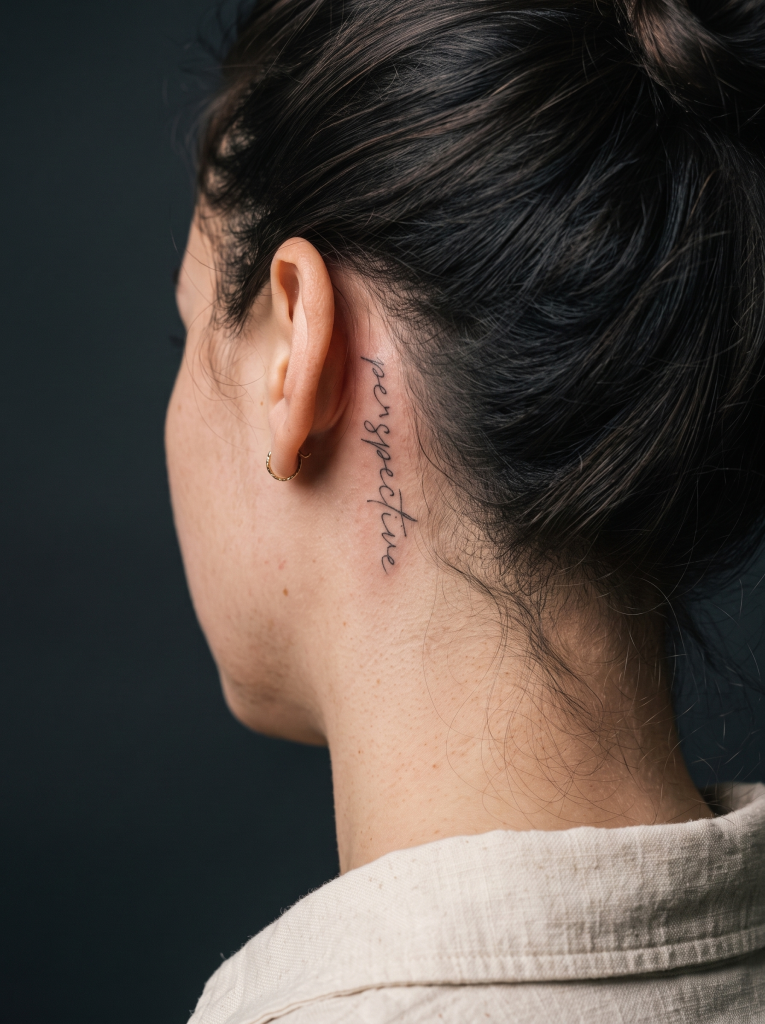
A tiny eye, a moth, or a small portrait needs the larger mastoid zone. It also needs soft, planned shading from an artist with healed realism work. Nadine’s fine line realism style guide explains how this detail is built.
Popular galleries rarely show darker styles. A small spider, dagger, bat, or anime symbol wears just as well behind the ear. Bold outlines help these designs read from a distance.
You can see healed examples of each style in Nadine’s tattoo portfolio.
Avoid designs that pack fine detail into a tiny space, use long sentences, or fight the curve of the ear. These designs blur, crowd, or look tilted as skin moves and ages. The fix is to simplify the design. Shrinking a busy design only makes the lines crowd faster.
Skin changes over time. A 2022 ultrasound study of facial skin found that facial skin in women gets thinner with age. Designs with open space between lines hold their shape longer as that happens.
A client brings a reference of a bouquet with five flowers and a banner. On the stencil, it covers the whole mastoid zone, and the lines nearly touch. Nadine redraws it as one open bloom on a single stem. The meaning stays, and the design reads clearly from across a room.
That redraw comes from a principle Nadine shared in her VoyageLA interview.
“I truly care about every tattoo my clients want.” Nadine Harvey, Tattoo Artist
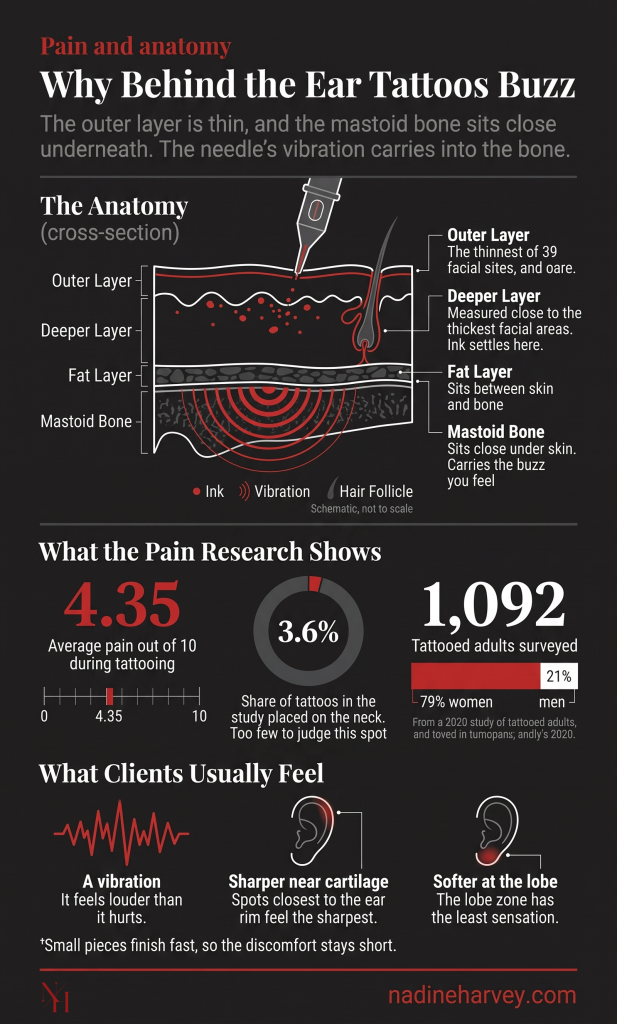
Nadine’s clients usually describe it as moderate, with a buzzing feeling that travels through the bone. No published study ranks pain behind the ear specifically. Online pain charts reflect artist opinion, not measured data. Small pieces finish fast, so the discomfort stays short.
A 2020 study of 1,092 tattooed adults found average pain during tattooing was 4.35 out of 10. Only 3.6% of tattoos in that study were on the neck. The study says little about this exact spot.
Anatomy explains the buzz. A study of facial skin thickness found the skin behind the ear has the thinnest outer layer of 39 facial sites. Its deeper layer measured close to the thickest areas. The surface is thin, and the mastoid bone sits close underneath.
For a wider comparison, read Nadine’s tattoo placement guide for women.
Yes, in most cases. A tattoo behind the lobe stays hidden with hair down and usually with hair half up. Pieces higher on the mastoid or reaching toward the neck show when hair is tied back or cut short. Your daily hairstyle matters more than your hair length.
| Hairstyle | Behind the Lobe | Up the Mastoid | Toward the Neck |
|---|---|---|---|
| Hair down | Hidden | Mostly hidden | Partly visible |
| Half up | Mostly hidden | Partly visible | Visible |
| Ponytail or bun | Visible | Visible | Visible |
| Short hair | Visible | Visible | Visible |
Tattoos are common now. Pew Research Center found that 38% of U.S. women have at least one tattoo. Pew also found that 24% of tattooed adults regret at least one.
Placement plays a role. A peer-reviewed study on tattoo regret found that tattoos on the face, neck, hands, wrist, or fingers predicted regret. Behind the ear sits right next to the neck. Decide how often you want it seen before you book.
Uniform rules have relaxed for this exact spot. The U.S. Army added behind the ear tattoos to its approved list in 2022.
Keep it clean, keep hair and products off it, and keep pressure off it. Mayo Clinic notes that most tattoos take about two weeks to heal. This spot needs extra care because hair, glasses, earbuds, and pillows touch it every day.
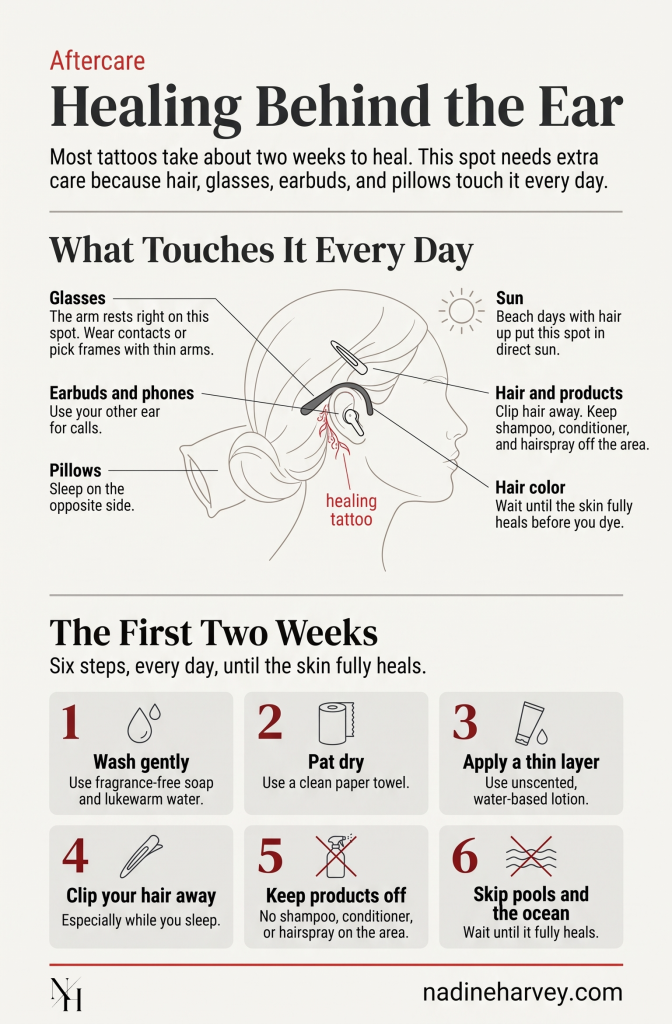
Beach days with your hair up put this spot in direct sun. The American Academy of Dermatology advises broad-spectrum, water-resistant SPF 30 or higher on healed tattoos. Reapply every two hours.
Dermatologists also advise tattooing skin that is free of moles. Check behind your ear before you book, since moles there are easy to miss.
See a board-certified dermatologist if a rash or swelling lasts past the healing window.
Choose a registered artist with healed fine line work in small placements. California’s Safe Body Art Act requires tattoo artists to register with their county and complete bloodborne pathogen training. Ask to see healed photos of small work. Healed photos show how lines settle after the skin recovers.
The FDA responded with final guidance on tattoo ink safety in October 2024. For more vetting tips, read how to choose a fine line tattoo artist.
Nadine Harvey draws every piece by hand before it touches skin. She fits each design to the client’s own ear, hairline, and piercings.
“It’s built around your body, designed to last, and made by hand.” Nadine Harvey, Tattoo Artist
Nadine also works as an editorial model, with features in i-D, Dazed, Nylon, and Paper. That work shapes how she places a tattoo. She checks how each piece reads in profile and on camera.
A behind the ear tattoo looks best when the design fits the zone. Start with where it sits. Then choose a style and keep the shape simple.
If this is your first tattoo, start with the first tattoo checklist. When you are ready to plan yours, you can book a consultation. You can read more about Nadine’s background on the About page.
Most pieces fall between half an inch and two inches. Behind the lobe works best under one inch. The mastoid zone holds slightly larger, vertical designs.
Yes, daily friction and sun exposure wear on this spot. Simple lines, open spacing, and SPF 30 or higher slow fading. Plan for a touch-up on fine line work over time.
Yes. Your artist should plan the design around your helix, conch, or lobe jewelry. The tattoo and the jewelry should share the space evenly.
A small symbol usually takes under an hour. Detailed realism or longer linework takes more time.
Yes, for most people. The size is small, and sessions are short. Plan for visibility and the buzzing feeling before you commit.