Spine tattoo ideas for women from editorial tattoo artist Nadine Harvey. Pick the right zone and style, plan for pain and healing, and choose designs that age well.
Women are more likely than men to have a tattoo. A 2023 Pew Research Center survey found 38% of women have one, compared with 27% of men. Yet most spine tattoo ideas online are only pictures. They do not show if a design will sit straight on your back or hold up for ten years.
This guide answers those questions. Nadine Harvey is an editorial tattoo artist in Huntington Beach with eight years of experience and thousands of pieces completed. You will learn how to pick a spine zone, choose a style that fits, and plan for pain, healing, and long-term care.
A good spine tattoo idea fits three things: the length of your spine, its natural curve, and the way skin ages. The design should run long and narrow. It should look straight when you stand relaxed. It should also leave enough open skin for lines to soften over time. A design that looks perfect online can fail all three tests on your body.
The spine is a narrow, vertical canvas. It moves every time you sit, bend, or reach. That makes fit matter more here than on a forearm or thigh.
Run every saved idea through these checks before your consultation.
Reference images help. They show the mood, motifs, and style you like. Copying another artist’s piece takes their work. It also ignores your own proportions.
Nadine Harvey draws every piece by hand around the client’s body before any ink goes in. Her homepage states the goal plainly.
“It’s built around your body, designed to last, and made by hand.” Nadine Harvey, Tattoo Artist
This matters for the long term. Pew found about 24% of tattooed adults regret at least one tattoo. A custom design is one way to plan against that.
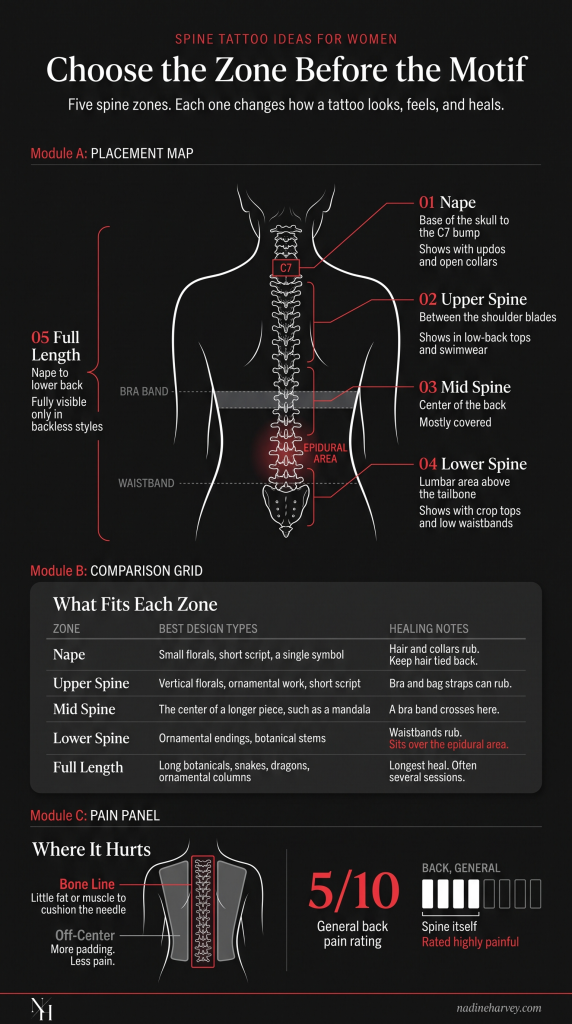
Choose the zone before the motif. The nape and upper spine suit shorter vertical pieces and show with low backs and updos. The mid spine sits under a bra band. The lower spine shows with low waistbands and sits over the area used for epidurals. A full-length piece needs the most planning and often more than one session.
Each zone changes how the tattoo looks, feels, and heals. The table below compares all five.
| Zone | Where It Sits | Visibility | Best Design Types | Healing Notes |
|---|---|---|---|---|
| Nape | Base of the skull to the C7 bump | Shows with updos and open collars | Small florals, short script, a single symbol | Hair and collars rub. Keep hair tied back. |
| Upper Spine | Between the shoulder blades | Shows in low-back tops and swimwear | Vertical florals, ornamental work, short script | Bra and bag straps can rub. |
| Mid Spine | Center of the back | Mostly covered | The center of a longer piece, such as a mandala | A bra band crosses here. |
| Lower Spine | Lumbar area above the tailbone | Shows with crop tops and low waistbands | Ornamental endings, botanical stems | Waistbands rub. Sits over the epidural area. |
| Full Length | Nape to lower back | Fully visible only in backless styles | Long botanicals, snakes, dragons, ornamental columns | Longest heal. Often several sessions. |
A partial piece covers one zone. It suits a first large tattoo and can often finish in one session. It also leaves room to extend the design later.
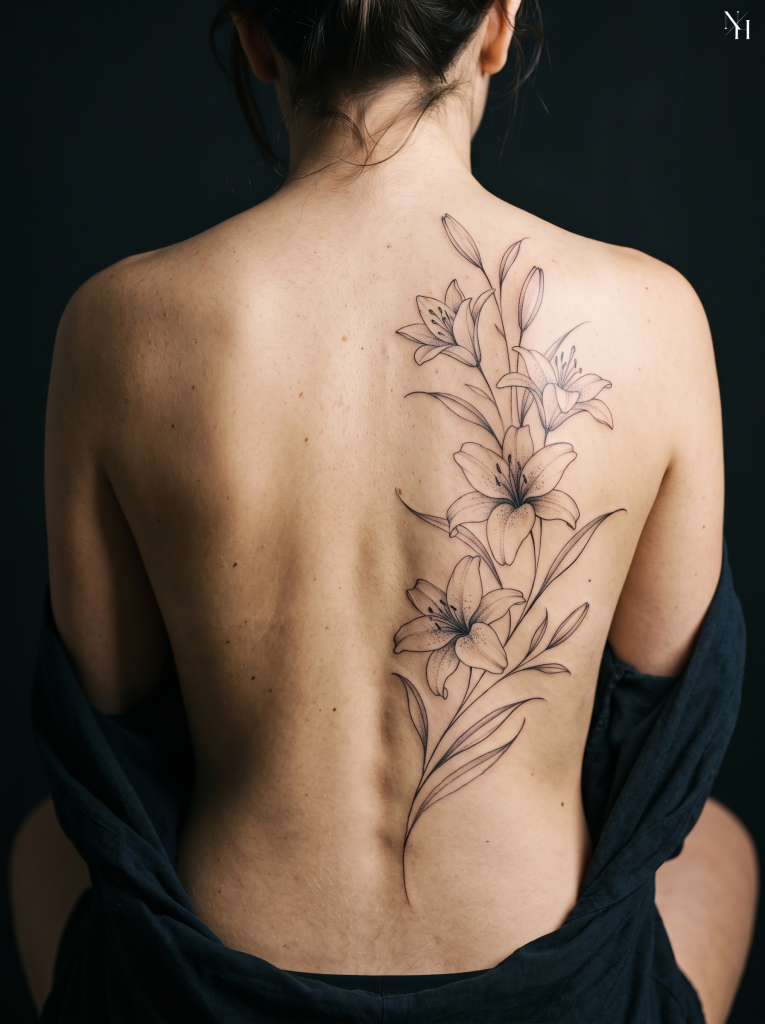
A full-length piece runs from nape to lower back. It reads as one column, so the drawing must flow across every zone. Plan for several sessions and a longer total healing time.
Nadine Harvey also models for editorial publications and fashion brands. That work gives her a clear view of how a spine tattoo reads in photos and backless clothing. A long vertical line draws the eye down the back. An off-center piece adds movement. You can see examples in her modeling portfolio.
The strongest spine tattoo ideas match a style to the spine’s long, narrow shape. Fine line botanicals, vertical script, ornamental patterns, black and grey realism, and illustrative anime or horror pieces all work well. Each style needs different sizing and spacing to stay clear. Choose the style first, then build the motif around it.
Each idea below includes a note on size and spacing for the spine.
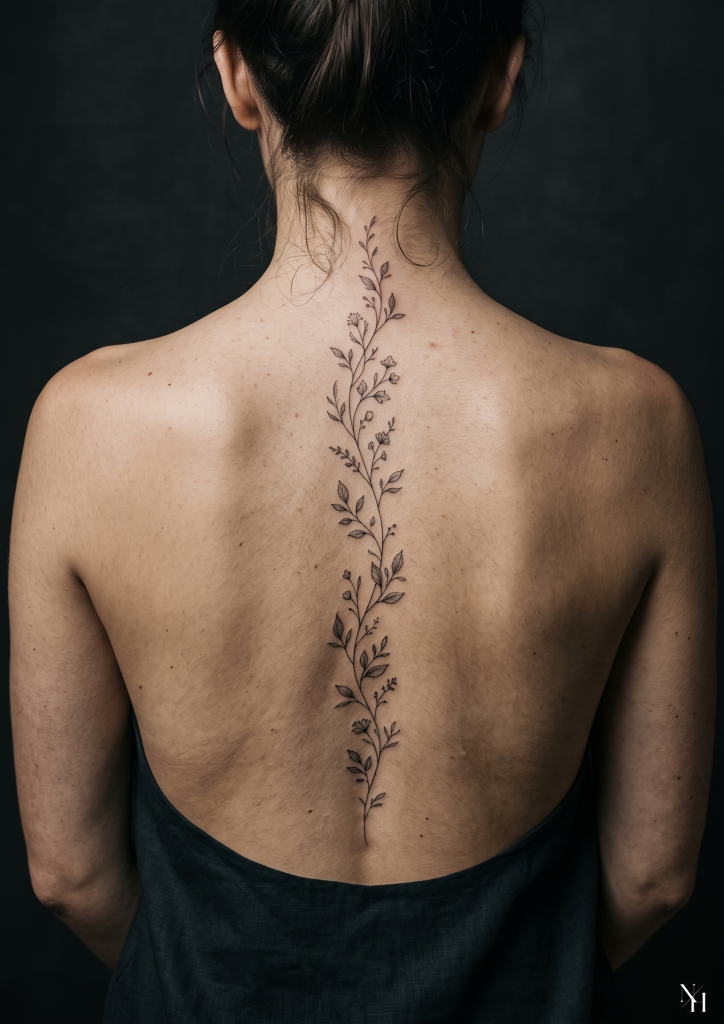
Stems, vines, and single blooms follow the spine’s line. Picture a peony at the nape with a stem running down, or a trail of small leaves. Leave open skin between petals. Fine detail packed too tight can blur over time. If the flower’s meaning matters to you, read our flower tattoo meanings guide.
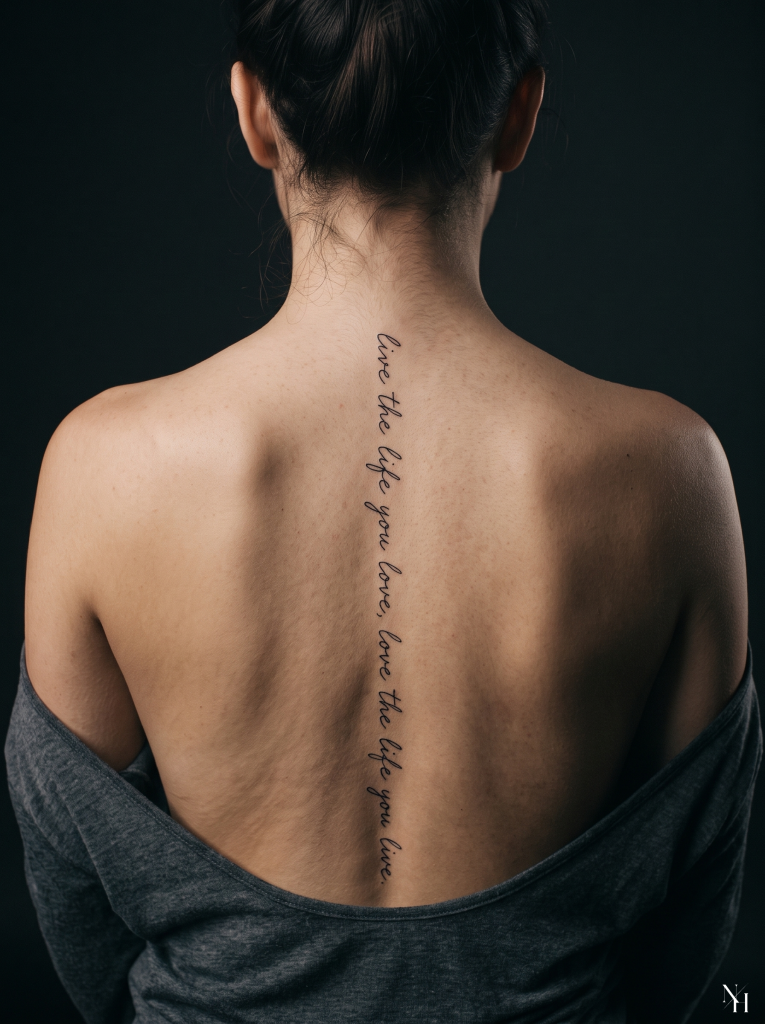
A name, date, or phrase down the spine is a classic choice. Meaning drives many of these pieces. Pew found 73% of tattooed women name honoring or remembering someone as a reason for a tattoo. Keep letters large enough to read from a few feet away. Short phrases age better than long verses.
Mandalas, bead strands, and pattern columns suit the spine’s center line. Symmetry looks striking on a straight axis. It also shows any tilt, so this style needs careful stencil work.
Snakes, moths, roses, and portraits in soft grey shading suit longer spine pieces. Realism needs size to show depth. A snake coiled along the full spine gives the shading room to work.
Bold outlines hold up well over the years. A vertical character panel, a dagger, or a horror collage can run the length of the spine. These styles are a core part of Nadine Harvey’s tattoo portfolio.
Spine tattoos rank among the more painful placements. The skin sits close to bone with little padding. Saniderm’s tattoo pain chart rates the general back around 5 out of 10 but calls the spine itself highly painful. Pain eases as a design moves off the bone line. It also depends on session length, rest, and your own tolerance.
Two things drive spine pain. One is how close the needle works to bone. The other is how long you sit.
The needle works right above the vertebrae. There is little fat or muscle there to cushion it. Skin to either side of the spine has more padding. Saniderm suggests placing designs to one side if pain is a concern.
Some clients ask about topical numbing creams. Check with your artist before using one. Some artists prefer to work on untreated skin.
A custom spine tattoo starts with your idea and ends with a stencil checked on your body. At Nadine Harvey’s private studio, the process runs in four steps: request, consultation, a hand-drawn design you review, and the session. The stencil goes on and gets checked before any ink touches skin. That check keeps the design straight on your spine.
Each step gives you a chance to adjust size, flow, and placement. By the session, your saved image has become an original drawing.
“I truly care about every tattoo my clients want.” Nadine Harvey, Tattoo Artist, in her VoyageLA interview
That care shows most in the design review. You can change size, wording, and flow before the stencil is made.
Posture changes how a stencil sits on the spine. A slouch, a raised shoulder, or a shifted hip can tilt it. Careful artists place the stencil while you stand in a natural, relaxed pose. They check it in a mirror and from several angles.
Many people have a slight natural curve in their spine. A good design adapts to it. The goal is a piece that looks straight when you stand and move.
A common request is a fine line phrase saved from Pinterest. The saved version might squeeze tiny letters into a long verse. A redraw could shorten the phrase, enlarge the letters, and add a stem of small leaves for flow. The meaning stays the same. The piece now fits one spine and holds up for years.
Heal a spine tattoo with gentle washing, light moisturizer, loose clothing, and a helper. Cleveland Clinic notes that back tattoos heal slower than small ones on the hands or arms. The surface usually heals in about two months. Deeper skin takes several more. You cannot easily reach or see your spine, so arrange help before your session.
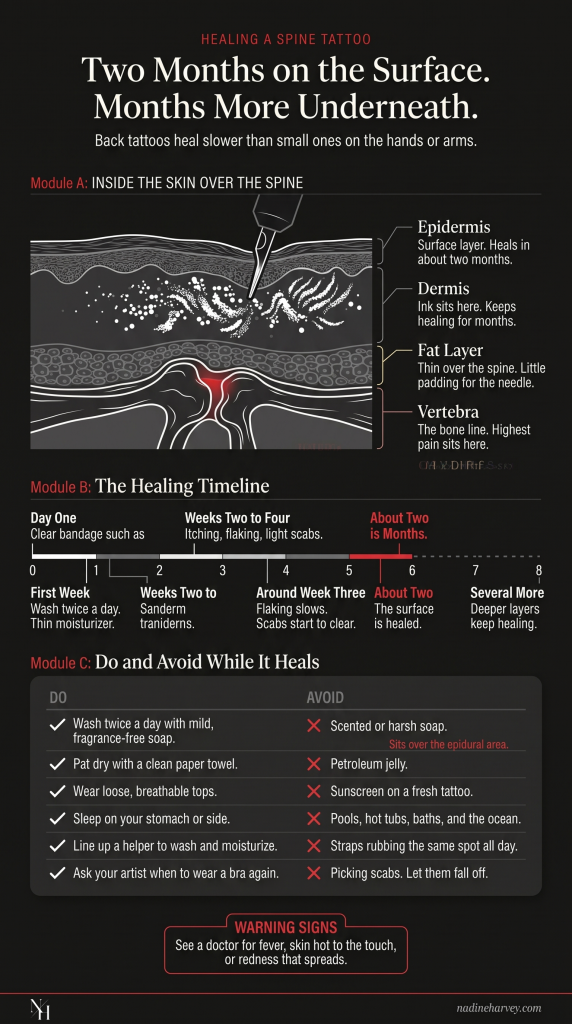
Cleveland Clinic dermatologist Shilpi Khetarpal, MD, compares a new tattoo to a piercing. Both are controlled injuries to the skin. Both need steady care to heal well.
A spine tattoo can age very well. The back gets far less sun and friction than hands or feet. How it ages depends most on design. All fine lines spread a little over time, so tiny script and tight detail blur first. Larger letters, steady line weight, and open space between elements keep a spine piece clear for decades.
Skin is living tissue, and every tattoo softens with age. Good spine design plans for that before the stencil goes on.
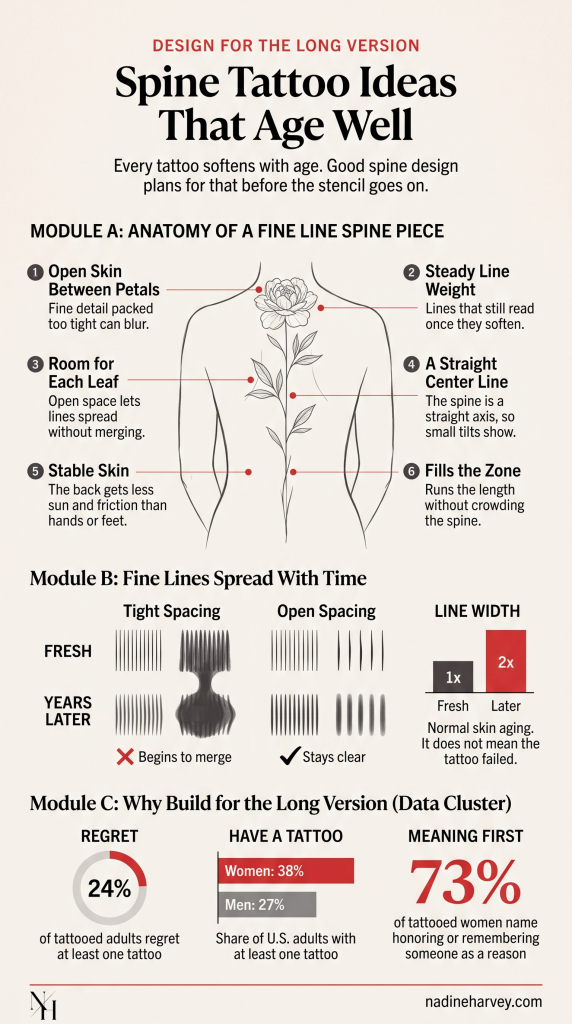
A tattoo removal studio, Ray Studios, notes that a very fine line can double in width over the years. The same studio says stable areas like the upper back hold up better than high-movement spots. That spreading is normal skin aging. It does not mean the tattoo failed.
Nadine Harvey designs for this from the first sketch. She leaves open space between petals and letters. She picks line weights that still read once they soften.
“Single-needle precision. Built to hold for decades.” Nadine Harvey, Tattoo Artist
UV light fades tattoo ink. Once you are fully healed, use a water-resistant sunscreen with SPF 30 or higher. An American Academy of Dermatology dermatologist advises applying it 15 minutes before sun exposure. Reapply every two hours. Beach days and backless dresses both count.
The same guidance says to tattoo only skin free of moles. You cannot watch moles on your own back, so keep them clear of ink. That way a dermatologist can still spot changes.
Yes, in most cases. Anesthesiologists have clear ways to work around lower back tattoos. They may choose a nearby gap between vertebrae, enter to the side of the midline, find a patch of clear skin, or make a tiny skin cut first. A review in a French anesthesia journal found no serious complications reported. Tell your care team early.
This matters if pregnancy is part of your plans. Planning ahead lets you keep both the tattoo and your birth options.
The concern is mostly theoretical. A needle passing through ink could carry tiny pigment fragments inward. A 2017 case report in the Birth and Growth Medical Journal notes that more pregnant patients now have lumbar tattoos. It describes a small skin incision that gives the needle a pigment-free path.
This section is general information, not medical advice. Your care team makes the final call.
Choose a registered artist who uses single-use supplies and can tell you about their ink. In California, the Safe Body Art Act requires tattoo artists to register with their county. Registration renews every year and requires at least two hours of bloodborne pathogen training each year. A large spine piece covers a lot of skin, so these standards matter.
In Orange County, the Health Care Agency’s Body Art Program handles artist registration. Artists must show proof of annual training to renew their registration. Registered artists display a current certificate at their workstation. You can ask to see it.
A 2024 FDA study tested 75 sealed inks from 14 makers. Of those, 26 were contaminated with bacteria. FDA microbiologist Seong-Jae Kim, PhD, warned that contaminated inks could cause infection from more than one type of bacteria.
A sterile label was no guarantee. About half the inks tested were labeled sterile, yet the label made no difference in which ones were contaminated. The FDA then issued final guidance for ink makers in October 2024 under MoCRA.
Ask your artist these questions:
A strong spine tattoo starts with the zone, then the style, then a design drawn for your body. Plan for real pain on the bone line, about two months of surface healing, and a helper for aftercare. Choose spacing and line weight that will age well. Work with a registered artist who can explain their ink and process.
Compare pain across the body in our tattoo placement guide for women. Prepare for the day with the first tattoo checklist. Learn how delicate detail holds up in our guide to fine line realism.
Nadine Harvey takes a limited number of bookings each month at her private studio in Huntington Beach. When you are ready, book a consultation with your idea and chosen zone. You can also read more about Nadine and her approach.
The line directly over the vertebrae hurts the most. There is little padding between skin and bone there. Designs placed to one side of the spine feel easier.
The surface usually heals in about two months. Deeper skin keeps healing for several more months. Back tattoos heal slower than small pieces on the arms or hands.
A bra band crosses the mid spine, so it can rub fresh work. Ask your artist about timing. Choose soft, loose styles while you heal.
All fine lines soften a little with age. Tiny letters and tight detail blur first. Larger lettering and open space between elements keep a fine line spine piece clear.
Yes. References help your artist understand the style and mood you want. A good artist uses them as a starting point and draws an original piece that fits your spine.