A tattoo starter kit gives you gear, not skill. See what beginners actually need first, from training and hygiene to safe machines, ink, and real costs.
Search “tattoo starter kit” and you get hundreds of cheap bundles. Most cost under 100 dollars. Most promise everything in one box. Very few tell you the truth.
This guide breaks down what a starter kit really includes. It explains what those kits leave out. Then it shows what you actually need to begin, in the order that matters.
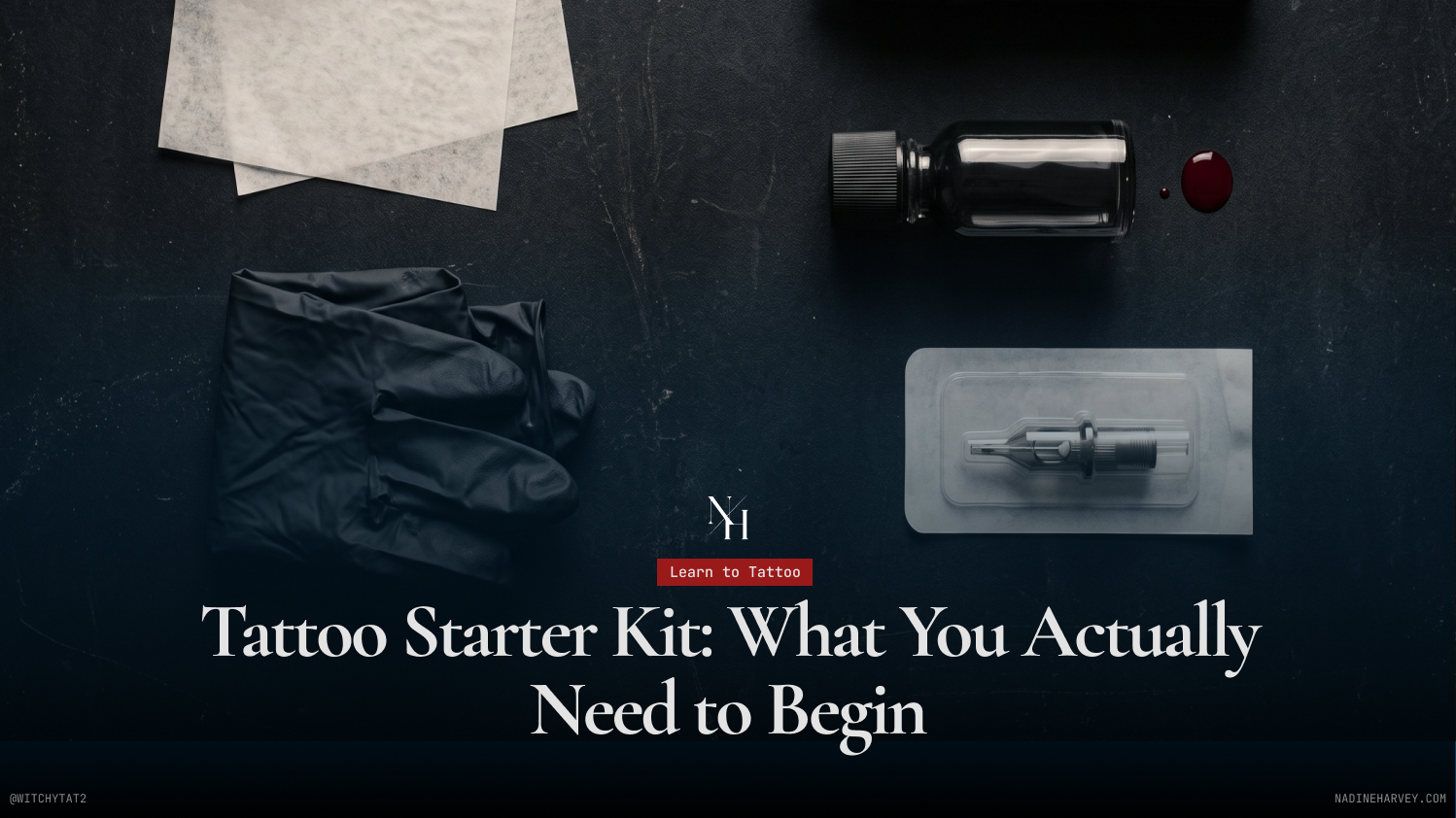
A basic tattoo starter kit includes a machine, needle cartridges, ink, a power supply, and a foot pedal. Many add practice skin, gloves, and transfer paper. The kit gives you the objects you touch. It does not give you the training, hygiene knowledge, or license you need to use them safely on a person.
Most kits look complete. That is the selling point. The problem is what sits outside the box.
Here is what a typical beginner kit contains:
The kit skips the parts that keep people safe. It has no training. It has no bloodborne pathogen course. It has no autoclave to sterilize reusable tools. It has no license.
Tattoos are now mainstream, which drives this demand. Pew Research Center found that nearly one in three American adults has a tattoo. More people want to make them, so sellers rush to fill that want.
The most important starter kit is not equipment. It is training. A tattoo needle punctures the skin hundreds of times a second. That carries real infection risk. You learn to manage that risk through an apprenticeship, a bloodborne pathogen course, and supervised practice. Gear is the last step, not the first.
I have spent eight years in the studio. The machine was never the hard part. The skill was. You can learn more about my background and how I built that over time.
“The machine took me a week to learn. Drawing well and working clean took years.” Nadine Harvey, Tattoo Artist
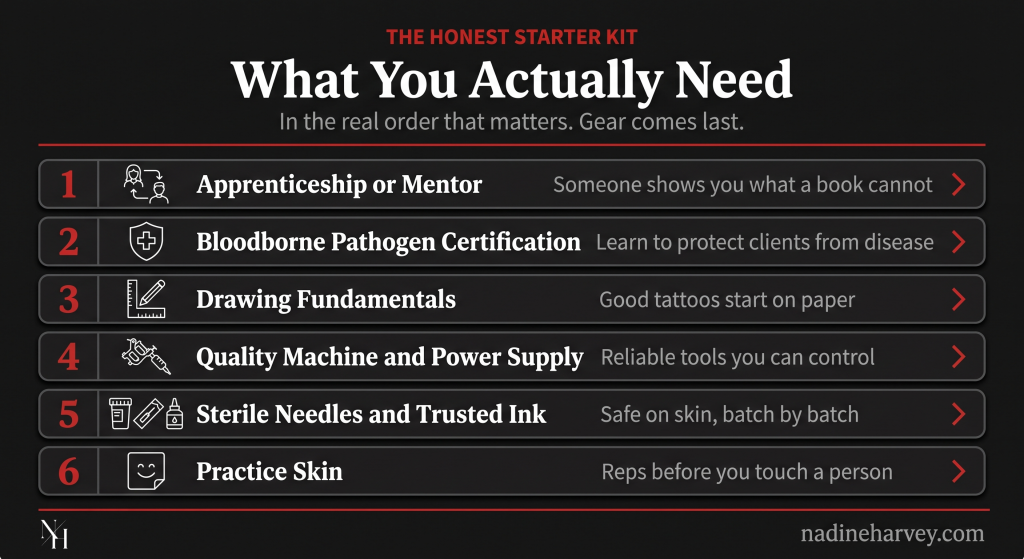
Put your money and time in this order:
| Priority | What You Need | Why It Comes First |
|---|---|---|
| 1 | An apprenticeship or mentor | Someone shows you what a book cannot |
| 2 | Bloodborne pathogen certification | You learn to protect clients from disease |
| 3 | Drawing fundamentals | Good tattoos start on paper |
| 4 | A quality machine and power supply | Reliable tools you can control |
| 5 | Sterile needles and trusted ink | Safe on skin, batch by batch |
| 6 | Practice skin | Reps before you touch a person |
The path takes time. The Alliance of Professional Tattooists has long recommended around three years of apprenticeship. Trainees often wait months before their first client.
Cheap all-in-one kits feel like a bargain. They are not. The machines are often weak. The needles can be poorly made. The ink may not be safe for skin. You outgrow the gear fast and replace it. What looked like 70 dollars turns into a much larger cost. You pay it in wasted work and client risk.
The trap is not the price. The trap is trust. A beginner cannot yet tell good tools from bad ones.
Kit ink is the biggest concern. In the U.S., there is no specific list of restricted substances for tattoo ink. Quality depends on the maker.
Labels can lie. When chemists tested inks sold as EU compliant, nine of ten failed the standard, and most had labeling errors. Europe now restricts many ink chemicals under REACH. Trusted brands like Eternal Ink, Dynamic, and World Famous exist for a reason.
“I only use trusted ink like Eternal and Dynamic, and I check every batch label before a session.” Nadine Harvey, Tattoo Artist
Most kit machines cannot be sterilized. They have no autoclave to match. That leaves cross contamination on the table.
The stakes are real. A review of 121 studies linked tattoos to higher hepatitis C and hepatitis B risk, though other factors played a part. Safe work matters because OSHA regulates tattooing under its Bloodborne Pathogens Standard. A kit teaches none of that.
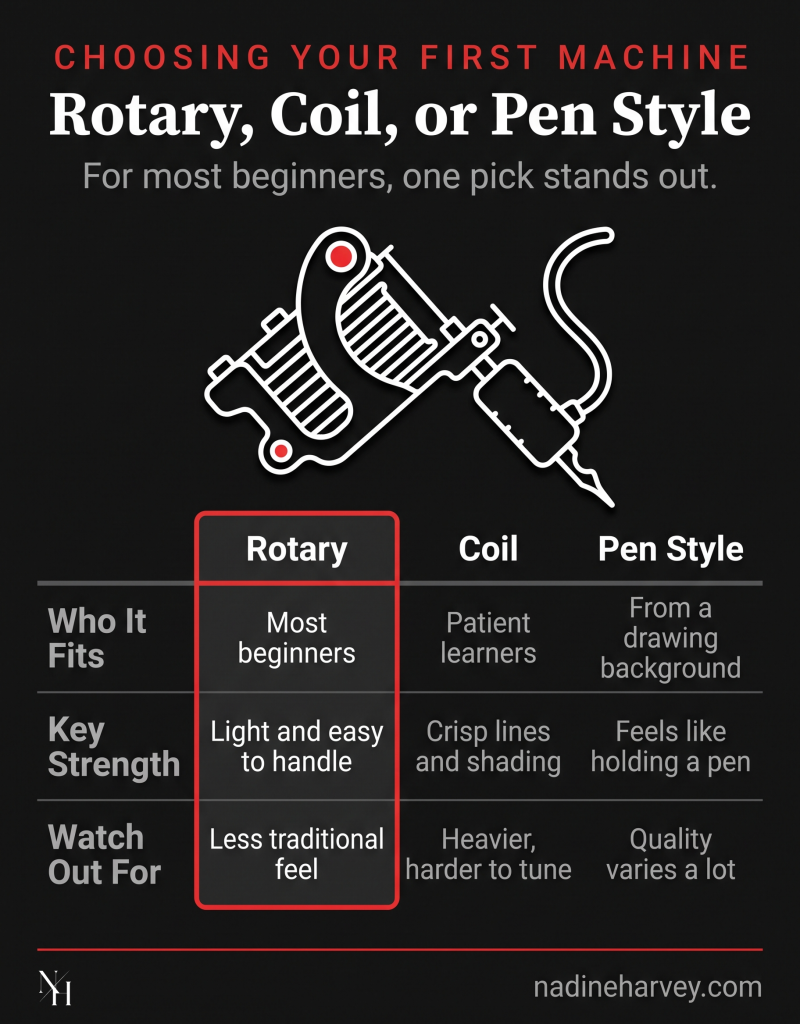
For most beginners, a pen style rotary machine is the easiest start. It is light, quiet, and simple to control. Coil machines feel traditional and give strong lines, but they take more skill. Whatever you pick, buy from a known brand. Avoid the no name machines bundled in cheap kits.
The machine is not where beginners struggle. Control is. A steady hand and a good stencil matter more than the tool.
| Machine | Who It Fits | Key Strength | Watch Out For |
|---|---|---|---|
| Rotary | Most beginners | Light and easy to handle | Less traditional feel |
| Coil | Patient learners | Crisp lines and shading | Heavier, harder to tune |
| Pen style | Artists from a drawing background | Feels like holding a pen | Quality varies a lot |
Skip knock off machines. Look for adjustable settings and clear reviews from real artists. A reliable power supply matters as much as the machine. Cheap power units give shaky output, and shaky output ruins lines.
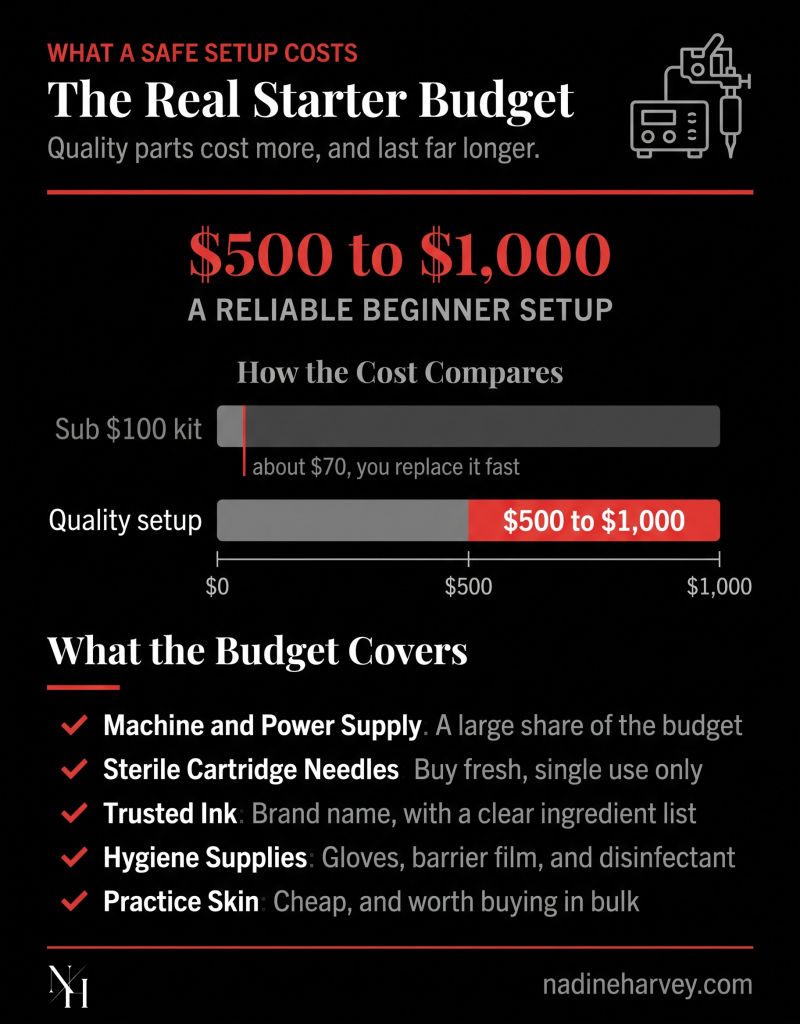
A safe beginner setup costs more than a bargain kit. Tommy’s Supplies suggests 500 to 1,000 dollars for a reliable start. That covers a quality machine, a real power supply, sterile needles, trusted ink, and hygiene supplies. A sub 100 dollar kit looks cheaper, but you replace it fast.
Think of the setup as an investment, not an expense. Good tools last years. Cheap tools last weeks.
Do not buy everything at once. Start with fewer, better items. Add as your skill grows. This is how working artists build a setup, and it saves money over time.
In many U.S. states, tattooing without a license is a criminal offense. Practicing without one carries legal and health risk. Rules vary by state and county. Before you tattoo anyone, check your local health department. A starter kit does not make home tattooing legal or safe.
This is the part sellers skip. A kit ships to your door with no license check. The law still applies.
Most areas require a license, a registered studio, and safety training. Local health departments set these rules. They exist to protect clients from harm.
Untrained work spreads disease more easily than professional work. Amateur home tattooing raises that risk sharply. When you tattoo a person, you take on their safety. That is a serious thing to do without training.
Here is the honest version. A starter kit is the easy part of tattooing. The hard part is the skill, the safety, and the years of practice behind it.
Learn to draw well. Find a mentor. Get certified. Then buy quality gear, one piece at a time.
“Each of my tattoos is original that I specially design for each of my clients.” Nadine Harvey, Tattoo Artist
If you are planning your own custom piece rather than learning to tattoo, you can see my black and grey and fine line work or book a consultation to talk it through.
You can practice on synthetic skin alone. You should not tattoo a person without training. Safe tattooing needs a mentor, a bloodborne pathogen course, and a license.
Often not. The ink may not be skin safe. The tools may not sterilize. Buy quality parts from trusted brands instead of a cheap bundle.
A pen style rotary from a known brand. It is light, quiet, and easy to control. Avoid the no name machines in cheap kits.
Plan for 500 to 1,000 dollars for a safe setup. Build it piece by piece. Quality gear lasts far longer than a bargain kit.
In many states, no. Tattooing without a license is often a crime. Always check your local health department rules first.