Fine line tattoo ideas for women, paired with the best spots, healing notes, and tips for choosing an artist. Written by tattoo artist Nadine Harvey.
I’m Nadine Harvey and I have tattooed for eight years in Southern California. I draw every design by hand. Most clients who ask about fine line want a design they love and a tattoo that stays sharp.
This guide gives you design ideas and a table that pairs each idea with a spot. You will also learn how fine line ages, how to care for it, and how to choose an artist. Fine line is not fragile when done right. It leaves less room for error, so the choices below matter.
The best fine line ideas use simple shapes with open space between lines. Single-stem flowers, birth flowers, short script, crescent moons, small animals, and dark illustration all work well. Pick one clear subject instead of many tiny details. A simpler design looks better on day one and ages better too.
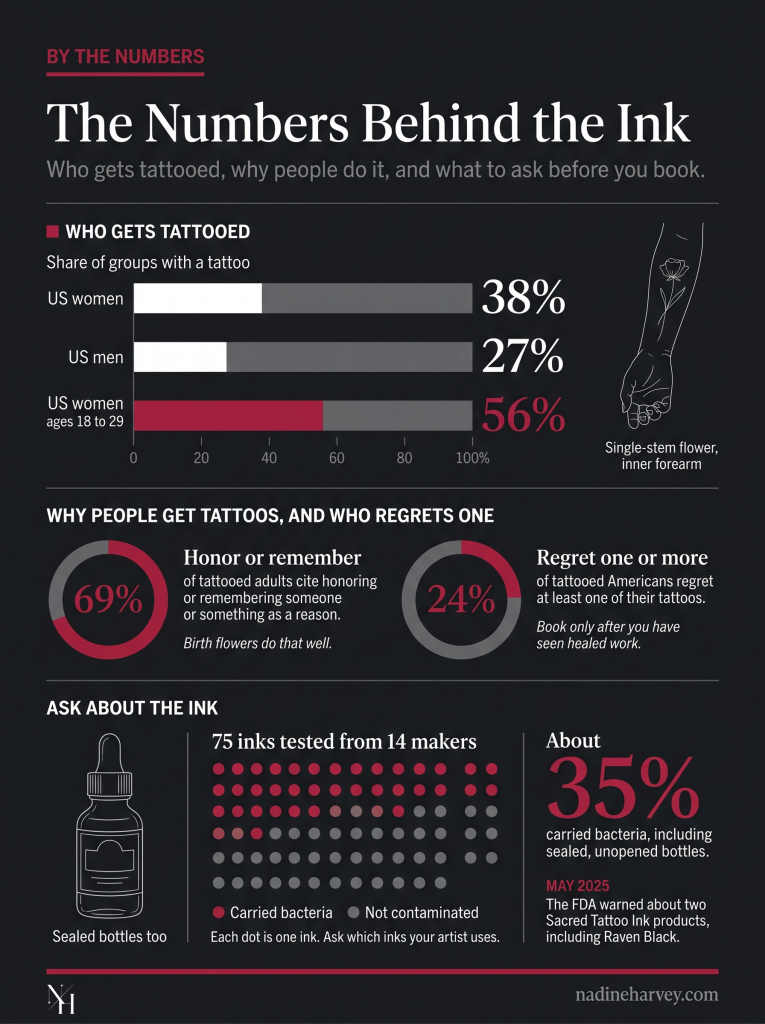
Tattoos are common among women. Pew Research Center found that 38% of US women have a tattoo, compared with 27% of men. Among women ages 18 to 29, the share is 56%.
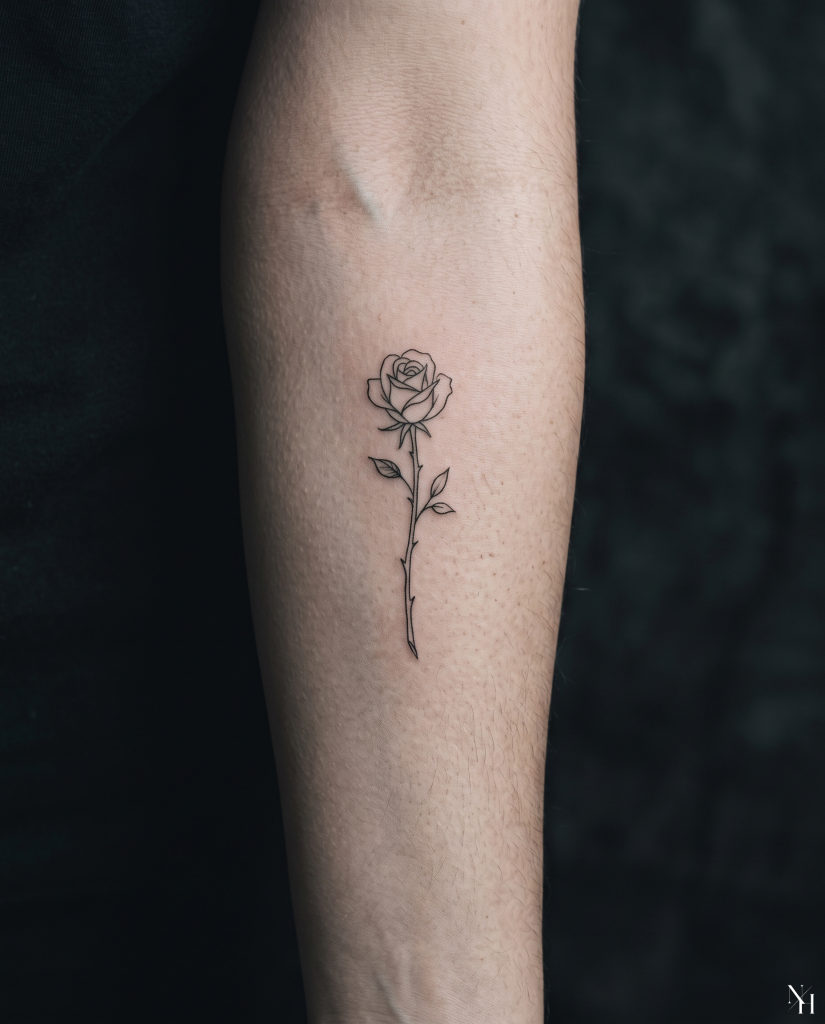
Flowers suit thin lines because petals and stems are built from curves. A single rose or daisy stem is an easy first design.
Pew also found that 69% of tattooed adults cite honoring or remembering someone or something as a reason. Birth flowers do that well. A small bouquet can hold one bloom for each person you love. Keep each bloom large enough to read.
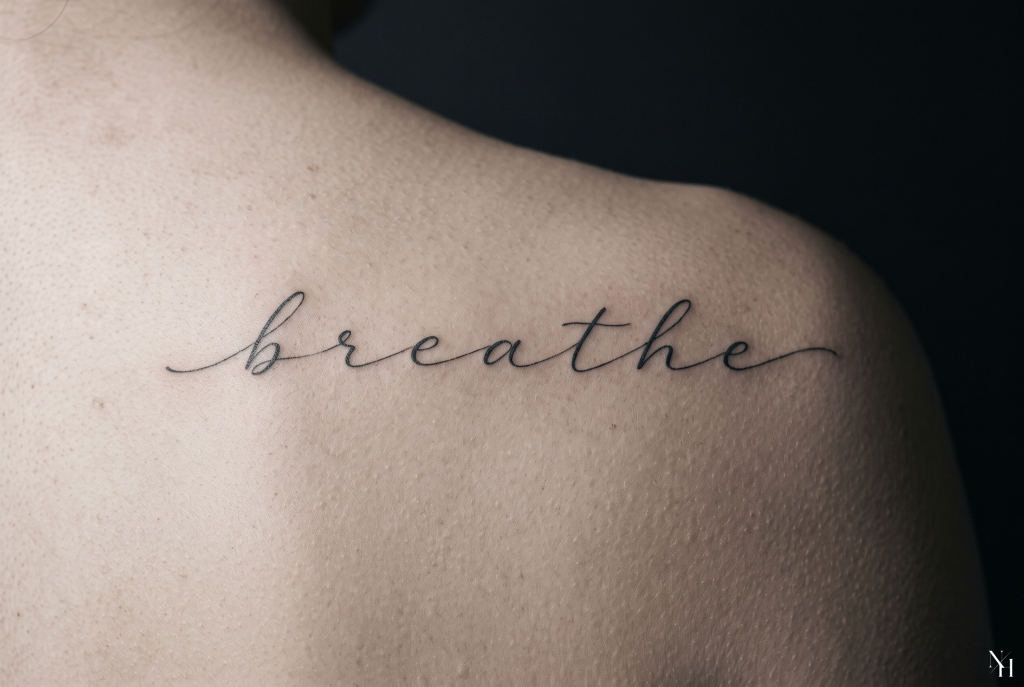
Short words, initials, and dates work well. So do tiny symbols such as a heart or a wave.
Size is the main risk. Tight letters blur first as lines soften. Leave extra space between letters. Choose a clean cursive or a light serif over a looped font.
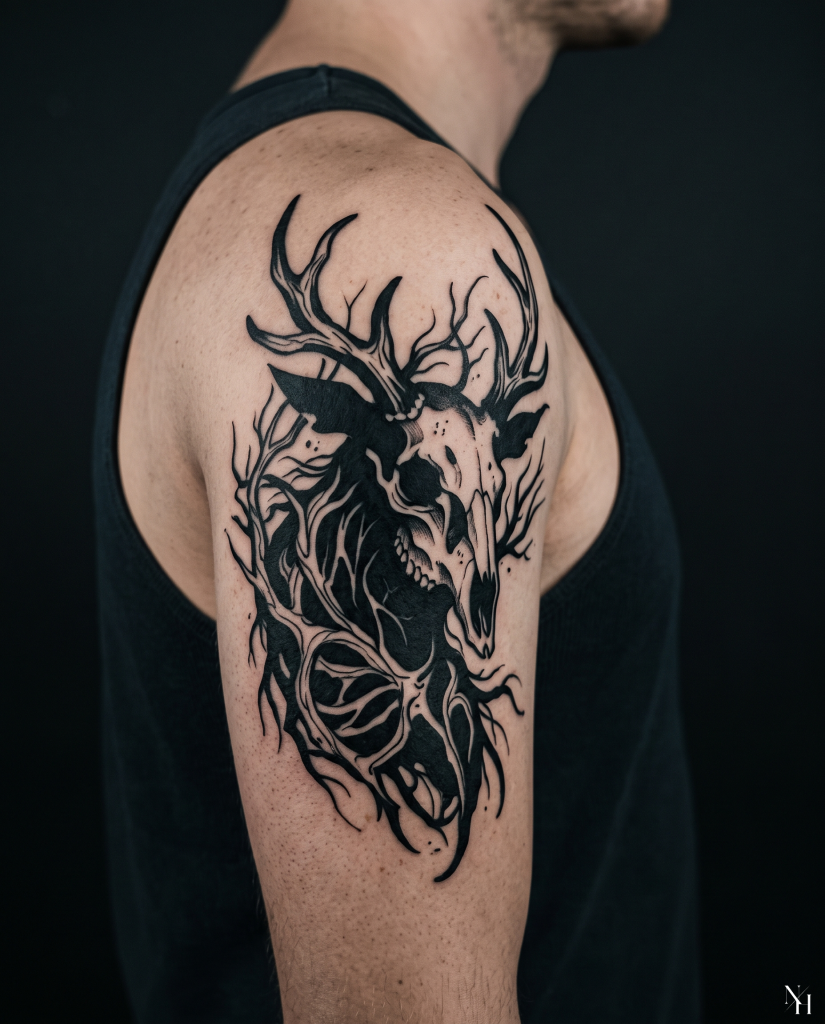
Crescent moons, stars, moths, and small animals read well in thin line. So do darker ideas. I shared my favorite styles in an interview with Voyage LA.
“My favorite styles are fine line horror, anime, and black and gray micro realism.” Nadine Harvey, Tattoo Artist
A thin-line skull wrapped in stems is one example. An anime-inspired detail is another. I keep the shapes simple and the lines spaced, just like a floral.
Fine line began in Southern California. Jack Rudy of Good Time Charlie’s Tattooland told OC Weekly that his shop brought single needle fine line black and gray into tattooing. That work started in East Los Angeles in the 1970s. I tattoo in the region where the style started.
Place fine line on flat, thick-skinned areas with low friction and little sun. The inner forearm, outer forearm, upper arm, thigh, shoulder, upper back, and calf hold detail best. Fingers, hands, feet, and ribs wear faster. Match the design to the spot, because small detail on a busy spot softens first.
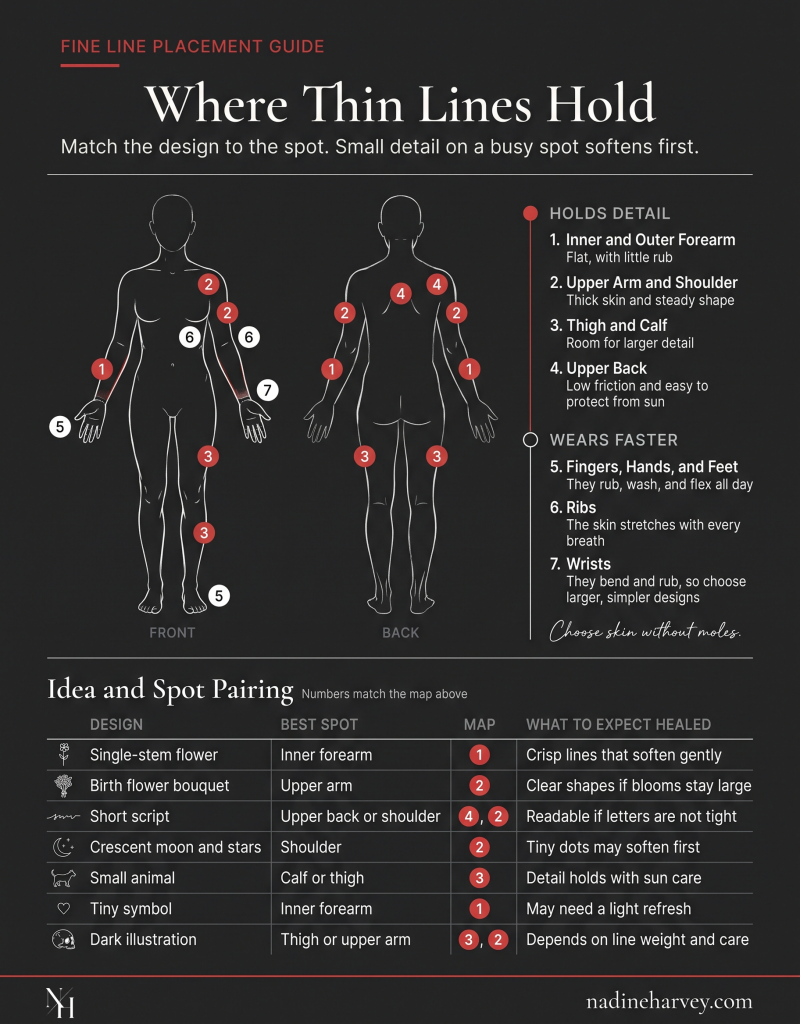
“I talk placement through with every client. A small change in spot can add years of crisp detail.” Nadine Harvey, Tattoo Artist
Pain also changes by spot. My guide to the least painful tattoo placements for women covers the options.
Choose skin without moles. The American Academy of Dermatology notes that a tattoo can hide early signs of skin cancer.
| Design | Best Spot | Why It Fits | What to Expect Healed |
|---|---|---|---|
| Single-stem flower | Inner forearm | Flat skin with little rub | Crisp lines that soften gently |
| Birth flower bouquet | Upper arm | Room to keep each bloom open | Clear shapes if blooms stay large |
| Short script | Upper back or shoulder | Low friction and space between letters | Readable if letters are not tight |
| Crescent moon and stars | Shoulder | Steady, flat curve | Tiny dots may soften first |
| Small animal | Calf or thigh | Thick skin and room for detail | Detail holds with sun care |
| Tiny symbol | Inner forearm | Simple shape reads at small size | May need a light refresh |
| Dark illustration | Thigh or upper arm | Space for layers of line | Depends on line weight and care |
Fine line tattoos soften over time. They do not have to fade away. They use less ink and sit shallower than bold work, so they change sooner. Artist skill, placement, sun, and aftercare decide how fast. Expect gentle softening over the years. A light touch-up can bring back crisp detail.
I will not promise a set number of years. No reliable source gives one, and skin, spot, and care change every result.
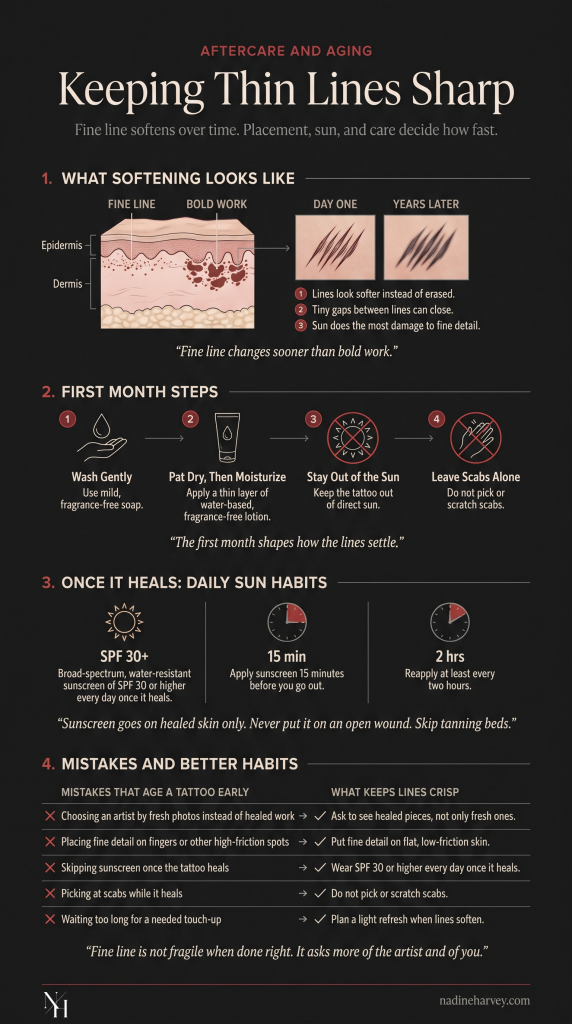
Take a client who wants one tiny word on her wrist. Tight letters on a bending spot will blur first. A slightly larger word on the inner forearm stays readable longer.
My guide to fine line realism tattooing covers how the style is made and how it ages.
Keep the tattoo clean, lightly moisturized, and out of the sun while it heals. Once it heals, wear broad-spectrum, water-resistant sunscreen of SPF 30 or higher every day. Skip tanning beds. Follow your artist’s care plan, because the first month shapes how the lines settle. Daily sun protection does the most to keep thin lines sharp.
Sunscreen goes on healed skin only. Never put it on an open wound. Apply it 15 minutes before you go out and reapply at least every two hours.
Dermatologist Bruce E. Katz called tattoos an investment in an American Academy of Dermatology release. Protect yours every day.
Plan for a touch-up down the road. Fine work may need a light refresh, and that is normal.
If your skin reacts, see a dermatologist. Reactions can appear right away or years later. This guide is not medical advice.
Judge an artist by healed work, not fresh photos. Fresh tattoos look sharp on everyone. Healed pieces show whether the lines held. Look for crisp, even lines months or years after the session. Then ask about ink sources, registration, and printed aftercare. A careful artist welcomes those questions.
“Less ink means less room for error. One shaky line shows.” Nadine Harvey, Tattoo Artist
Pew found that 24% of tattooed Americans regret at least one tattoo. Book only after you have seen healed work. My guide on how to choose a fine line tattoo artist goes deeper.
The FDA treats tattoo inks as cosmetics. State and local authorities oversee the practice of tattooing. So you need to ask about ink and permits yourself.
In 2024, FDA scientists tested 75 inks from 14 makers. About 35% carried bacteria, including sealed bottles. In May 2025, the FDA also warned about two Sacred Tattoo Ink products, including Raven Black.
Ask which inks your artist uses. A careful artist answers without hesitation.
In Orange County, the Orange County Health Care Agency requires every artist to hold a registration. Artists renew every year and complete two hours of bloodborne pathogen training. Studios need a valid permit. These rules sit under the California Safe Body Art Act.
A consultation is a short talk about your idea, spot, and size. You share references. The artist suggests changes, then draws a custom design. You review it before any ink touches skin. Bring clear references, your preferred spot, and your questions about healing and touch-ups.
My first tattoo checklist lists everything to do before you book.
I take a limited number of clients each month. If you want a custom fine line piece, start with a consultation request.
Start with the spot, then choose the design. Flat, low-friction skin keeps thin lines readable. A skilled artist, daily sunscreen, and a touch-up plan keep them crisp. Ask to see healed work before you book. Fine line is not fragile when done right. It asks more of the artist and of you.
Browse my tattoo portfolio to see black and grey, fine line, anime, and horror work. You can also read about my studio and background.
They soften sooner because they use less ink. Good placement, sun protection, and aftercare slow that down. A touch-up can restore crisp detail.
Yes, if the design and spot suit thin lines. It tends to heal with less trauma than heavy work. Choose an artist with strong healed pieces.
It depends on the spot, your skin, and sun exposure. Fine work may need a light refresh over time. Your artist can judge this once the tattoo heals.
Wait until it fully heals. Until then, keep it covered and out of direct sun. After healing, use broad-spectrum, water-resistant SPF 30 or higher.
Ask which brands they use. Ask to see their registration and the studio permit. Ask for printed aftercare instructions.