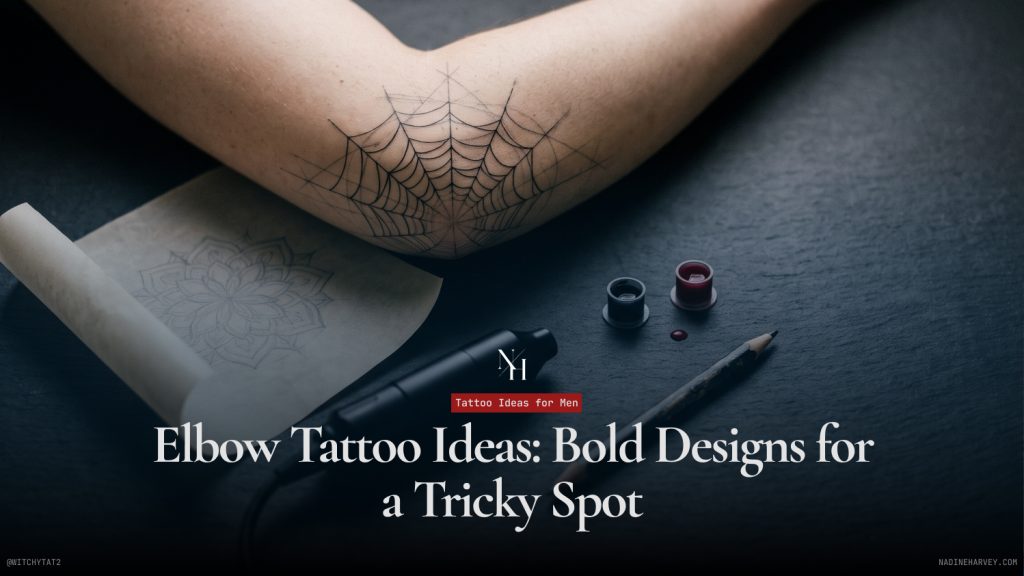
Tattoo artist Nadine Harvey shares elbow tattoo ideas built for a bending joint, plus honest pain, healing, and fading advice.
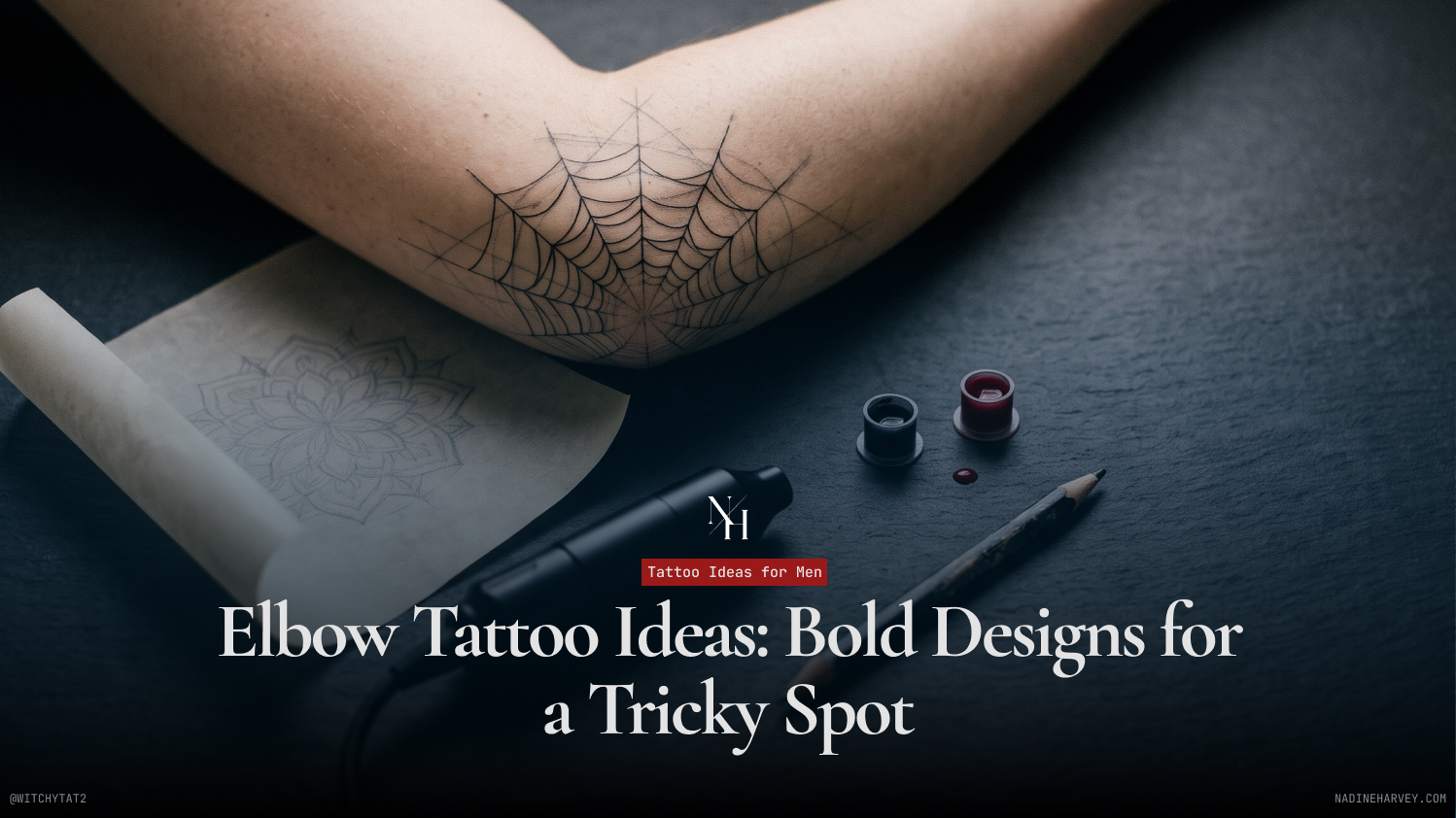
The elbow is one of the hardest spots on the arm to tattoo. It bends all day. The skin is thin. Bone sits right under it, with almost no padding.
Most elbow ideas online were drawn flat, not for a moving joint. This guide shows which designs and styles work on each part of the elbow. You will see how Nadine Harvey draws for a bending arm after eight years of tattooing. You will also learn what the pain feels like and how to heal the piece so it lasts.
An elbow tattoo can sit in the ditch, on the outer point, or around the whole joint. The ditch is the soft hollow on the inside of your arm. It suits round, centered designs. The outer elbow is a bony cap. It suits shapes that radiate out from the center or fill the point. Choose the surface first. Then choose the subject.
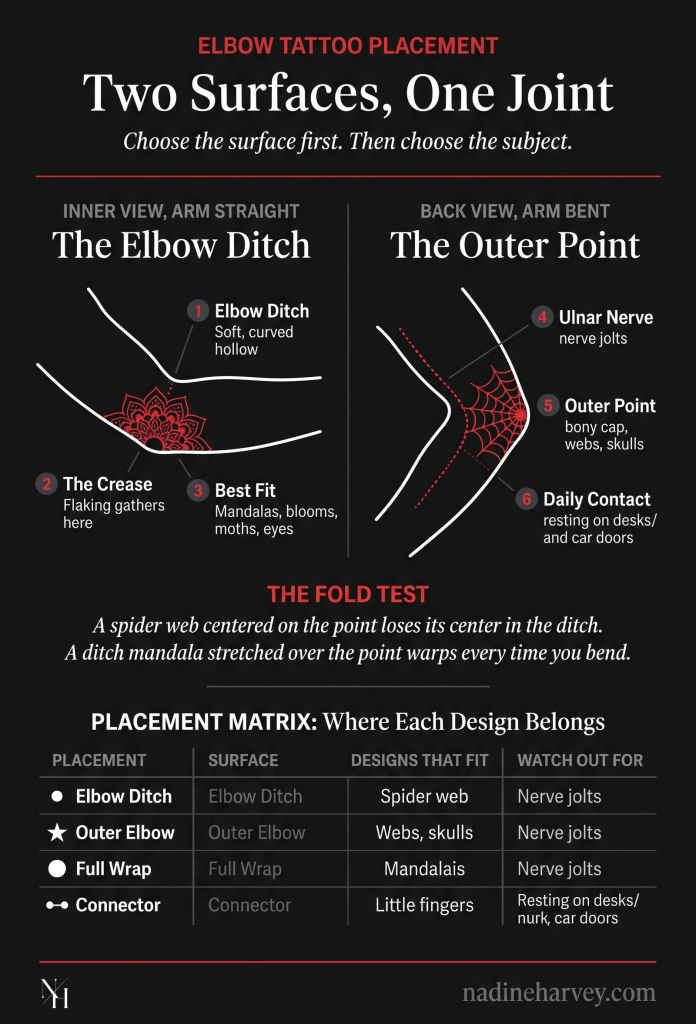
These two surfaces behave in opposite ways. A spider web centered on the outer point loses its center in the ditch. A ditch mandala stretched over the point warps every time you bend.
| Placement | Surface | Designs That Fit | Watch Out For |
|---|---|---|---|
| Elbow Ditch | Soft, curved hollow | Mandalas, large blooms, moths, eyes | Creasing and cracking while it heals |
| Outer Elbow | Bony point | Webs, suns, star bursts, skulls | Buzzing pain and daily rubbing |
| Full Wrap | The whole joint | Flames, vines, snakes | Long sessions and careful planning |
| Connector | Link inside a sleeve | Texture, foliage, background | Needs the full arm planned together |
The ditch folds shut each time you bend your arm. Round designs fold with it and open back up cleanly. A centered mandala or a large peony fills the hollow edge to edge.
The outer point shows whenever your arm bends. It also rests on desks, armrests, and car doors all day. Designs that grow out from the center use the point as their starting spot.
Many elbow tattoos belong to a larger arm. Pew Research Center found that 32 percent of U.S. adults have a tattoo, and 22 percent have more than one. Plan the elbow early. That avoids an awkward gap between your upper and lower arm pieces.
Nadine Harvey sees this pattern in her own studio. She told Voyage LA that some clients who started with one small piece now have nearly full sleeves. The elbow is where those sleeves meet.
The best elbow designs work with the joint’s shape. Circles and symmetry fill the ditch. Radiating lines and solid forms fit the outer point. Flowing subjects like flames and vines hide the stretch of movement. Skip tiny text and small repeated detail, because those blur first on a joint.
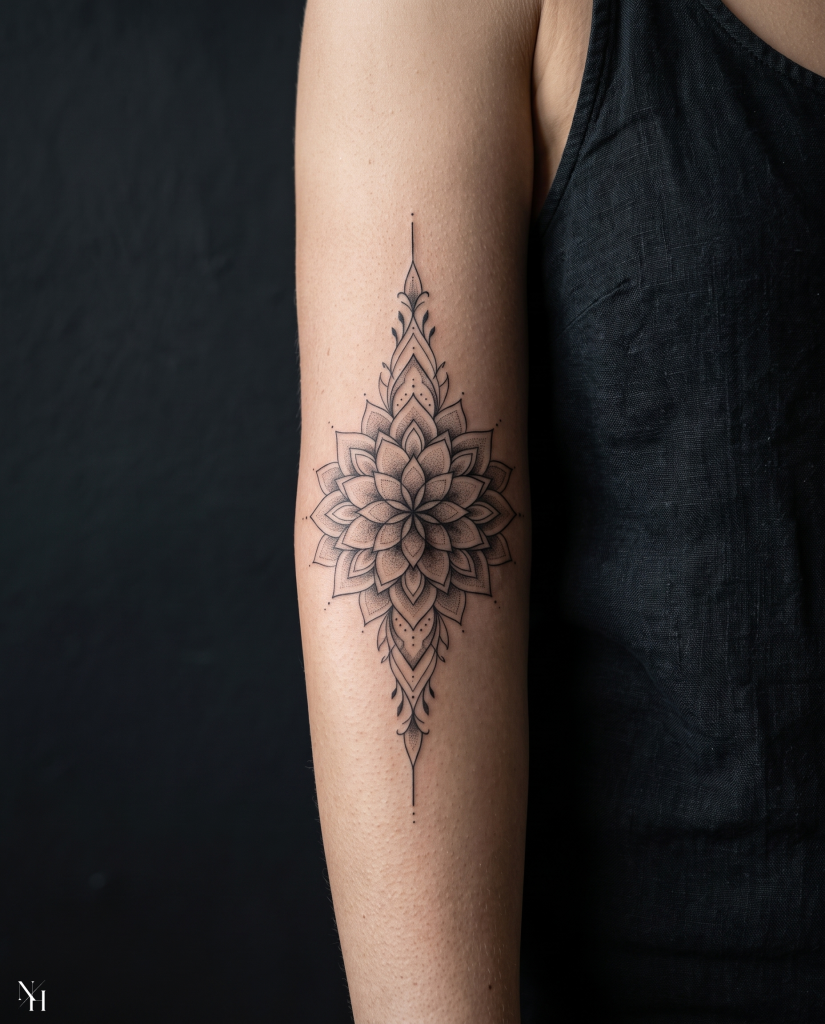
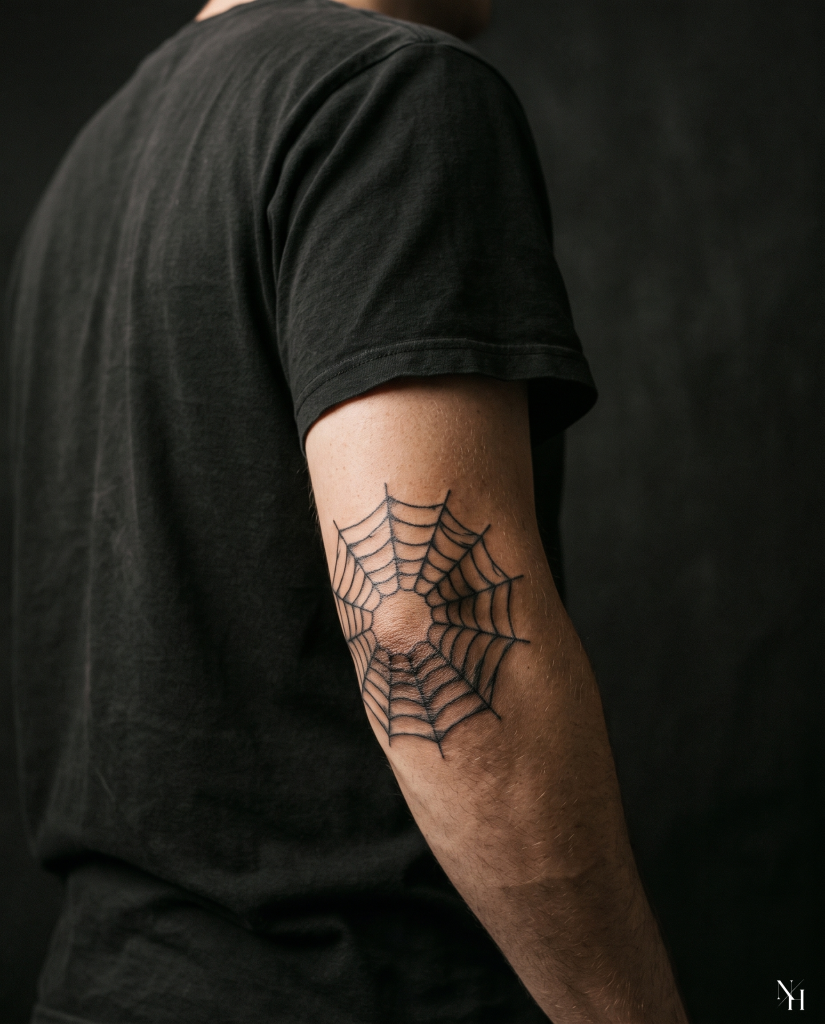
Flames, climbing vines, and snakes can curl right around the point. Nobody expects fire or a vine to stay symmetrical. That makes these subjects forgiving when the arm moves.
Fine script across the crease rarely holds up. Neither do clock faces with tiny numerals or thin geometry at the edges. If you want one of these, size it up and move it off the crease.
Bold line weight and strong contrast age best on an elbow. That does not rule out finer styles. Black and grey realism, fine line, anime, and horror can all work at the right size. The deciding factor is space. Lines need room between them so the skin can move without details merging.
The same Pew survey found 24 percent of tattooed Americans regret at least one tattoo. On a hard spot like the elbow, style choice is part of avoiding that.
Smooth grey shading over a crease takes real control. A realism eye or portrait in the ditch needs more size than you might plan. Extra size gives each tone room to settle as the skin folds.
Fine line is one of Nadine Harvey’s core styles. Her fine line realism style guide covers how fine work ages and how to choose an artist for it. On the elbow, fine line needs slightly heavier lines, wider spacing, and fewer tiny details.
“Fine line work is more delicate than bold work. It is not fragile when done right.” Nadine Harvey, Tattoo Artist
Horror fits the elbow naturally. Spider webs, skulls, eyes, and moths all match the joint’s shape. Anime work suits the ditch when the character sits inside a circular frame, such as a moon or a halo.
A good elbow tattoo is drawn for a moving arm, not flat paper. The artist sketches around the joint’s landmarks. Then the artist tests the stencil with the arm straight and bent. Lines that stretch or fold get fixed before any needle work. This step decides whether the piece still reads well years later.
Nadine Harvey draws every design by hand before the stencil stage. Each piece is original and built around one client, one idea, and one session. Her editorial modeling work also trains her eye for how an arm reads in motion and on camera.
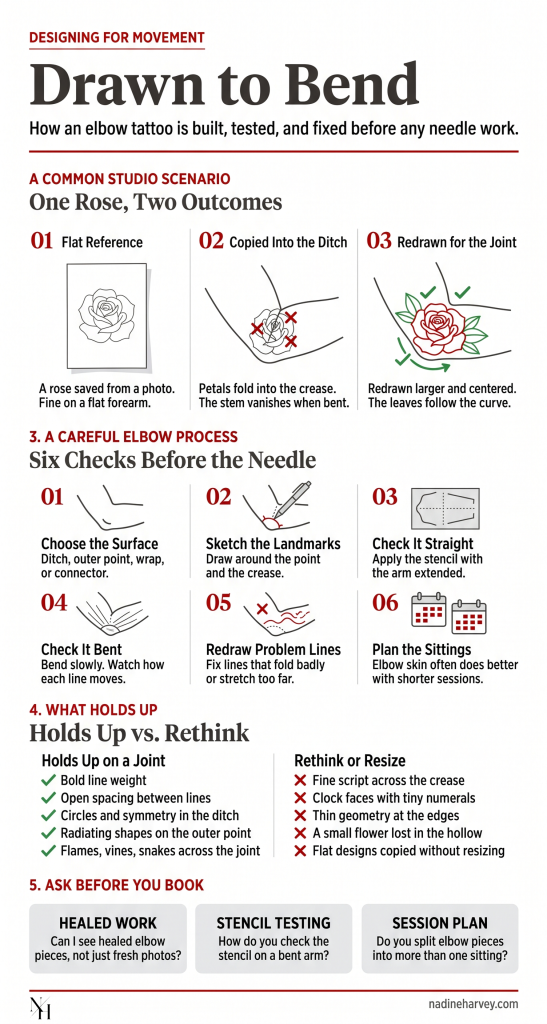
“I draw every piece by hand before any needle touches skin.” Nadine Harvey, Tattoo Artist
A client brings a photo of a rose saved online. On a flat forearm, it would look fine. In the ditch, the petals fold into the crease. The stem vanishes when the arm bends.
The fix is simple. Redraw the rose larger and center the bloom in the hollow. Then let the leaves follow the curve.
Elbow tattoos rank among the more painful placements. Healthline lists both the inner and outer elbow in its high to severe pain group. The outer point brings a buzzing vibration on bone. Work near the inner back of the elbow can send a jolt into your ring and little fingers.
There is almost no padding between skin and bone on the outer point. Healthline’s tattoo pain guide explains that nerves near bone pick up the needle’s vibration. It calls this vibrating pain.
Thin skin also leaves less room for error. A heavy hand can push ink too deep. That causes a blowout, a blurry halo around the lines.
The jolt comes from the ulnar nerve, often called the funny bone. The American Academy of Orthopaedic Surgeons explains that it passes under a bony bump called the medial epicondyle. There, it sits close to the skin.
Cleveland Clinic sports medicine physician Dr. Dominic King told Live Science that the nerve is exposed in that bony tunnel. This spot is on the inner back of the elbow. It is not in the front ditch.
Ask your artist before using any numbing product. In 2024, the FDA warned against certain numbing creams sold for tattooing. It advised skipping over-the-counter products above 4 percent lidocaine.
Healthline also lists simple steps for the day of your session:
A 2017 study cited by Healthline found tattooed people may handle pressure pain better. That is one reason the elbow rarely makes a good first tattoo.
Elbow tattoos heal slower than flat skin because the joint never stops moving. The surface often looks healed within a few weeks. Deeper skin can take up to six months. Follow your artist’s aftercare exactly. Limit hard bending early on. Protect the healed piece from sun and friction.
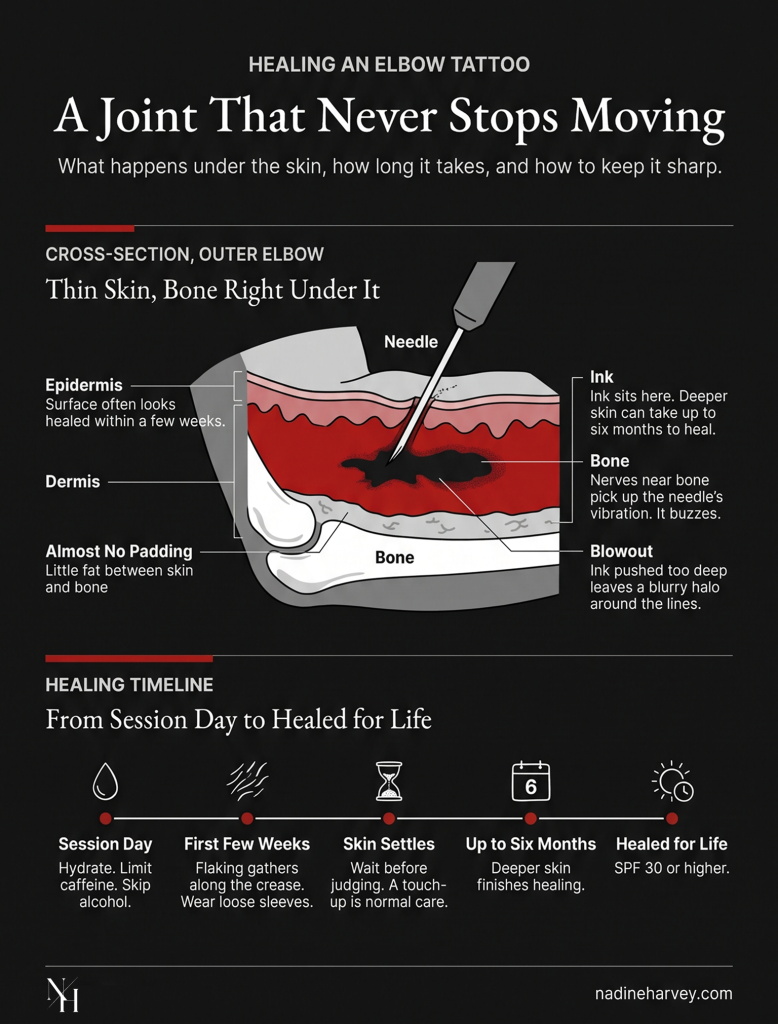
Healthline notes that deeper skin can take up to six months to heal, even when the surface looks done. On the elbow, flaking often gathers along the crease. Follow the aftercare your artist gives you over any general advice.
The outer elbow sees a lot of sun here. The American Academy of Dermatology notes that UV light can fade some tattoo inks. Once your tattoo heals, use broad-spectrum, water-resistant SPF 30 or higher. Reapply it at least every two hours.
Never put sunscreen on a fresh tattoo. Wait until your artist clears the skin as healed.
For dry skin, the AAD suggests a water-based lotion. It warns that petroleum jelly can cause ink to fade.
Joints bend and rub more than flat skin, so a few lines can soften during healing. Wait until the skin fully settles before judging. A touch-up after that is normal care for a joint.
Spreading redness, heat, pus, or fever are not normal healing signs. See a doctor if you notice any of them. This guide offers design advice, not medical advice.
The right elbow tattoo starts with the surface and fits the joint’s shape. It uses enough scale to age well. It comes from an artist who draws for movement and can show healed elbow work. Plan for pain, a slow heal, and a possible touch-up from the start.
California’s Safe Body Art Act requires every practitioner to complete bloodborne pathogens training each year. In Orange County, the Health Care Agency’s Environmental Health division enforces it.
Ask about ink, too. The FDA now oversees tattoo ink as a cosmetic. It issued final guidance on ink contamination in October 2024.
Nadine Harvey works from a private studio in Huntington Beach. She takes a limited number of pieces each month. Her About page lays out her approach: slow, intentional work built to age well.
“I’m not interested in tattoos that look loud at six months and dated at six years.” Nadine Harvey, Tattoo Artist
Browse her tattoo portfolio for black and grey, fine line, anime, and horror work. When your idea is ready, request a consultation.
Yes, for most people. Thin skin and bone close to the surface put both the inner and outer elbow in the high pain group.
Yes, with changes. Use slightly heavier lines, wider spacing, and a larger size than you would on a forearm.
They often soften sooner because the joint bends and rubs all day. Bold lines, SPF 30 or higher, and a touch-up keep them sharp.
Usually not. Start on a flatter, less painful spot. Come back to the elbow once you know how your skin heals.
The surface often heals in a few weeks. Deeper skin can take up to six months.