Wondering how much to tip a tattoo artist? The standard is 15 to 25 percent. See tip amounts by price, when to tip more, and how to pay, from artist Nadine Harvey.
You are about to pay for your tattoo. Then the real question hits. How much should you tip? Most guides bury the answer under long stories. This one does not.
Here you will learn the exact tip range, the dollar amounts by price, and when to tip more. You will also learn how to tip on big pieces, what to do on a tight budget, and why tipping still matters in 2026. The goal is simple. You should walk to the counter feeling calm and prepared.
The standard tip for a tattoo artist is 15 to 25 percent of the total price. Most people tip 20 percent for good work. You tip on the full cost, not per hour. On a 500 dollar tattoo, that means about 75 to 125 dollars, according to U.S. News. For a small piece or touch-up, 15 to 25 dollars works well.
The percentage feels familiar. It matches what you already tip at a salon. The reasons behind it are a little different.
Tattooing takes skill, time, and steady hands. Your artist also spends unpaid hours before you arrive. A fair tip reflects all of that.
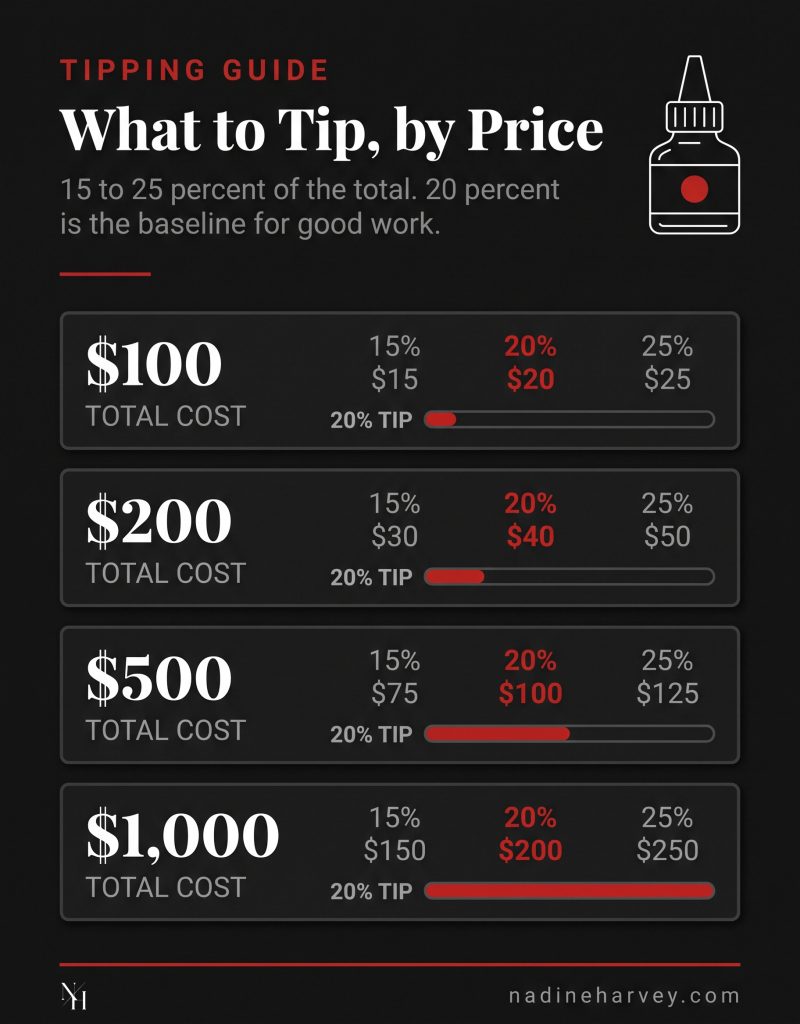
Use this table to find your number fast. These are common ranges, not strict rules.
| Tattoo Price | 15 Percent Tip | 20 Percent Tip | 25 Percent Tip |
|---|---|---|---|
| 100 dollars | 15 dollars | 20 dollars | 25 dollars |
| 200 dollars | 30 dollars | 40 dollars | 50 dollars |
| 500 dollars | 75 dollars | 100 dollars | 125 dollars |
| 1,000 dollars | 150 dollars | 200 dollars | 250 dollars |
Some pieces earn a bigger tip. Lean toward 25 percent when the work asks more of your artist.
“In a long black and grey session, I check in on your comfort the whole time. That steady care is part of what a bigger tip recognizes.” Nadine Harvey, Tattoo Artist
Your artist rarely keeps the full price you pay. Shop costs and supplies often take 40 to 50 percent of a tattoo’s cost, per Tattooing 101. Many artists rent their chair and give a large cut to the studio. The tip is one of the few parts that goes straight to them for their work.
This is why the tip carries weight. It is not padding on top of a big paycheck. It is a direct thanks for the person who inked you.
Tattoo artist Michelle Sinatra put it plainly to U.S. News. A 200 dollar tattoo might leave the artist with only 100 dollars after the shop takes its share.
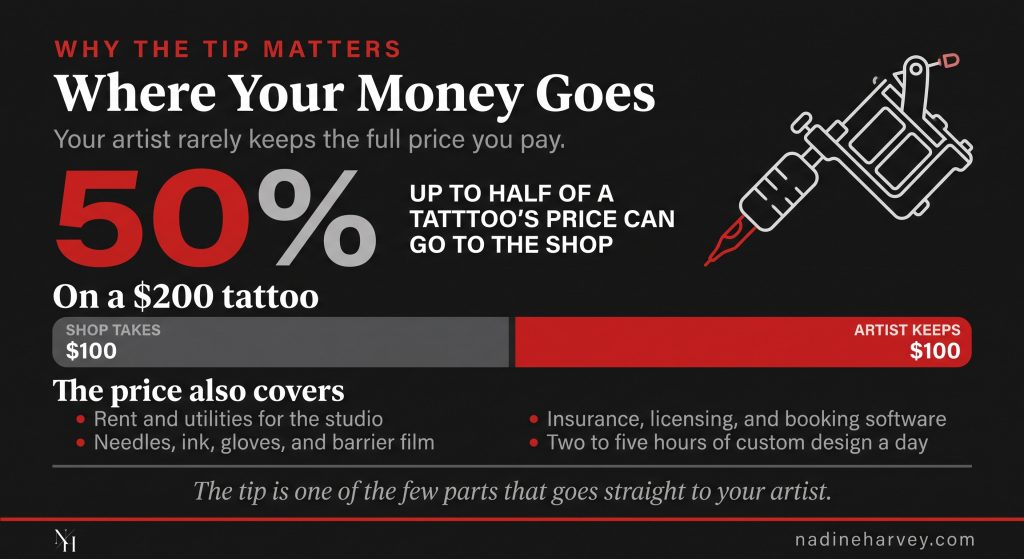
Your payment covers more than the hour in the chair. It pays for a long list of real costs.
The best custom work starts long before your appointment. Many artists spend two to five hours a day drawing designs, and that time is rarely billed on its own.
Nadine Harvey draws every piece by hand before ink touches skin. “The main thing that sets me apart is that I genuinely care about my work,” she told VoyageLA. A tip is a simple way to honor those quiet hours. You can see that hand-drawn approach across her black and grey portfolio.
For a piece that takes several sittings, tip after each session. Base the tip on that day’s cost, not the full project total. A half sleeve often runs 600 to 2,000 dollars, and a full sleeve 1,500 to 6,000 dollars or more, per Tattoo Swizard. Tipping per session keeps things fair for both of you.
Big pieces feel hard to tip because the numbers get large. A clear method removes the stress.
Some clients prefer to wait and tip when the whole piece is done. Both approaches are fine. Tattoo artist Frank Cornolo told U.S. News that multi-session clients often tip per session, while some wait until the piece is complete.
“On a full sleeve, I would rather you tip a little after each session than hold it all to the end.” Nadine Harvey, Tattoo Artist
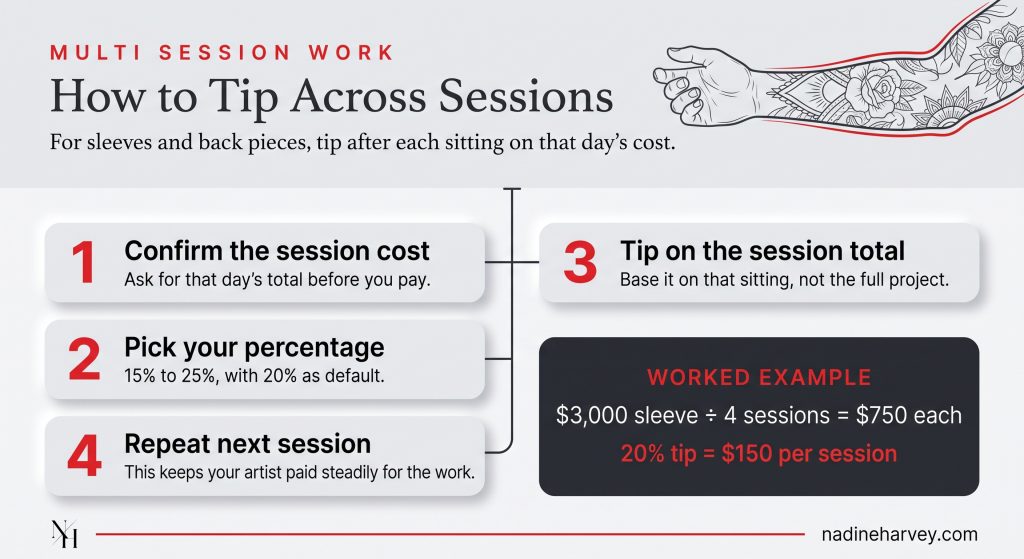
Here is a simple process for a multi-session piece.
Say your full sleeve costs 3,000 dollars across four sessions. Each session runs about 750 dollars.
A 20 percent tip is 150 dollars per session. You tip that amount each time, not one large tip at the end. This helps your artist get paid steadily for their work.
Cash is often the easiest way to tip a tattoo artist. It goes straight to them with no card fees or delays. Still, many shops now accept card tips too. The smartest move is to ask your artist or the studio what they prefer before your appointment, so you arrive with the right amount ready.
A little planning saves an awkward moment at the counter. Some smaller studios do not process tips on cards at all.
If you plan to tip in cash, get it before you arrive. Card readers and ATMs are not always nearby.
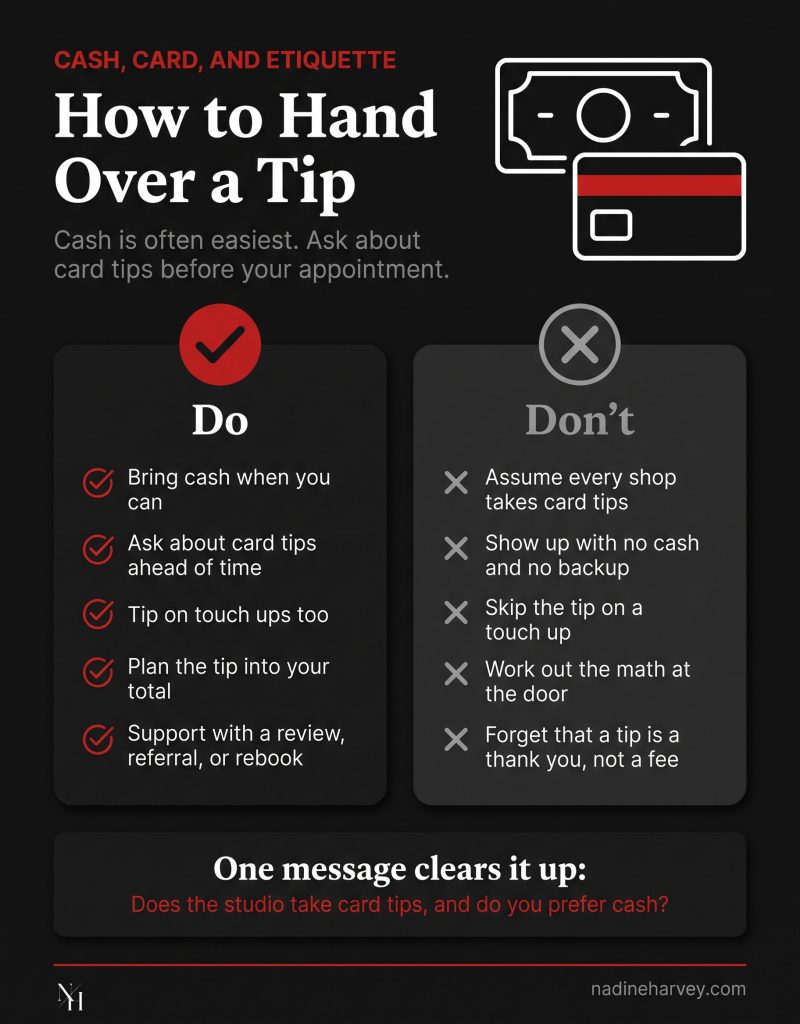
A quick message clears everything up. Try something simple.
A few small errors trip clients up. Skip these.
If money is tight, tip as close to 15 percent as you can, then support your artist in other ways. If you are unhappy, tell your artist first, since many will fix small issues. Tipping is appreciated, never demanded. As artist Michelle Sinatra told U.S. News, a tip is never expected, but it is always graciously appreciated.
Budgets are real. A smaller tip with genuine thanks beats no tip and a rushed exit.
Plan the tip into your total from the start. That way the number never surprises you at the end.
Speak up before you decide against a tip. Do it kindly and early.
Many artists will adjust or fix a fresh piece. Some offer a touch-up at no charge. Give them the chance before you hold back.
If the issue is real and the artist will not help, a lower tip is fair. Trust your read of the situation.
Cash is not the only thank you. These help your artist in real, lasting ways.
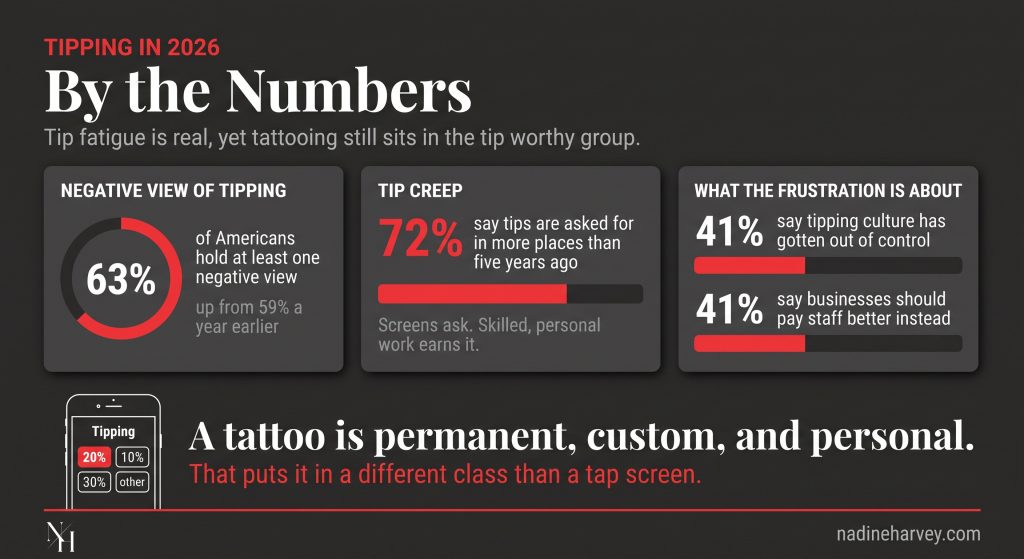
Yes. Tipping a tattoo artist is still expected in the United States, even as tip fatigue grows elsewhere. Bankrate found that 63 percent of Americans hold at least one negative view about tipping, up from 59 percent the year before. That frustration targets checkout prompts, not skilled personal services. Tattooing sits firmly in the tip-worthy group.
You are not imagining the tip prompts everywhere. About 72 percent of adults say tips are asked for in more places than five years ago, per Pew Research Center data. That pushback is fair.
There is a clear line. People are pulling back from screens that ask for a tip with no service. They still tip for skilled, hands-on, personal work.
The mood around tipping has shifted. The data from Bankrate shows steady frustration with tip creep.
Yet people who do tip are not tipping less per visit. Bankrate analyst Ted Rossman told Newsweek that tipping frequency is down, while the amounts people give have stayed flat or even risen.
A tattoo is permanent, custom, and personal. That puts it in a different class than a coffee counter tap screen.
One recent change is worth a quick note. A federal law signed in 2025 lets many tipped workers deduct up to 25,000 dollars in tip income for tax years 2025 through 2028, per When In Your State. In California, artists also earn a full state minimum wage before any tips. Your tip still lands as a real thank you on top of that.
Tipping a tattoo artist is simpler than it feels. Start at 15 to 25 percent, with 20 percent as your safe default. Push higher for custom, large, or long work. Tip per session on big pieces.
Bring cash when you can, and ask about card tips ahead of time. If your budget is tight, tip what you can and back it up with a review or a referral. Above all, remember the tip is a thank you, not a fee.
Ready for a piece drawn just for you? You can book a consultation with Nadine and plan your design and budget from the start.
Tip on the total price you pay for the piece or the session. You do not tip per hour on top of that.
Tip about 75 to 125 dollars, which is 15 to 25 percent. Most people land near 100 dollars for good work.
Yes. For small pieces or touch-ups, a 15 to 25 dollar tip is a kind and common amount.
Yes, if the owner did your tattoo. Their work deserves the same thanks as any other artist’s.
No. Many studios accept card tips. Just ask first, since some shops prefer cash and a few cannot process tips on a card.