Tattoo artist income ranges from $25,000 to over $100,000. See how pay works, what a tattoo really leaves an artist, and what raises a rate.
The question sounds simple. The answer is not. Search for a tattoo artist salary and you get numbers that do not agree. One site says $58,000. Another says $106,000. Both can be right, because tattoo income is not a fixed salary.
This guide gives you the real range and the reason behind it. You will see how artists get paid, what a tattoo price actually leaves them, and what raises a rate. The numbers come from public data, not guesswork.
Most tattoo artists earn between $30,000 and $80,000 a year. Top artists pass $100,000, and a few earn far more. Beginners often start near $25,000. There is no single salary. Income shifts with skill, location, rate, and how booked an artist stays. The averages you see online rarely match one real person.
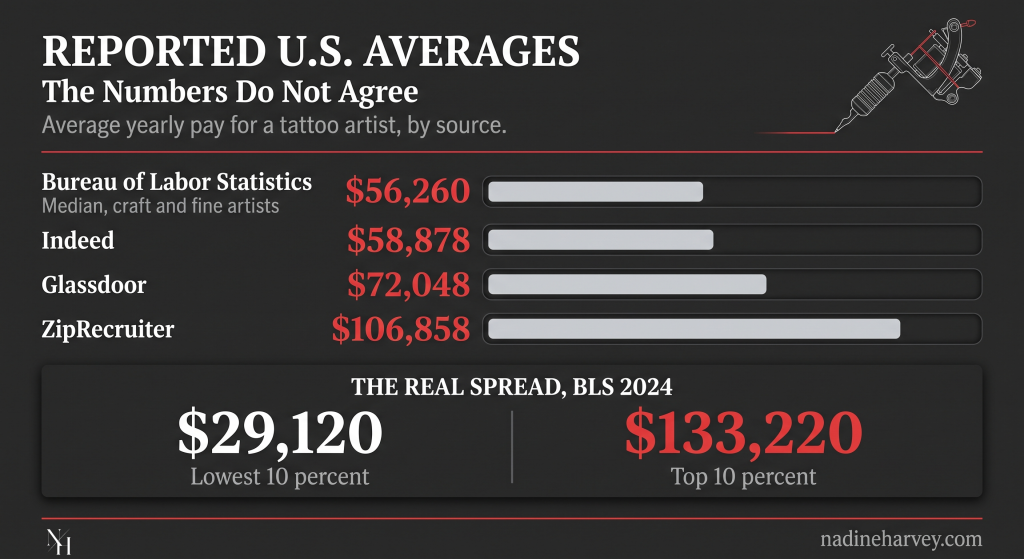
The public numbers prove the point. They disagree because they measure different things.
The U.S. Bureau of Labor Statistics puts the median wage for craft and fine artists at $56,260 in May 2024. The lowest 10 percent earned under $29,120. The top 10 percent cleared $133,220.
Job sites land all over the map. Indeed reports an average near $58,878. ZipRecruiter lists $106,858, with most artists between $43,500 and $80,000. Glassdoor sits between them at about $72,048.
Most tattoo artists work for themselves. An average blends a first-year apprentice with a booked-out veteran. That single number fits neither.
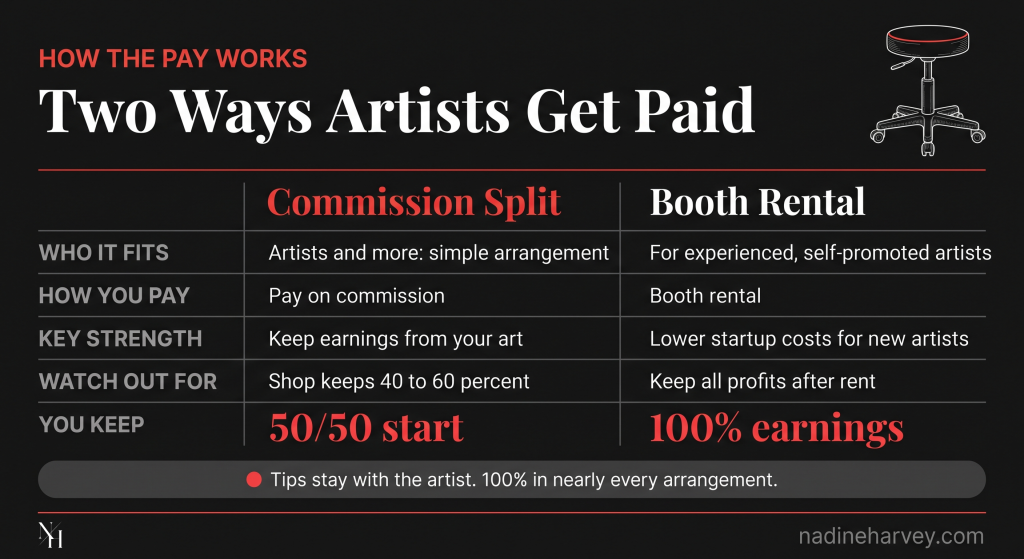
Most tattoo artists charge by the hour or by the piece, then share that money with the shop. Few earn a set salary. They work as independent contractors under one of two models. The shop either takes a percentage of each tattoo, or the artist pays flat rent for the space. Tips stay with the artist.
Understanding this is the key to the whole topic. The pay model decides how much of each tattoo the artist keeps.
Large custom work is usually priced by the hour. Small or pre-drawn flash often has a flat price. The client pays at the end of each session, so the artist is paid even if a later session is missed.
The two main models split risk in different ways. Industry data on shop splits shows most fall between 40/60 and 60/40, with 50/50 a common starting point. Booth rental fees run from a few hundred dollars up to around $500 a month.
| Pay Model | Who It Fits | Key Strength | Watch Out For |
|---|---|---|---|
| Commission Split | New or building artists | Lower risk, shop supplies and traffic | Shop keeps 40 to 60 percent |
| Booth Rental | Established, booked artists | Keep everything after rent | Rent is due even in slow weeks |
In nearly every arrangement, the artist keeps 100 percent of tips. A shop taking a cut of tips is a warning sign.
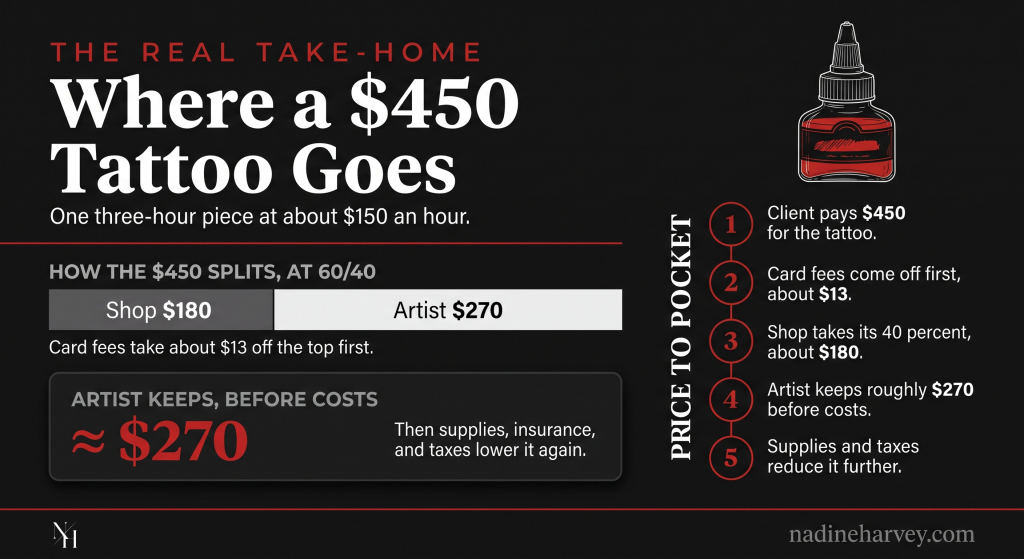
The sticker price is not take-home pay. On a $450 tattoo, an artist on a 60/40 split keeps about $270 before costs. Card fees come off first. Then supplies, insurance, and taxes come out. A strong-looking day shrinks fast once the real costs land. This gap is what most people miss.
Let us walk one tattoo from price to pocket.
One industry estimate puts the average rate near $150 an hour. Here is a three-hour piece at that rate.
Several costs come straight out of the artist’s share. New artists often forget them.
“Clients see the price. They do not see the disposables, the insurance, and the taxes that come out of it.” Nadine Harvey, Tattoo Artist
Four things move a tattoo rate most: style, specialty, location, and reputation. A skilled specialist in a big city charges far more than a generalist in a small town. Years alone do not set the price. Demand does. When an artist stays booked for months, the rate climbs because the calendar is already full.
Rate is a signal of demand, not just time in the chair.
Clients now search for the artist who does one style best. A specialist in black and grey realism or fine line work can charge more than someone who takes any design that walks in.
“I stopped taking every design that walked in. Focusing on black and grey realism is what let me raise my rate.” Nadine Harvey, Tattoo Artist
Rates track the local market. A studio in a major coastal city can charge more than one in a small town. Client income shapes what a rate can hold.
A strong reputation fills the calendar. A full calendar lets an artist raise rates without losing work. This is why press and a strong body of work raise income. They keep the schedule full, and a full schedule supports a higher price.
Tattoo income grows in clear stages. Early on, rates are low and the shop takes a large share. Mid-career artists build steady clients and raise their price. Established artists who stay booked can pass six figures. Each stage looks like a different job, which is why one average never fits.
Here is how the career-stage estimates break down.
| Career Stage | Typical Yearly Range | What Drives It |
|---|---|---|
| Apprentice Or Early | $25,000 to $40,000 | Low rates, learning, large shop cut |
| Mid-Level | $50,000 to $80,000 | Steady clients, higher rate |
| Established | $100,000 and up | Booked out, strong reputation |
The jump between stages comes from rate and demand, not extra hours. Most artists cannot add more chairs to the day.
A private, appointment-only studio earns in a different way. The artist takes fewer clients but charges more for each piece. There is no walk-in traffic and no shop split to a chain. Income comes from booked, high-value custom work. This model rewards quality and planning over volume and speed.
This is the model I work in, and the numbers reflect it.
A private studio limits bookings on purpose. Each piece gets full attention and a fair price. The goal is a small number of strong tattoos, not a high count of quick ones.
Every design I do is drawn by hand before any ink touches skin. That work sits inside the price.
“I draw every piece by hand first. I price for a tattoo that still reads clean in twenty years, not for a fast turnaround.” Nadine Harvey, Tattoo Artist
After eight years tattooing in Southern California, that standard shapes my rate. If you want work built to last, you can book a consultation to start the process.
Tattooing is rarely the only income. Many artists add revenue that does not depend on chair time. Flash sheets, prints, and merch sell to a wider audience. Guest spots reach new cities. Modeling and brand work pay artists with a strong visual identity. Many treat their art and their image as one practice.
Each stream smooths out the slow weeks that every artist has.
Tattoo income has no single answer, and now you know why. The range is wide because pay depends on rate, model, location, and demand. The most useful number is not the average. It is the take-home pay after the split and the real costs.
If you are planning your first serious piece, this helps you read a rate with clear eyes. A higher price often reflects skill, demand, and a design made only for you. To see that kind of work in one place, start with the tattoo portfolio and go from there.
They can. Established artists who stay booked often earn six figures. Beginners earn much less while they build skill and clients. The pay follows demand and rate more than hours worked.
Most start near $25,000 to $40,000 a year. Rates are low at first, and the shop takes a larger share. Income rises as skill and demand grow.
Most splits fall between 40 and 60 percent for the shop. A 50/50 split is a common starting point. Booth rental is the other model, where the artist pays flat rent and keeps their earnings.
Yes, in almost every case. Artists keep 100 percent of tips. A shop that takes part of your tips is not following the norm.
It sits near the national average. A specialist or veteran artist may charge more. For a newer artist, it can be high. Rates always shift with skill, style, and location.