Compare tattoo apprenticeship cost, time, and licensing rules against tattoo classes. A working California artist breaks down which path actually gets you hired.

Most guides on this topic sell you something. A tattoo school sells classes. A shop apprenticeship page sells structure. Neither one leads with the fact that matters first. No class and no apprenticeship gives you a license to tattoo.
This guide compares real cost, real time, and real hiring outcomes. You will learn what each path actually teaches. You will also learn how to spot a bad apprenticeship or a weak course before you pay for either one.
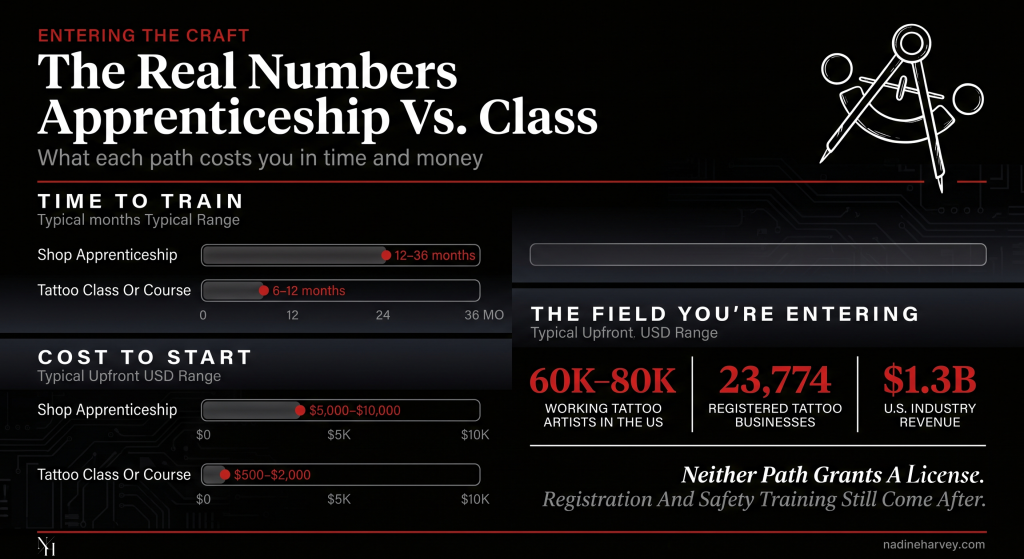
A shop apprenticeship takes one to three years. It often costs five thousand to ten thousand dollars up front. A tattoo class takes a few months to a year. It usually costs five hundred to two thousand dollars. Neither one gives you a license on its own. You still need county level registration plus bloodborne pathogens training.
Here is how the two paths stack up.
| Path | Typical Length | Typical Cost | Licensing Outcome | Mentorship |
|---|---|---|---|---|
| Shop Apprenticeship | 1 to 3 years, often 1 to 2 years when run well | $5,000 to $10,000 up front, or unpaid work for a year or more | No license alone. Still need registration and BBP training | Direct, hands on, from one working artist |
| Tattoo Class Or Course | A few months to a year | $500 to $2,000, more for well known instructors | No license alone. Still need registration and BBP training | Often remote, sometimes group based |
Cost and time only tell part of the story. A cheap class does not always mean weak training. A long apprenticeship does not always mean strong training.
What matters more is whether real feedback happens every week. Tattoo educators at Tattooing101 point out that only your local health department can issue that license, no matter which path you choose.
A shop apprenticeship usually runs one to two years when a mentor teaches you well. A tattoo class or course usually runs six to twelve months. Poorly run apprenticeships can stretch past three years. Some shops want free labor more than they want to teach you fast.
Length depends on who runs the program, not on a fixed rule. A structured tattoo school program typically runs six to twelve months, based on a set curriculum. A shop apprenticeship has no fixed timeline. Your mentor decides when you are ready.
If you train in California, know that the state sets no fixed apprenticeship hour requirement. You register at the county level under the Safe Body Art Act, according to Tattoo Studio Pro.
Some shops stretch an apprenticeship past three years on purpose. A slow teaching pace keeps you working for free longer than it should.
As Tattooing101 puts it, “A good tattoo apprenticeship will last 1-2 years.” If your mentor will not give you a rough timeline in your first month, treat that as a warning sign.
A shop apprenticeship often costs five thousand to ten thousand dollars up front. On top of that, you may work unpaid for a year or more. A tattoo class usually costs five hundred to two thousand dollars. Courses taught by well known artists often cost over one thousand dollars. Neither number includes state fees or safety training.
The upfront apprenticeship fee is real. Many shops charge five thousand to ten thousand dollars before you touch a client. You still work for little or no pay during that time.
A handful of costs apply no matter which path you pick.
BBP training follows the federal Bloodborne Pathogens Standard. This rule applies to anyone with a reasonable risk of blood exposure on the job. Budget for it every year. It is an annual cost, not a one time fee.
Insurance, a sterile setup, and your first real equipment add up fast after training ends. Factor those into your decision now, not after you commit.
A shop apprenticeship teaches you to read real skin, real clients, and real pressure in the room. A class teaches technique on synthetic skin through videos or live demonstrations. Both cover sanitation, machine setup, and design basics. Only one puts you next to a working artist every single day.
According to GetLicenseMap, “the traditional and most widely recognized path into tattooing is the apprenticeship.” That reputation comes from daily repetition, not a syllabus.
Reading a client’s nerves before a first big piece is not a skill a video can teach. Watching a mentor adjust a design mid session builds judgment fast.
In my own studio, every tattoo starts as a hand drawn design before it ever touches skin. That kind of judgment takes years to build. It rarely comes from a screen alone.
“Every piece I tattoo starts as a drawing first. That habit is the one thing I look for in any apprentice.” Nadine Harvey, Tattoo Artist
Classes are useful for building drawing fundamentals before you ever approach a shop. A stronger portfolio going in gives you a better shot at a good apprenticeship later.
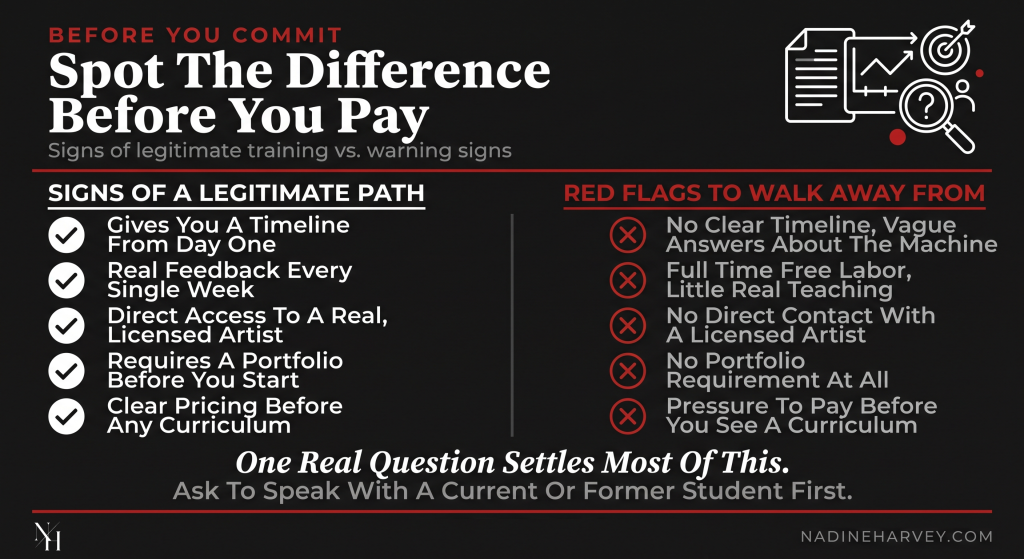
A legitimate apprenticeship gives you a rough timeline, real feedback every week, and a mentor who explains their reasoning. A legitimate course gives you direct access to a real, licensed artist. It does not rely only on pre recorded videos. If either one skips these basics, walk away before you pay anything.
The Alliance of Professional Tattooists notes that “understanding which course is right for you matters.” That choice affects your training. It also affects client safety once you start working.
Watch for these signs before you commit money or time.
Ask to speak with a current or former apprentice or student first. A legitimate mentor or school will not hesitate to connect you.
“A real mentor tells you exactly where you stand every week. If they will not do that, they are not really teaching you.” Nadine Harvey, Tattoo Artist
Shops still lean toward apprenticeship trained artists. They trust a mentor’s judgment over a certificate. A course does not close the door. It puts more weight on your portfolio. The United States has an estimated 60,000 to 80,000 working tattoo artists. A strong portfolio matters more than which path you took.
The field is crowded. The U.S. tattoo industry includes roughly 23,774 registered businesses. Together they generate close to $1.3 billion a year. That scale means real competition for a chair, whichever path you choose.
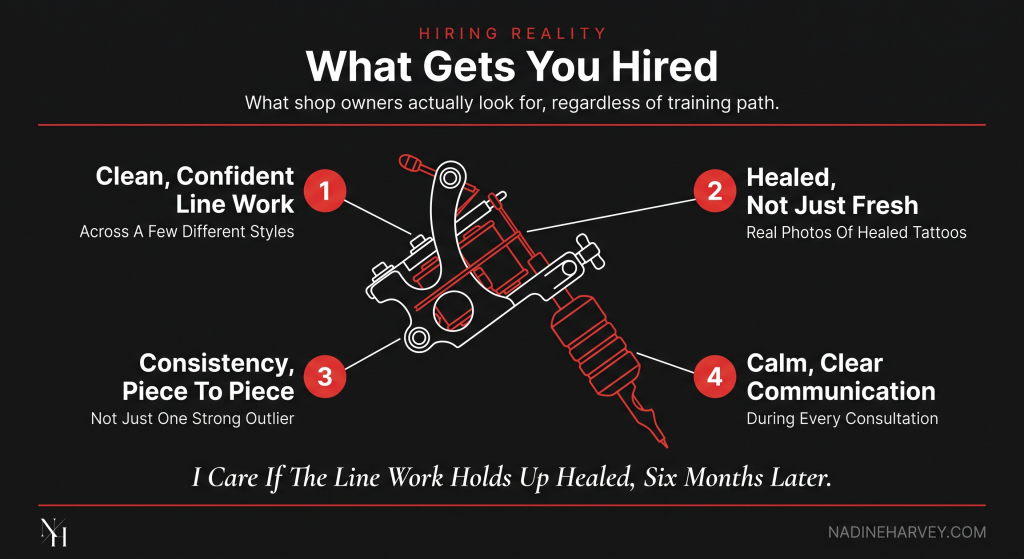
Most owners care less about your training path and more about specific proof.
“I do not care which path got someone here. I care if their line work holds up healed, six months later.” Nadine Harvey, Tattoo Artist
Practice daily on synthetic skin before you approach any shop. A small set of well drawn flash designs shows more than a long list of unfinished sketches.
Ask yourself three questions before you choose.
Some artists blend both. A short class builds drawing and machine basics first. A real apprenticeship follows, with a stronger portfolio already in hand.
Want to see what years of hands on training look like in finished work? My tattoo portfolio shows that process start to finish. You can also read more about my own path on the about page.
Yes, in most states. Licensing usually requires bloodborne pathogens training and registration, not a documented apprenticeship. States including California, Texas, and Florida set no state level apprenticeship hour requirement.
Some do, but not all. Always confirm the course includes training that meets your state’s rule. This certification is required separately everywhere.
California requires at least two hours of training, renewed every year under the Safe Body Art Act. Renewal nationally typically runs twenty five to seventy five dollars.
Yes. Many artists take a class first to build drawing and machine basics. They apply for an apprenticeship later with a stronger portfolio already built.