Learn how to become a tattoo artist step by step. Build a portfolio, land an apprenticeship, get licensed in California, and start your career.
So you want to tattoo for a living. The path can look closed off and confusing. Most guides skip the real steps, the true cost, and the legal rules.
This roadmap fixes that. You will learn how to build skill, land an apprenticeship, and get licensed. You will also see honest numbers on time, money, and pay. The advice draws on eight years of hands-on studio work.
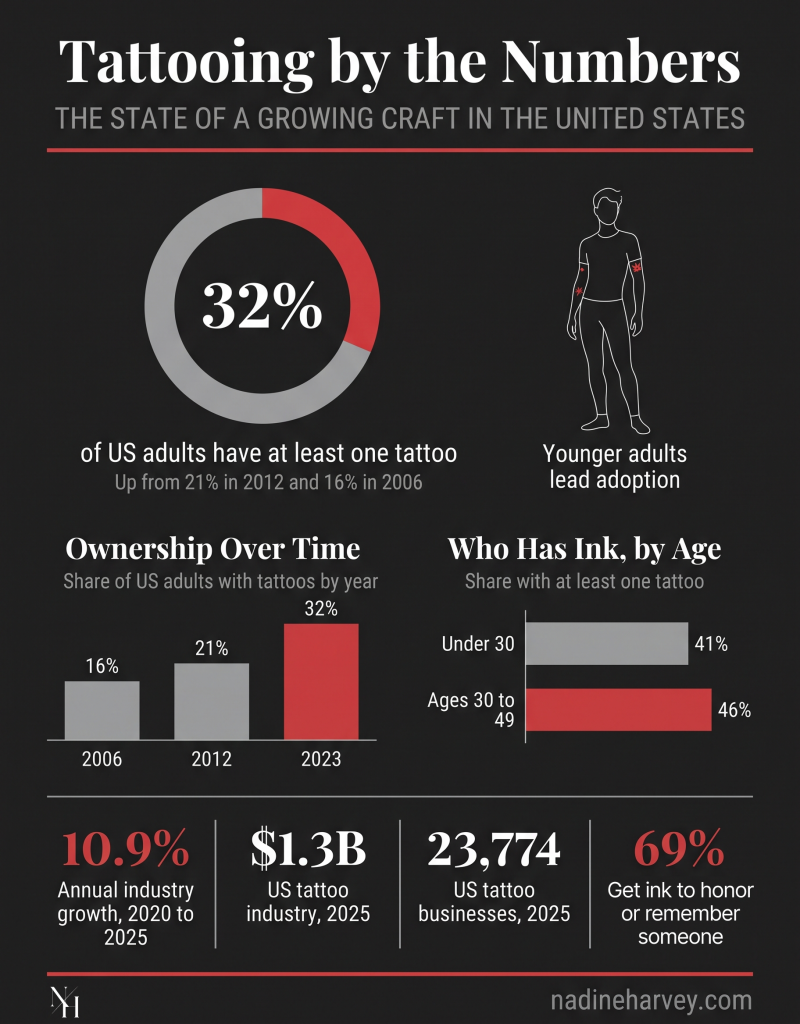
Yes. Tattooing is a real and growing career. About 32 percent of US adults now have at least one tattoo, up from 21 percent in 2012. The US tattoo industry grew about 10.9 percent per year from 2020 to 2025. Demand is strong, and clients now expect skilled, custom work.
Tattoos have moved into the mainstream. That shift creates steady work for trained artists.
The numbers back this up. Pew Research Center found that 32 percent of adults have a tattoo. Younger adults lead the way. Among people under 30, 41 percent have ink. Among those 30 to 49, the figure reaches 46 percent.
The business side is healthy too. IBISWorld reports the US tattoo artists industry hit about 1.3 billion dollars in 2025. It counts 23,774 tattoo businesses across the country. The global tattoo market sat near 2.4 billion dollars in 2025.
Clients want meaning in their tattoos. Pew found that 69 percent of tattooed adults got ink to honor or remember someone.
That matters for your work. You do more than draw. You help people mark something that matters to them.
Strong demand does not mean easy money. More artists compete for the same clients. Skill and trust set you apart. A clear style and clean work will carry your career.
You need solid drawing skills first. You cannot tattoo better than you can draw. Good artists understand line, shape, contrast, and how a design sits on the body. You also need patience, focus, and a steady hand. Art skill comes before any machine. Build it on paper before you build it on skin.
Drawing is the foundation. Everything else sits on top of it.
Start with the basics of art and design. Indeed’s career guide lists core elements like line, shape, value, and contrast. Learn these on paper first.
Body flow matters too. A tattoo is not a flat drawing. It has to follow muscle and movement. A design made for a shoulder should curve with the shoulder.
Custom drawing is how you find your voice. Over time, you learn what you love to draw. That becomes your style.
“I draw every design by hand before I pick up a machine. That first sketch is where the tattoo is really made.” Nadine Harvey, Tattoo Artist
You can see how that plays out across my work and background.
Your portfolio is the one thing that lands an apprenticeship. It should hold 10 to 15 of your best finished drawings, not sketches. Show clean line work, strong shading, and range. Include designs people would actually wear. A small set of excellent pieces beats a large pile of average ones.
Shop owners judge you on your book. It shows both your skill and your discipline.
Quality beats volume every time. Ten strong drawings say more than a hundred rushed ones. Each piece should look finished and intentional.
Want to see how range looks in practice? Browse the tattoo portfolio for examples across black and grey, fine line, and illustration.
An apprenticeship is supervised training under a working artist. It usually runs one to three years. It is often unpaid, and the hours are long. You start by cleaning, setting up stations, and watching. Over time, you earn the right to tattoo. This is still the most common way into the trade.
The apprenticeship is the standard entry point. It teaches skill, safety, and studio life.
Expect to earn trust slowly. Early on, you clean and observe. You learn hygiene, setup, and how the shop runs. Indeed’s guide notes this stage commonly lasts one to three years.
Not every apprenticeship is fair. Some shops take advantage of free labor. Look for a licensed studio and a mentor who teaches. Avoid any deal that stays vague about what you will learn.
You can start learning at home, but self-teaching has real limits. Online courses now teach drawing and machine basics. They cannot replace hands-on feedback or proper hygiene training. Most trusted shops still prefer an apprenticeship. The safest path blends both. Build skills early, then train under a working artist.
This is a real debate in the industry. Both sides have a point.
Self-teaching builds early skill. You can practice drawing and study for free. But tattooing involves blood and skin. Safety is not something to guess at.
Here is how the two paths compare.
| Path | Who It Fits | Key Strength | Watch Out For |
|---|---|---|---|
| Apprenticeship | Most serious beginners | Hands-on mentor and real safety training | Often unpaid, long hours |
| Self-taught | Early skill building | Flexible and low cost to start | No feedback, weak on hygiene |
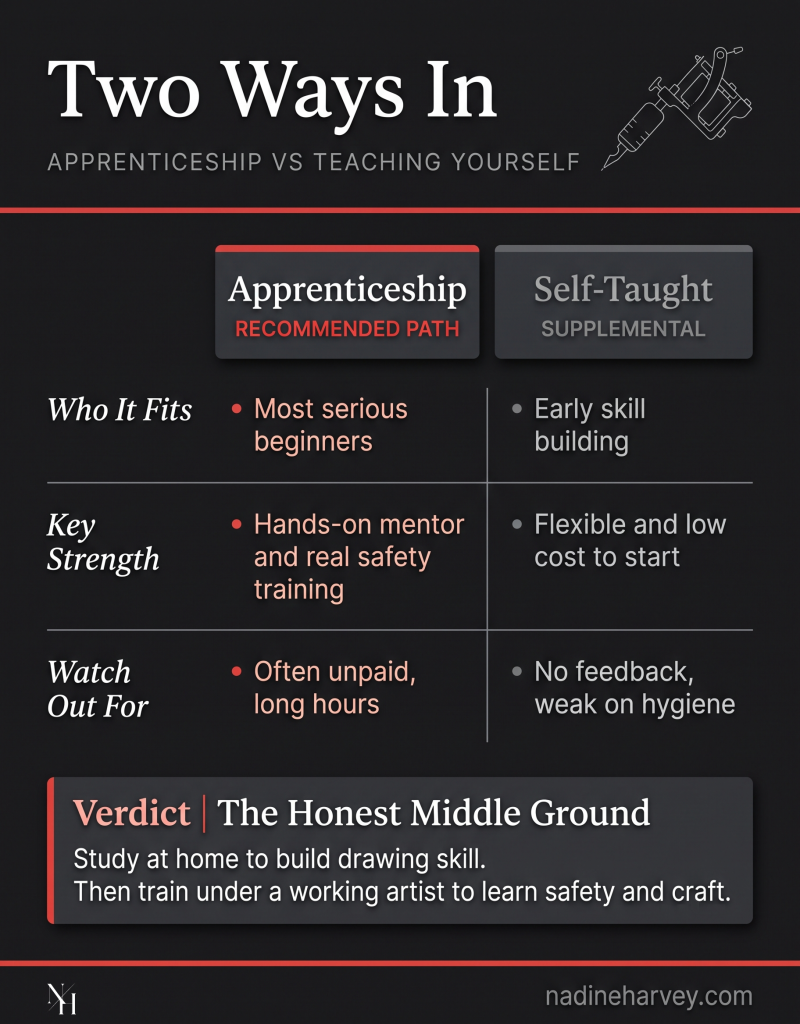
Study at home to build drawing skill. Then seek an apprenticeship to learn the rest. This mix respects both speed and safety.
In California, you must register as a body art practitioner with your county. This comes from the Safe Body Art Act, effective July 1, 2012. You register every year. You also need annual bloodborne pathogens training of at least two hours. Studio owners need a separate health permit to operate.
California takes tattoo safety seriously. The rules protect both you and your clients.
The Safe Body Art Act sets the statewide standard. Every artist must register with their local county agency. In Huntington Beach, that means Orange County.
Training is a yearly task. You must complete bloodborne pathogens training of at least two hours. You renew it each year.
Rules vary by state and even by county. Always check your local health department. What applies in California may not apply elsewhere.
Ink and hygiene safety protect your clients from infection. Tattooing breaks the skin, so clean practice is not optional. The FDA now regulates tattoo ink as a cosmetic. In October 2024, it issued guidance to reduce ink contamination. Safe supply choices and single-use needles are part of the job.
Clean practice protects clients from harm. They trust you with their skin.
The stakes are real. The FDA found contamination even in sealed ink bottles. Firms ran 18 voluntary ink recalls between 2003 and 2024.
Clean work is how you keep clients and a good name.
“In a private studio, I open a fresh set of single-use needles for every client. You never reuse, and you never guess.” Nadine Harvey, Tattoo Artist
That control keeps each session safe and calm.
Plan for one to three years of training before you work solo. Costs vary a lot. An apprenticeship is often unpaid, and you may buy your own supplies. Machines, needles, ink, and practice skin add up. Budget for safety training and county fees too. Treat this as an investment in a long career.
There is no fixed price tag. Your path shapes your cost.
Time is the biggest cost. Most artists train one to three years. During that time, pay is low or nothing at all.
Many apprentices keep a part-time job during training. Pace yourself so you do not burn out. Focus on skill first. The money follows the work.
Tattoo artist pay varies widely. The average US salary sits near 55,000 dollars per year. Many artists earn between 45,000 and 79,000 dollars. New artists often earn far less at first. Top artists with strong names earn much more. Skill, reputation, location, and booking demand all drive your income.
Income in this field is not fixed. It reflects your skill and your name.
Reported averages differ by source. Salary.com lists about 55,107 dollars per year. Other sources like ERI SalaryExpert report lower figures near 37,000 dollars. The range is wide because artists set their own rates.
Good work is built for the long version. Early years pay little. But a trusted artist with a full book earns a real living.
“I build every piece to look right in ten years, not ten minutes. That standard is what keeps clients coming back.” Nadine Harvey, Tattoo Artist
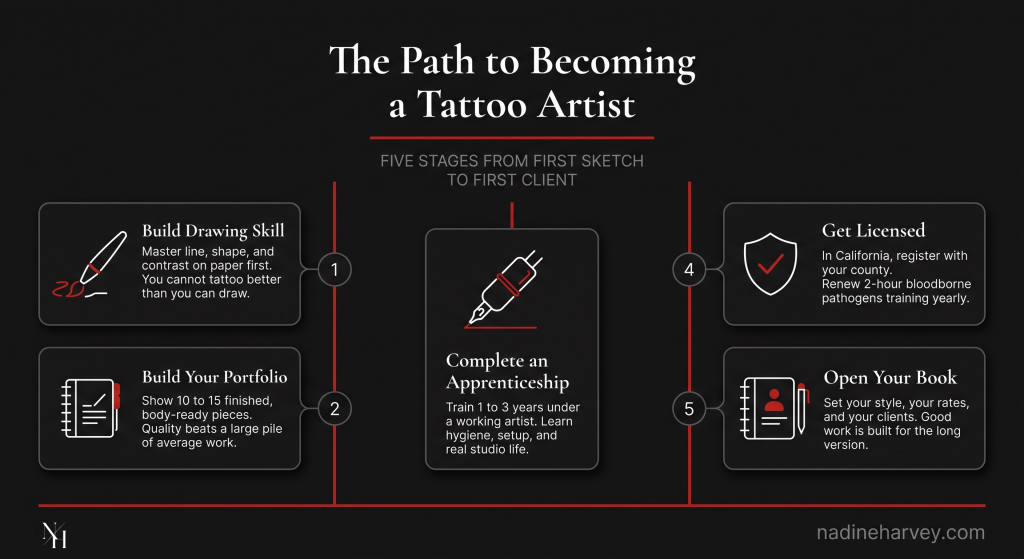
Becoming a tattoo artist is a long, honest climb. You start with drawing. You build a portfolio. You train under a working artist. Then you get licensed and open your own book.
The demand is real, and the work rewards patience. Focus on skill and safety before income. Draw every day. Study the artists you admire. Keep your work clean.
Curious about custom work or the studio path? Look through the tattoo styles I work in, or reach out through the booking page to start a conversation.
No. You do not need a college degree. You need drawing skill, a portfolio, and training. Most artists learn through an apprenticeship, not a classroom.
Most artists train one to three years. The exact time depends on your skill, your mentor, and your effort. There is no fixed timeline.
Yes, for skilled and committed artists. About 32 percent of US adults have tattoos, and demand keeps growing. Competition is real, so quality matters.
You can learn some skills alone. But most shops and clients trust trained artists. An apprenticeship also teaches the hygiene that keeps clients safe.
You must register with your county each year. You also need annual bloodborne pathogens training of at least two hours. Studios need a health permit.