A working tattoo artist explains how to choose your first machine. What to buy, what to skip, and why training matters more than gear.
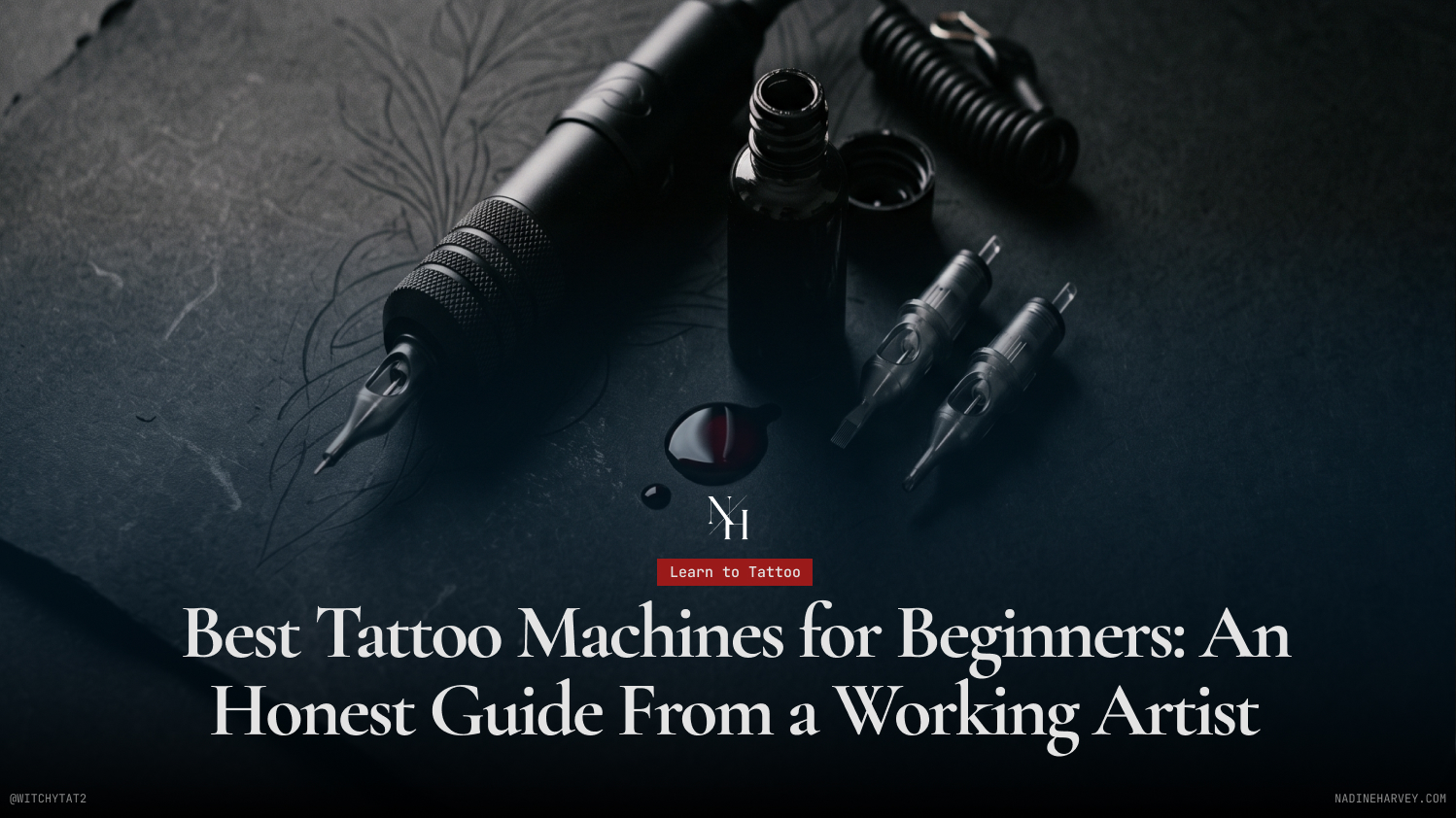
Choosing your first tattoo machine feels huge. There are hundreds of options, endless opinions, and a lot of noise built to sell you something. Most guides online are affiliate lists or shops promoting their own gear.
This guide is different. I have spent eight years behind the machine and completed thousands of pieces. I have no machine to sell you. I will tell you what to buy, what to skip, and what actually matters first.
The best beginner machine is a simple, reliable rotary or pen-style machine with adjustable voltage and standard cartridge fit. It should run the same way every pass. Skip anything built around raw power or a big brand name. A steady machine lets you read your own mistakes instead of blaming the tool.
I know that answer feels boring. New artists want the machine that pros use. But a hard-hitting machine in an untrained hand only adds problems.
Your hand speed is still shaky. Your skin stretch is developing. Your angle drifts. A hard machine hides those errors instead of showing them.
“When a line comes out shaky, I want to know it was my hand, not the machine. That is why I tell every apprentice to start on a steady rotary.” Nadine Harvey, Tattoo Artist
Tattooing is a booming field, and that pulls in a flood of gear. The US tattoo industry is worth about $1.3 billion and includes more than 23,000 businesses. The global tattoo market sits above $2.3 billion.
That growth means brands push machines hard. It does not mean the machine makes the artist. Demand is real too, since Gen Z and Millennials make up more than 59 percent of clients.
Here is the short framework I use when someone asks what to buy.
If a machine checks those four boxes, price and brand matter far less.
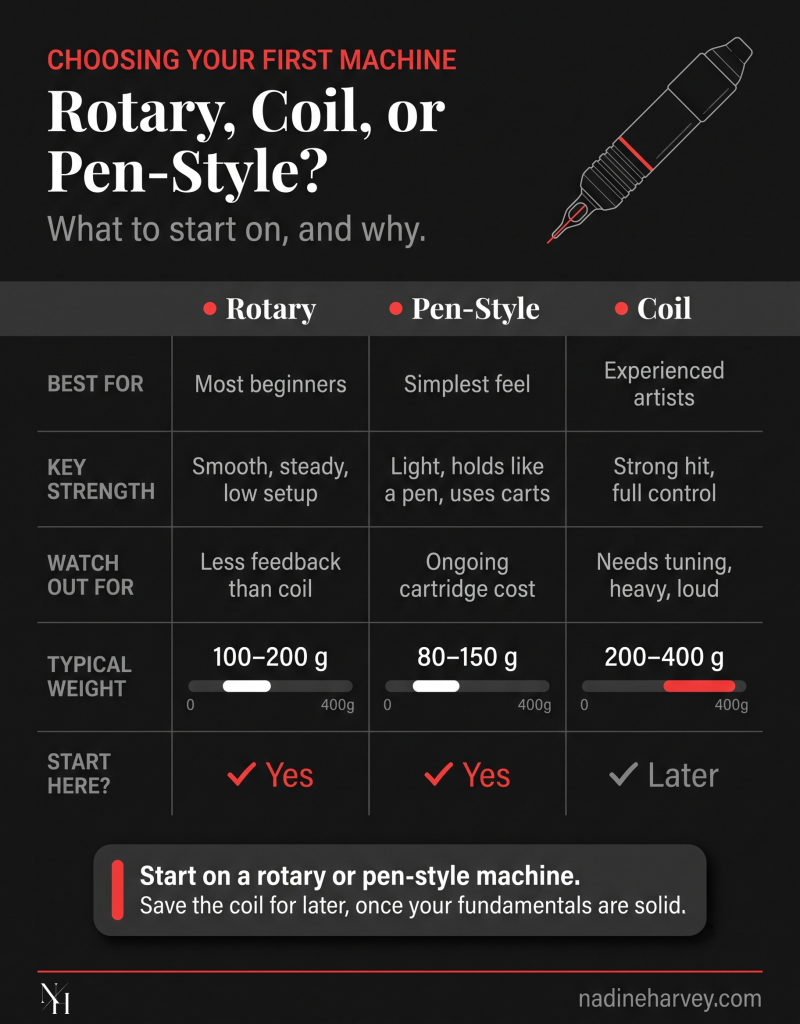
Start on a rotary or a pen-style machine. Both are light, quiet, and easy to control. They need little setup, so you can focus on technique. Coil machines hit hard and carry tradition, but they need tuning and a trained ear. Save the coil for later, once your fundamentals are solid.
The type of machine shapes how you learn. Pick the one that removes distractions, not the one that looks the coolest.
| Machine Type | Who It Fits | Key Strength | Watch Out For |
|---|---|---|---|
| Rotary | Most beginners | Smooth, steady, low setup | Slightly less feedback than coil |
| Pen-style | Beginners who want the simplest feel | Light, holds like a pen, uses cartridges | Ongoing cartridge cost |
| Coil | Experienced artists | Strong hit, full mechanical control | Needs tuning, heavy, loud |
A rotary uses a motor to move the needle in a smooth stroke. A pen-style machine is a rotary shaped like a pen. Both feel natural fast.
You set your voltage, check your needle depth, and work. No springs to adjust. No contact screw to chase.
A coil machine can pull bold lines and pack color all day. But only when it is set up right. That means learning spring tension, contact screw gap, and armature movement.
That knowledge is worth having. It is not worth having in week one.
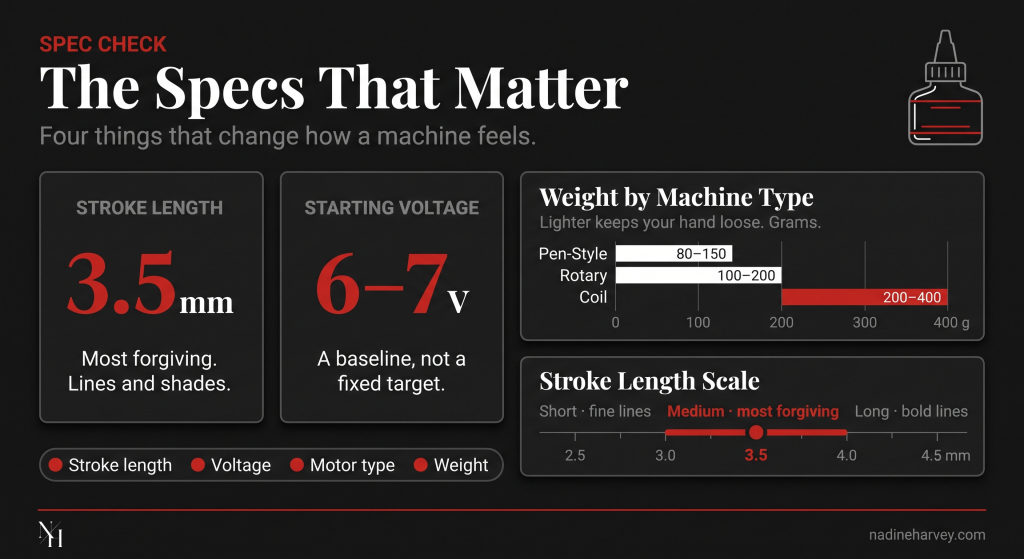
Focus on four specs: stroke length, voltage, motor type, and weight. Ignore marketing terms and flashy screens. A 3.5mm stroke, a usable voltage range, a smooth motor, and a light body will serve almost every beginner. These four traits control how a machine feels and how fast you improve.
Beginners often buy on looks or price. The specs below are what change your daily practice.
Stroke length is how far the needle travels each cycle. It decides how the machine hits the skin.
If you buy one machine, a 3.5mm stroke is the most forgiving. It lets you practice most techniques without switching gear.
Voltage controls needle speed and power. A good starting point on a rotary is about 6 to 7 volts. Treat that as a baseline, not a fixed target.
If your lines come out light, you may be moving too fast for the voltage. Slow your hand before you add power. A brushless motor is a strong upgrade too, since it runs cooler and holds a steadier speed over long sessions.
“I still run most of my black and grey work around 7 volts and let my hand speed do the rest.” Nadine Harvey, Tattoo Artist
Weight affects more than comfort. A heavy machine tightens your grip and stiffens your wrist. That tension shows up in the work.
Pen-style machines run about 80 to 150 grams. Rotaries sit around 100 to 200 grams. Coils run heavy, often 200 to 400 grams. Lighter helps you stay loose and precise.
Both wired and wireless machines work well for beginners. Wireless is now the default. It gives you a clean setup and free movement. Wired machines give you constant, stable power with no battery drop. Neither choice will hold back your learning. Pick the one that keeps your practice simple and consistent.
This choice gets overhyped. The bigger factor is whether the machine runs the same way every time.
A wireless pen clips onto a small battery pack. No foot pedal. No clip cord. Less clutter on your station.
For home practice, that simple setup lowers stress. You focus on the needle, not the cables.
A wired machine runs through a power supply. Voltage stays steady as you work. There is no slow drop as a battery drains.
That steadiness can help when you are still learning control. If you like fewer variables, wired is a fair choice.
A solid mid-range kit is a fine way to start. It gives you a machine, power, cartridges, and practice skin that all work together. Avoid the cheapest bundles, since rough motors and loose cartridges teach bad habits. Buy a machine on its own only once you know what needle types and setup you prefer.
Kits remove the guesswork of matching parts. That is their real value for a beginner.
The cheapest kits online cost you more in the long run. Watch for these traps.
Expect to spend between $60 and $300 for a first setup. Under $100 gets you a basic kit for testing your interest. The $100 to $200 range buys a machine that will grow with you. Above $200, you reach near-professional gear. You do not need to overspend to learn well.
Price does not equal skill. A mid-range machine has everything a beginner needs.
| Budget | What You Get | Best For |
|---|---|---|
| Under $100 | Basic kit, all parts included | Testing if tattooing is for you |
| $100 to $200 | A quality machine you can grow into | Serious learners and new apprentices |
| $200 and up | Near-professional performance | Committed students with a clear plan |
Put the money you save toward practice skin, cartridges, and training. Those pay you back faster than an expensive machine.
Do not tattoo real skin until you are trained and registered. In California, you must register with your county, complete annual bloodborne pathogens training, and show your Hepatitis B status. This applies to apprentices working on a live person too. Until then, practice only on silicone. Real skin carries real risk to your client and to you.
This is the part most guides skip. It is the part that protects people.
If you plan to tattoo in California, here is the basic path.
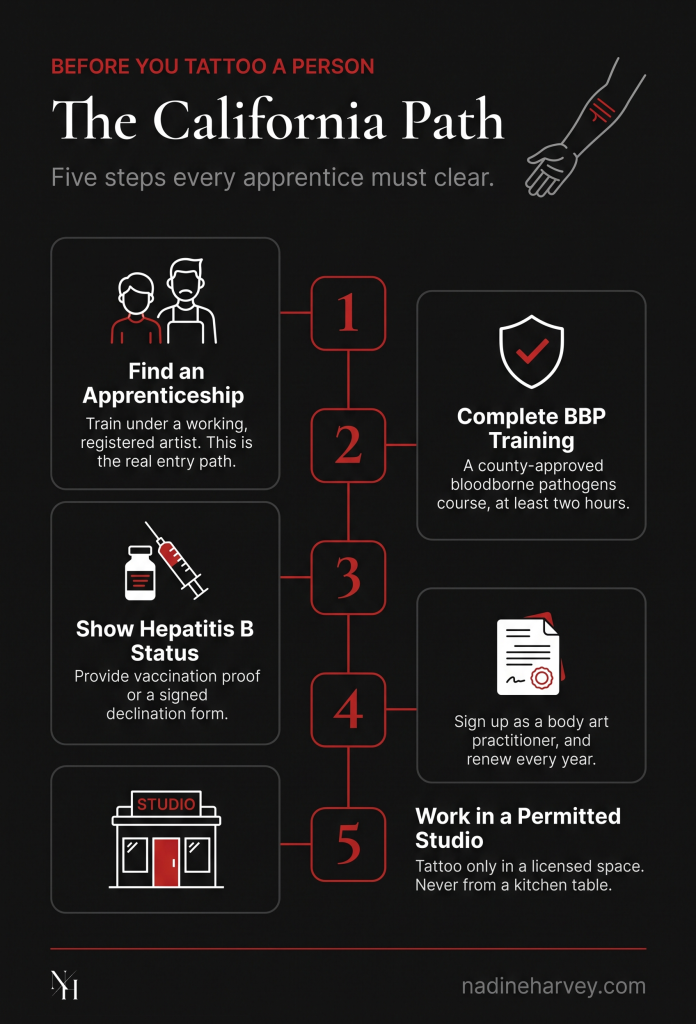
The California Safe Body Art Act sets these rules. It covers students and apprentices, not just shop owners.
Tattooing draws blood, so federal safety rules apply. The OSHA Bloodborne Pathogens Standard covers the whole trade. OSHA notes that good infection control protects “not only workers from potential exposure, but clients, as well.”
A few habits keep you compliant and safe.
The FDA also monitors tattoo ink safety, so buy ink from trusted brands only.
Your machine is the easy part. The real work starts after the box is open.
I got my start the hard way. As I shared in my Voyage LA interview, “I got my first tattoo at 14 and I instantly fell in love with the industry.” Then I spent a year knocking on shop doors before anyone took me on.
That path taught me the truth. Buy a simple, steady machine. Then pour your energy into an apprenticeship, clean habits, and thousands of reps on practice skin.
I am one of the roughly 25 percent of US tattoo artists who are women. The machine was never what set anyone apart.
Drill straight lines. Practice smooth curves. Learn how depth and stretch feel. Move to real skin only when your results are clean and repeatable. Do it only once you are trained and registered.
If you found this as a client rather than an aspiring artist, take a look at my black and grey portfolio to see where these fundamentals lead. When you are ready for a custom piece, you can book a consultation at my Huntington Beach studio.
You can practice machine control at home on silicone skin. You cannot learn hygiene, skin behavior, or healed results alone. An apprenticeship teaches the parts you cannot see on fresh work. Never tattoo a person without proper training and county registration.
Wireless machines are convenient and beginner-friendly. They reduce clutter and let you move freely. Wired machines give steadier power with no battery drop. Both work well, so choose the setup that keeps your practice simple and consistent.
Start with a 3.5mm stroke. It handles both lining and shading, so you can practice most techniques with one machine. Shorter strokes suit soft shading. Longer strokes suit bold lines but need more control.
A reliable setup costs $60 to $300. The $100 to $200 range is the sweet spot for serious learners. Spend less on the machine and more on practice skin, cartridges, and training. Those improve your work faster.
Yes, if you want to tattoo people safely and legally. You can learn to hold a machine at home. You cannot learn sanitation, station setup, and healed results without a mentor. It is also required for registration in most areas.