California has no state tattoo license. Learn how to register as a body art practitioner, what it costs by county, and the real steps to tattoo legally.
Most people search for a tattoo license in California and hit a wall of conflicting advice. The truth is short. California does not issue a tattoo license. You register as a body art practitioner with the county where you work.
This guide walks through the real steps, the real costs, and the rules that trip up new artists. I have registered and renewed in Orange County for years. I will show you what the process actually looks like, not just the paperwork.
No. California does not offer a tattoo license. You register as a body art practitioner with your local county health department. The state sets the minimum rules through the Safe Body Art Act. Each county runs its own registration. So the correct term is registration, not license. This one distinction clears up most of the confusion online.
The word “license” makes people look for a state board or an exam. Neither exists for tattooing. There is no test to pass and no state agency to apply to.
A license usually comes from a state board. Registration is a county record. It shows you meet the safety rules. As the Body Art Training Group puts it, your registration shows current bloodborne pathogen training, Hepatitis B status on file, and safe practice.
If you search state boards, you will waste time. Go straight to your county health department instead. That is where every California tattoo artist registers.
The Safe Body Art Act (AB 300) took effect on July 1, 2012. It sets the minimum safety rules for tattooing, piercing, branding, and permanent cosmetics across California. Every county follows it. The law exists to stop the spread of infection between artists and clients. It covers training, vaccination, consent, and clean facilities.
The law is about health, not art. A public health official summed it up well. The purpose is to prevent both the artist and the client from getting diseases like hepatitis and HIV, said a Contra Costa health specialist.
The Act asks every practitioner to do a few key things.
The law also requires a consent notice about ink. It states that tattoo inks are not FDA approved and the health effects are unknown. I go over this with every client before we start.
“I walk each first-session client through the ink notice and my full setup before the needle touches skin. Clean hands and clear consent come first, every time.” Nadine Harvey, Tattoo Artist
Before you apply, gather four things. You need a government photo ID that proves you are 18 or older. You need a bloodborne pathogen (BBP) training certificate from an approved provider. You need Hepatitis B vaccination proof or a signed declination form. And you need a shop that holds a valid facility permit. Some counties also ask for a passport-style photo.
Each item exists for a reason. The ID confirms your age. The training keeps you and your clients safe. The vaccination step protects you from a real workplace risk.
Keep this list handy when you apply.
You do not have to get the vaccine. You can sign a declination form instead. The OSHA declination option is legal and common. Still, many artists choose the vaccine for their own protection.
Pick a body-art-specific BBP course. A generic course may not count. Your county keeps a list of approved providers, so check it before you pay.
The process is short once your documents are ready. You complete your BBP training, sort out your Hepatitis B step, and confirm your shop holds a facility permit. Then you submit your application and fee to the county health department. Most counties process it within days. Your registration lasts one year, and you renew it before it expires.
Here is the order I recommend.
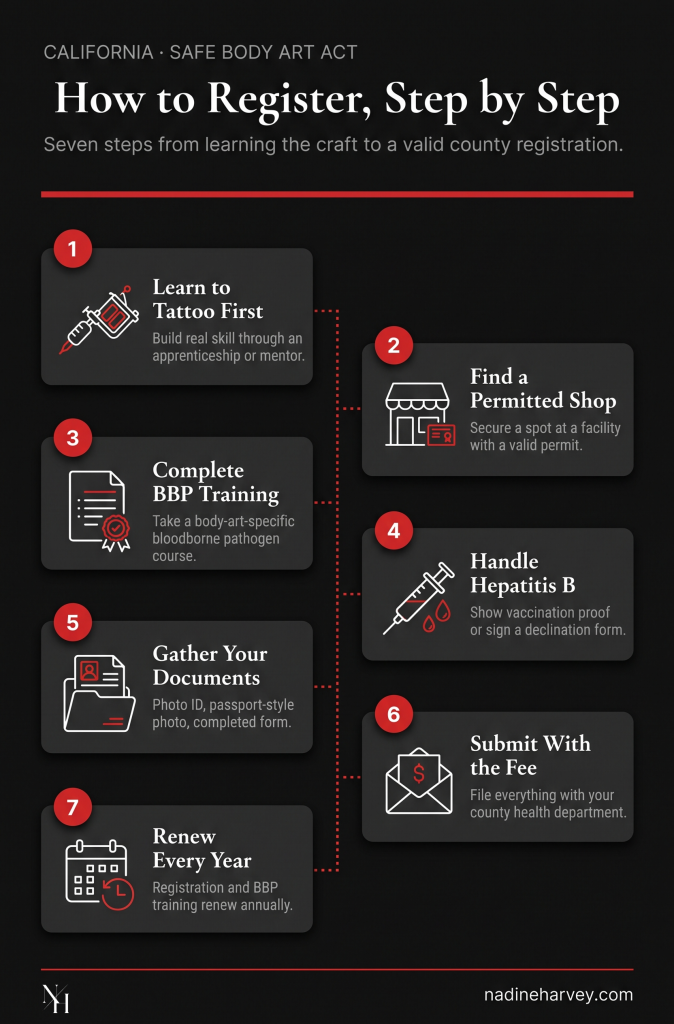
Registration is not a one-time task. You renew every year with fresh BBP training. Let it lapse and you may pay a reinstatement fee.
Your registration is county-based. It has limited reach elsewhere. A registration from one county cannot be used in another beyond five consecutive days or 15 total days in a year. Register in each county where you work often.
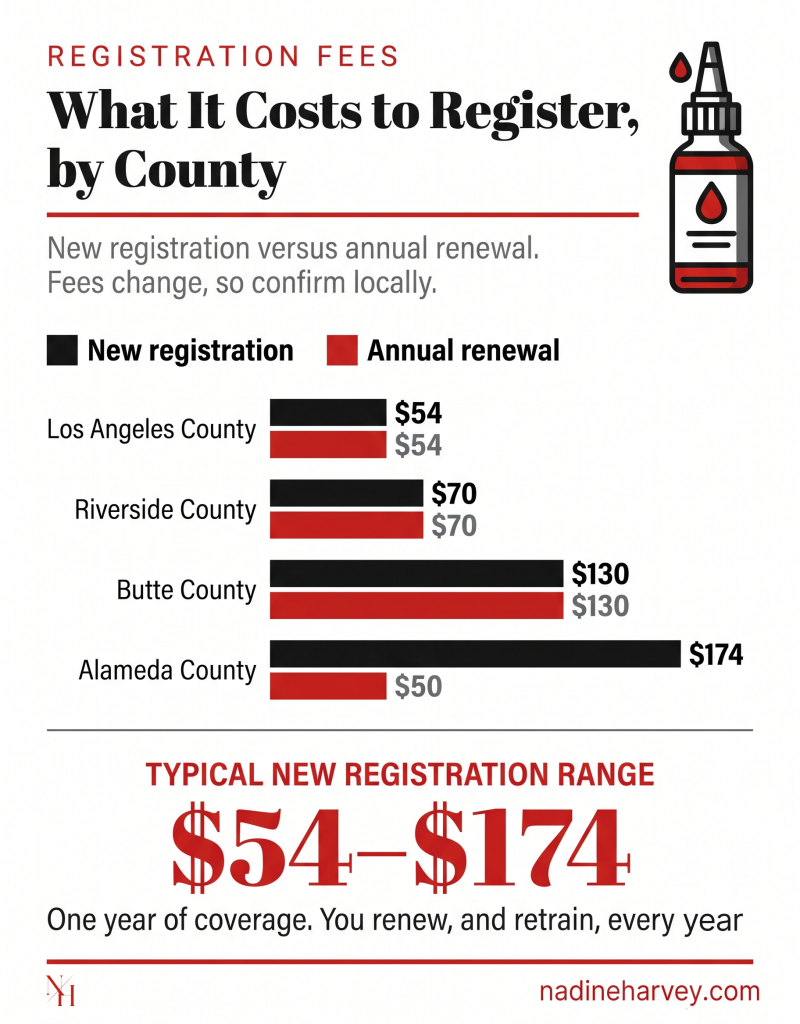
Costs are low but vary by county. Los Angeles County charges about $54. Riverside County charges about $70. Alameda County charges $174 for new registration and $50 to renew. Butte County charges about $130 for both. Fees change, so confirm the current amount with your county before you apply.
The fee is small compared to the cost of setting up to tattoo. Still, plan for it as a yearly expense, not a one-off.
| County | New Registration | Annual Renewal |
|---|---|---|
| Los Angeles | About $54 | About $54 |
| Riverside | About $70 | About $70 |
| Alameda | About $174 | About $50 |
| Butte | About $130 | About $130 |
Counties set their own fees to cover their costs. That is why the range is wide. Always treat these numbers as a guide and check the live figure.
The registration fee is the smallest part. Factor in your training course, your vaccination, and your booth or chair costs. The field is growing, with about 23,774 tattoo businesses across the country. Setting up right is worth the effort.
In Orange County, the Health Care Agency runs the program. One rule stands out. The county only issues a registration to artists who own or work at a shop with a valid facility permit. First-time applicants can apply online. Returning artists renew by replying to a county reminder email with a current BBP certificate.
This facility rule shapes real career choices. You cannot register with a home address and start tattooing from your kitchen. You need a permitted space first.
This rule guided my own path in Huntington Beach. I work from a private studio that meets the facility standards. The permit is not a formality. It sets the clean, safe conditions my clients rely on.
“My private studio passes the same facility checks as any shop. For fine line and black and grey work, that controlled, sterile setup is not optional.” Nadine Harvey, Tattoo Artist
You can see the results in my tattoo portfolio.
Keep the county details close. You can reach the Body Art Program by email at the address on the county page, or by its body art hotline. Submit documents online, in person in Santa Ana, or by mail.
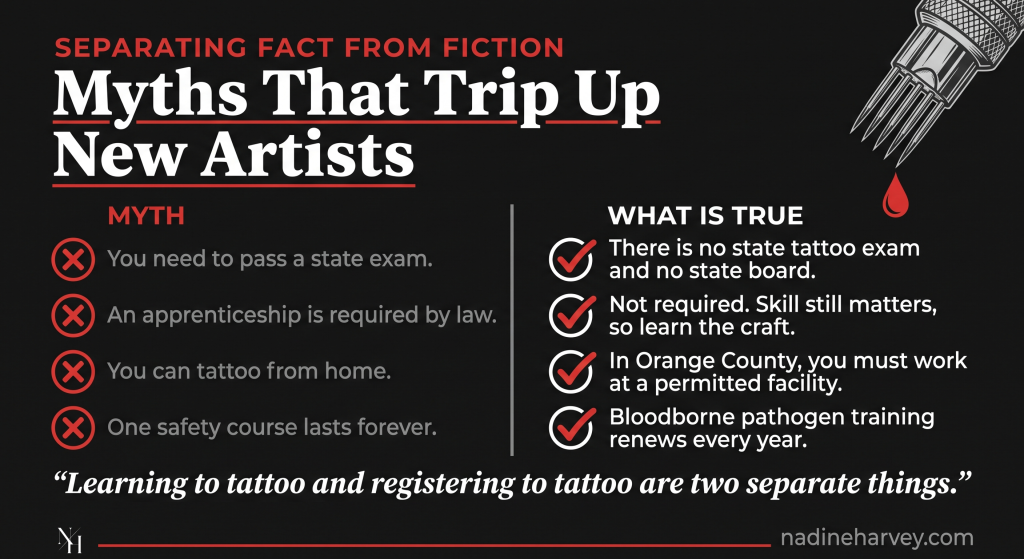
Bad advice spreads fast online. Some guides confuse tattoo rules with cosmetology board rules. Others repeat outdated steps. Knowing the myths saves you time and money. Below are the ones I hear most from artists starting out, along with what is actually true under California law.
Sorting fact from myth is half the battle. Here are the traps to avoid.
False. There is no state tattoo exam and no state board. Some articles mention a state licensing system with exams and a fixed renewal date. That system is for cosmetology and barbering, not tattooing. Do not follow it.
The law does not require an apprenticeship. California even removed an old six-month experience rule. That said, ability still matters. An apprenticeship builds real skill, even if the law does not require it.
“The paperwork took me about a week. Learning to hold a clean line for anime and horror pieces took years. Do not confuse the two.” Nadine Harvey, Tattoo Artist
In counties like Orange County, no. You must work at a permitted facility. Home tattooing without a facility permit is not legal here.
No. Bloodborne pathogen training is annual. You renew it every year with your registration.
Getting set up to tattoo in California is clearer than it looks. There is no state license. You register with your county, keep your training current, and work from a permitted shop. That is the core of it.
Start with skill, then handle the paperwork. Confirm your county’s current fee and forms, since details change. The safety rules protect you and the people who trust you with their skin.
If you want to see how a private, permitted studio approach looks in practice, view my work and studio or book a consultation when you are ready.
No. California has no tattoo license. You register as a body art practitioner with your county health department and renew that registration every year.
It depends on the county. Fees run from about $54 in Los Angeles to about $174 for a new registration in Alameda. Confirm the current fee with your county.
You must be at least 18. You prove your age with a valid government-issued photo ID when you register.
No. The law does not require one. An apprenticeship still helps you build real skill, which matters as much as the paperwork.
In Orange County, no. You must work at a shop with a valid facility permit. Gen Z and millennials make up more than 59 percent of clients. Even with that demand, the facility rule still applies.
Every year. You renew your registration and your bloodborne pathogen training annually.