Learn how clean fine line tattoos are made, from needle choice to hand control. See how fine lines age and how to judge an artist before you book.
Fine lines show every mistake. A tiny shake shows up as a wobble. Too much depth causes a blowout. This is why thin linework is one of the hardest skills in tattooing.
This guide explains how clean fine lines are made. You will learn the needles, settings, and hand control behind them. You will also learn how fine lines age, and how to judge an artist before you book.
Fine line tattoos are hard because thin lines expose every mistake. A small shake looks large. A heavy hand causes a blowout. Less ink also means faster fading when depth is wrong. Clean lines come from the right needle, low power, steady hands, and correct depth. Skill matters far more than gear here.
Fine line and minimalist tattoos keep growing in demand. That growth is driven by social media and younger clients, according to tattoo industry data for 2026. Trend forecasts also name micro and fine line work as a major direction for 2026.
More demand means more artists try the style. Not all of them do it well. That gap is why understanding how fine lines are made helps you.
A thin line has almost no room for error. As Tattooing 101 notes, a tiny shake looks huge in a thin line. There is no bold outline to cover it.
Thin needles also meet less resistance in the skin. That makes it easy to go too deep. Too deep means a blowout, where ink spreads under the surface.
People use these terms as if they mean one thing. They do not. Here is a simple breakdown.
| Style or Technique | How It Works | Best For |
|---|---|---|
| Fine line | Thin lines, little shading, often a 3RL | Botanical, script, minimal designs |
| Single needle | One needle (1RL) for the thinnest possible line | Delicate detail, pencil-like work |
| Micro realism | Small realism with soft shading | Tiny portraits, detailed animals |
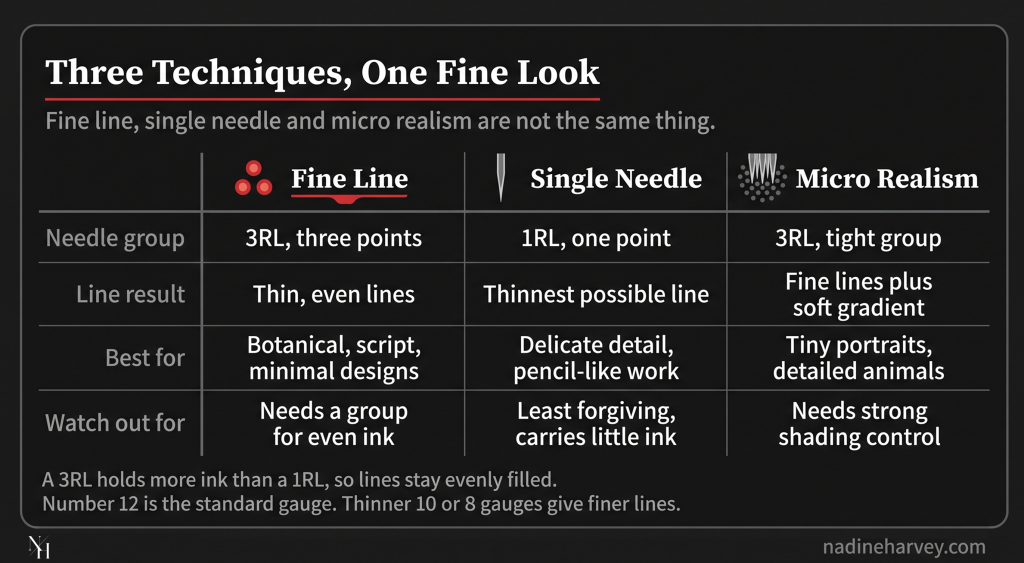
Most fine line work uses a single needle (1RL) or a three point round liner (3RL). The 3RL is the common choice. It holds more ink than a 1RL, so lines stay evenly filled. Number 12 is the standard gauge. Thinner gauges, like number 10 or number 8, give finer and more delicate lines.
The needle is the first decision that shapes line quality. Get it wrong and no setting will save the line. Learn more in this guide to tattoo needle sizes.
A 1RL is a single point. It makes the thinnest line, but it is the least forgiving. It also carries very little ink.
A 3RL groups three points together. CNC Tattoo explains that a 3RL holds ink better than a 1RL. That gives cleaner saturation and a more even line.
Gauge means the thickness of each needle. A higher number is thinner. Bugpin needles are thinner than standard, so they suit delicate work.
Watch out for these common needle mistakes:
Fine lines need less power than bold lines. A thin needle slides in easily, so high voltage slices the skin. Use a short stroke for soft, controlled work. Hold the machine nearly upright, at about 80 degrees. This angle helps the needle enter cleanly and follow the stencil without tearing.
Machine setup for fine lines is about restraint. Most problems come from too much power, not too little. See more in this overview of tattoo machines.
A long stroke and high power push hard into the skin. That works for bold lines. For thin lines, it cuts.
Use a short stroke and low voltage instead. The needle should tap the skin, not punch it.
Depth control is everything in fine line work. CNC Tattoo recommends an angle near 80 degrees for most linework.
Too deep and the ink spreads into a blowout. Too shallow and the ink falls out as the tattoo heals. The right depth sits in a narrow window.
Steady lines come from bracing the hand, not from a naturally still hand. Artists use three points of contact. They anchor the elbow, rest the palm, and link the pinky to the stretching hand. They pull the machine toward the body for control. They keep a steady pace and press lightly through the whole line.
Hand stability is a learned skill. It takes years of repetition. After eight years of daily work, this becomes muscle memory, as you can see across Nadine Harvey’s black and grey portfolio.
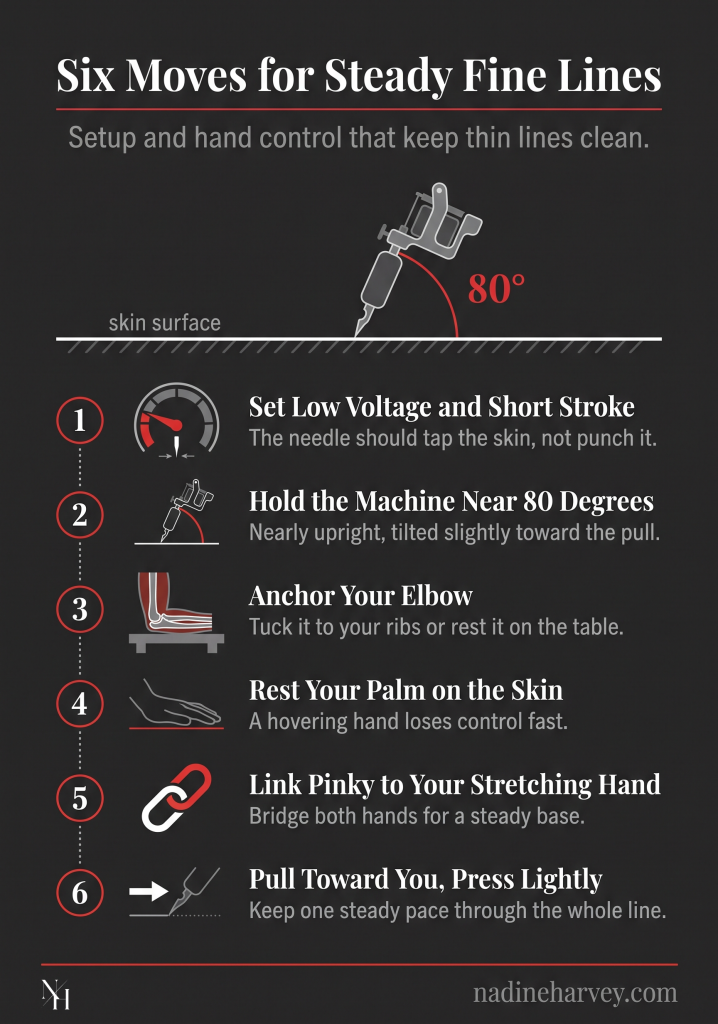
Follow these steps to steady your hand:
This creates a stable base. It also gives you a way to control depth by hand.
“I brace on every line. On ribs or fingers, I use my pinky as a pivot, so the machine follows the curve.” Nadine Harvey, Tattoo Artist
Pull the machine toward your body. Painful Pleasures notes that pulling gives more control and a clearer view of the stencil.
Avoid these mistakes that ruin clean lines:
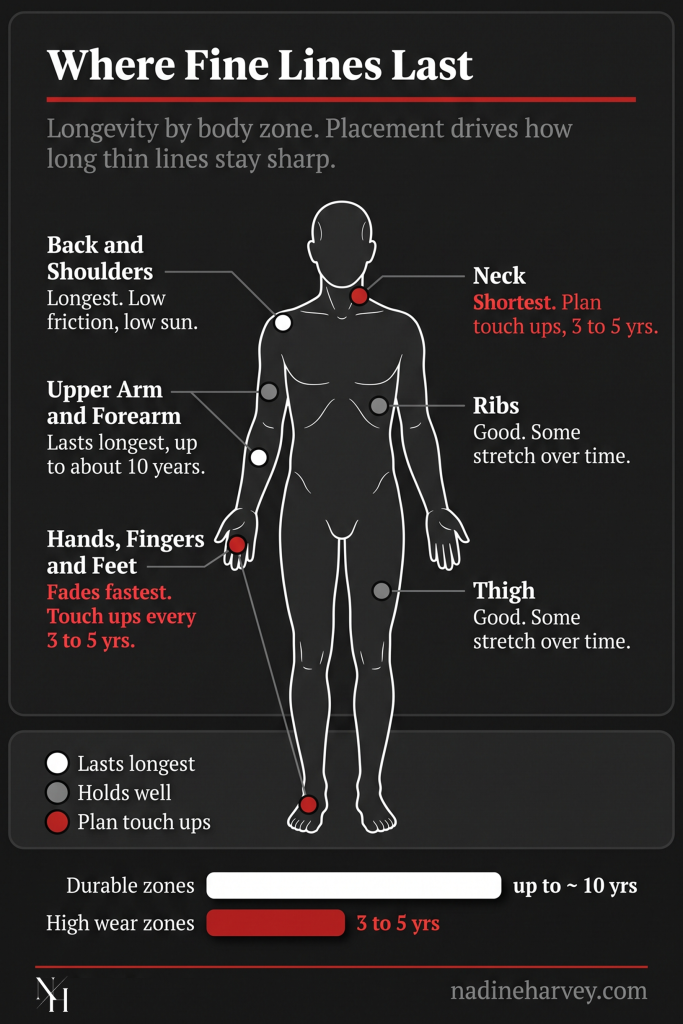
Fine line tattoos can fade faster than bold ones. They sit closer to the surface and use less ink. Placement matters most. In low friction, low sun spots, fine lines can last around ten years. On hands, fingers, and necks, expect touch ups every three to five years. Good technique slows this down.
This is the top question clients ask. An honest answer builds trust. Removery explains that fine lines fade more because they carry less ink near the surface.
Where you place a fine line piece changes how long it stays sharp.
| Placement | Longevity | Notes |
|---|---|---|
| Inner forearm, upper arm, back | Longest | Low friction and low sun |
| Ribs, thigh | Good | Some stretch over time |
| Hands, fingers, feet, neck | Shortest | High friction and sun, touch ups every 3 to 5 years |
“I plan placement before I plan the design. A forearm holds a thin line for years. Fingers will not.” Nadine Harvey, Tattoo Artist
Black ink holds up best for fine line work. Skin Factory Tattoo notes that lighter colors fade faster and need more touch ups.
Sun exposure breaks down ink faster than almost anything. Sunscreen on a healed tattoo protects the lines. A short touch up every few years keeps thin work crisp.
Judge an artist by healed work, not fresh photos. Fresh lines always look crisp. Healed lines reveal the truth. Look for even, unbroken lines with no heavy blur. Ask to see pieces that are one year old or older. Check that the studio is licensed and clean. In California, that means Safe Body Art Act compliance.
The right artist protects both your skin and your result. This is the decision most guides skip. It is also the one that matters most to you.
Use this checklist when you review an artist’s work:
You can review healed fine line and black and grey pieces on Nadine’s tattoo portfolio. Her dual practice in editorial and modeling work also shapes her eye for clean, balanced design.
Safety is not optional. California runs the Safe Body Art Act through county health departments. Practitioners must register each year. Studios need a permit and pass yearly inspections.
California also requires an honest ink disclosure. Consent forms must state that tattoo inks are not FDA approved. A good artist explains this rather than hiding it.
As Nadine said in her Voyage LA interview, “The main thing that sets me apart is that I genuinely care about my work.” That care shows in clean setup, single use needles, and honest guidance. You can read more about her approach and eight years of experience.
Clean fine lines are not luck. They come from the right needle, low power, correct depth, and a braced, steady hand. A 3RL or single needle, a short stroke, and an 80 degree angle set the foundation.
Longevity depends on placement, ink, and aftercare. Forearms and upper arms hold lines longest. Hands and fingers need more touch ups. Black ink and sun protection keep work sharp.
If you want fine line work that lasts, choose an artist by healed results. Check the portfolio. Check the licensing. When you are ready, book a consultation to plan a piece that stays sharp for years.
They often feel lighter than bold work. Thin needles and less ink mean less trauma to the skin. Placement still affects pain, since bony areas hurt more.
Most heal in about two to three weeks on the surface. They may peel and itch less than bold tattoos. Keep them clean and out of the sun while they heal.
Any licensed artist can try, but the style is unforgiving. Fine line work needs strong hand control and depth control. Always check healed examples before you book.
It depends on placement. Low friction spots may hold for years. Hands, fingers, and necks often need a touch up every three to five years.