Learn what practicing on fake tattoo skin teaches, from needle depth to material choice, and how to know when you’re ready for real skin.
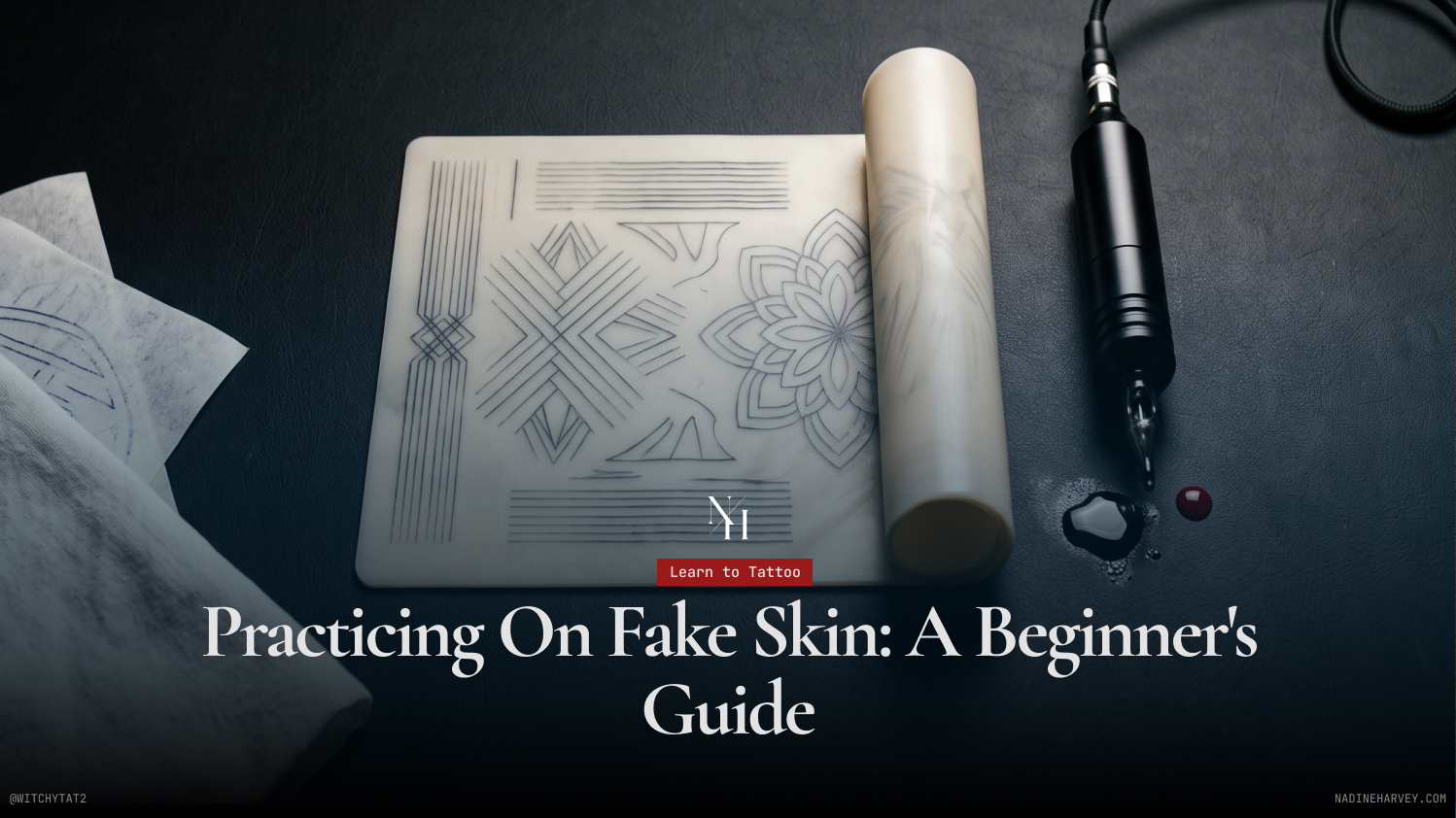
Every tattoo artist starts the same way. Long before real skin, there is fake skin. It is the safest place to learn machine control, needle depth, and a steady hand.
This guide breaks down what fake skin actually teaches. It also covers what it cannot teach, and how to know when you are ready for real clients. You will get a real setup process, material basics, and the honest limits that product pages rarely mention.
Most tattoo practice skin is made from silicone, rubber, PVC, or latex. Silicone comes closest to real human skin in texture and give. Rubber and PVC cost less and hold up to heavy repetition, but they feel stiffer under the needle. For your first sheets, material matters more than brand.
Not every fake skin behaves the same way under a machine. A stiff PVC sheet resists your needle differently than a soft silicone hand form does.
Practice skin brands vary in silicone, rubber, PVC, or latex construction, so test a few before you settle on one.
Buy two or three material types before you commit to one. Your hand will feel the difference fast.
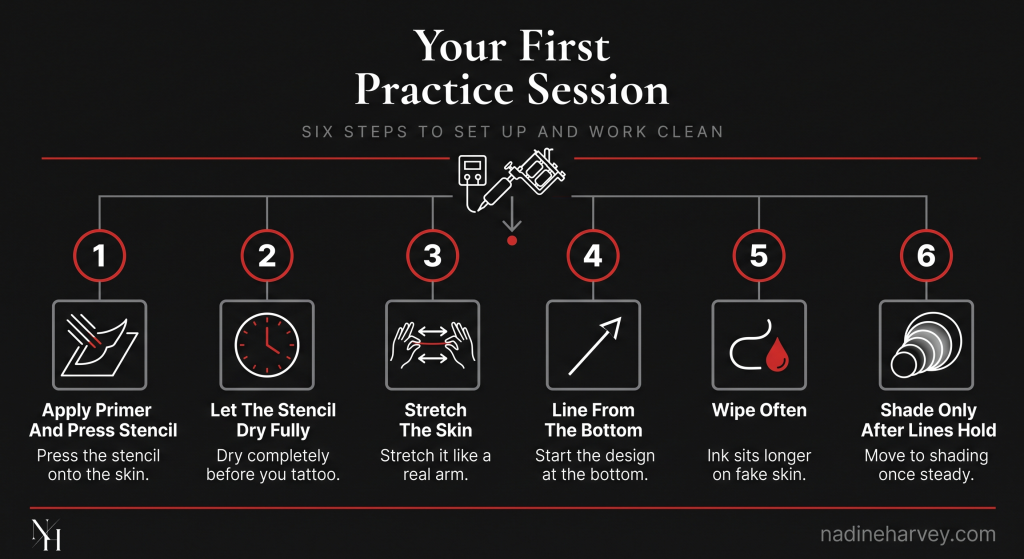
Ink sits on top of practice skin longer than on real skin. Wipe more often than feels necessary.
Fake skin cannot bleed, swell, or heal, so it cannot teach those skills. It gives you a flat, consistent surface every time. Real skin changes by location, by client, and even by the hour. This gap is the biggest thing beginners underestimate.
Fake skin also absorbs ink differently than real skin does. A piece can look darker and more saturated on practice skin than on an actual client.
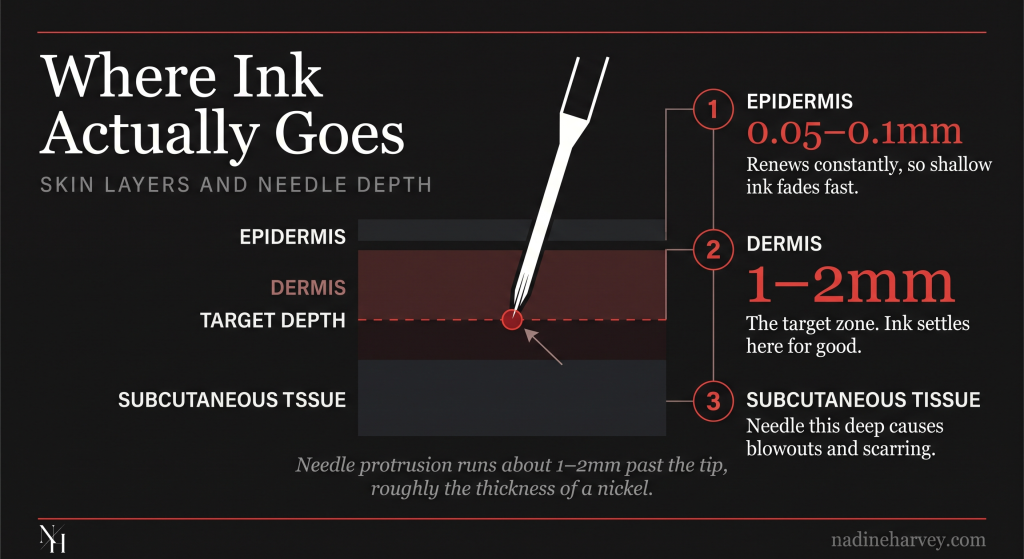
Fake skin forgives mistakes real skin will not forgive. Go too shallow and it will not fade. Go too deep and it will not blow out.
That forgiveness feels good, but it can create a false sense of proficiency before you are ready. Treat clean fake skin results as a starting point, not proof you are done learning.
“Clean lines on fake skin do not mean you are ready. Real skin will tell you the truth fast.” Nadine Harvey, Tattoo Artist
A first session needs four things. A dry stencil, a dialed in needle depth, diluted ink, and a plan to work bottom to top. Skipping any one of these leads to smeared stencils or muddy lines. Set up slowly the first few times. Speed comes later.
Tattoo ink is meant to sit roughly 1 to 2 millimeters into the dermis. Too shallow and the line fades. Too deep and it blurs.
A simple check works well on fake skin. Flip the sheet over. If the needle marks cut clean through, your machine is set too hard.
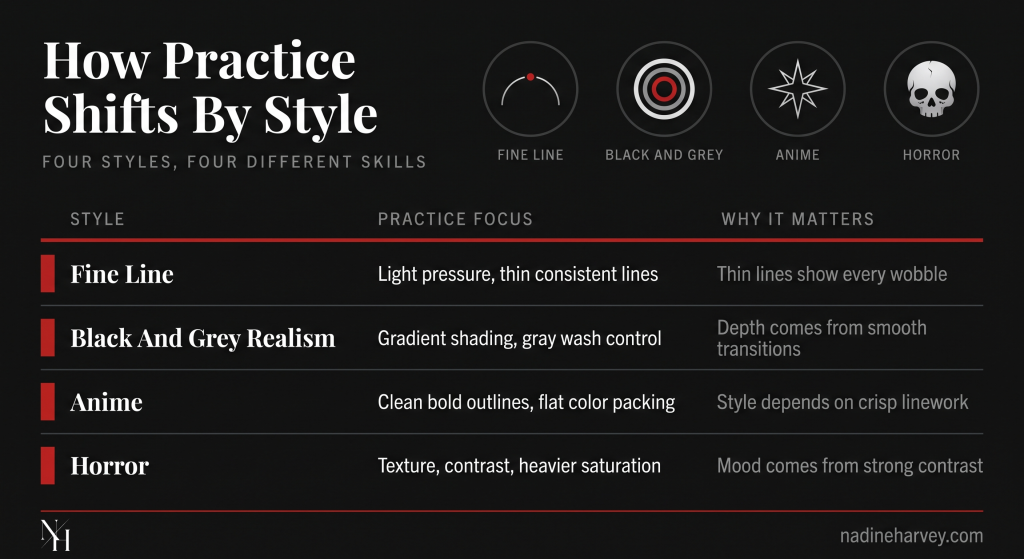
Different styles ask for different control, so your practice should shift with the style you want to learn. Fine line demands a light, steady hand. Black and grey realism leans on shading and gradient control. Anime and horror styles each bring their own line weight and texture needs.
| Style | What To Practice Most | Why It Matters |
|---|---|---|
| Fine line | Light pressure, thin consistent lines | Thin lines show every wobble |
| Black and grey realism | Gradient shading, gray wash control | Depth comes from smooth transitions |
| Anime | Clean bold outlines, flat color packing | Style depends on crisp linework |
| Horror | Texture, contrast, heavier saturation | Mood comes from strong contrast |
I work across fine line, anime, horror, and black and grey realism. Each style still asks something different of my hand. See more about my path on my About page.
In an interview with Voyage LA, I talked about the year of rejection before I landed my first apprenticeship at 20.
“I got a year of no before one shop finally said yes. That waiting taught me patience before skill ever could.” Nadine Harvey, Tattoo Artist
You are ready when your lines hold up without redoing them, your shading stays even, and mentors approve your work without major notes. Confidence alone is not the signal. Consistency across many pieces is.
“A mentor catching your mistakes on practice skin is a gift. It means you will not make them on a client.” Nadine Harvey, Tattoo Artist
Patience matters more than speed. An artist quoted by Killer Ink Tattoo said it plainly. Learning takes time, and rushing does not shorten that.
After fake skin, the real path runs through a supervised apprenticeship, licensing, and only then, real clients. This is not optional, and it is not the same everywhere you live.
Most tattoo apprenticeships run one to three years. You move from drawing, to fake skin, to supervised real work under a mentor’s eye. Requirements vary a lot by state, from a short exam to thousands of training hours.
If you are still mapping out that path, our guide to tattoo licensing covers the paperwork side in more detail.
In California, the Safe Body Art Act requires bloodborne pathogens training and Hepatitis B vaccination proof before you touch real skin. In Orange County, artists also need an annual Body Art Practitioner Registration through the local health department.
None of this replaces mentorship. It sits alongside it.
Fake skin teaches the mechanics. It never teaches the full skill set. That comes from mentorship, real clients, and years of hands on work.
If you are ready to plan your own piece, look at my tattoo portfolio or book a consultation to talk through your idea.
Technically yes, but quality drops fast after the first pass. Fresh sheets give you a more honest read on your technique.
There is no fixed number. Readiness comes from consistent, mentor approved results, not a set hour count.
Silicone feels closer to real skin. Rubber and PVC cost less and hold up well for repetition drills.
No. Licensing and registration apply once you move to tattooing real clients, not during fake skin practice.