Learn to read tattoo needle codes like 1207RL. See how diameter, count, and taper shape your lines, comfort, and how your tattoo ages over time.
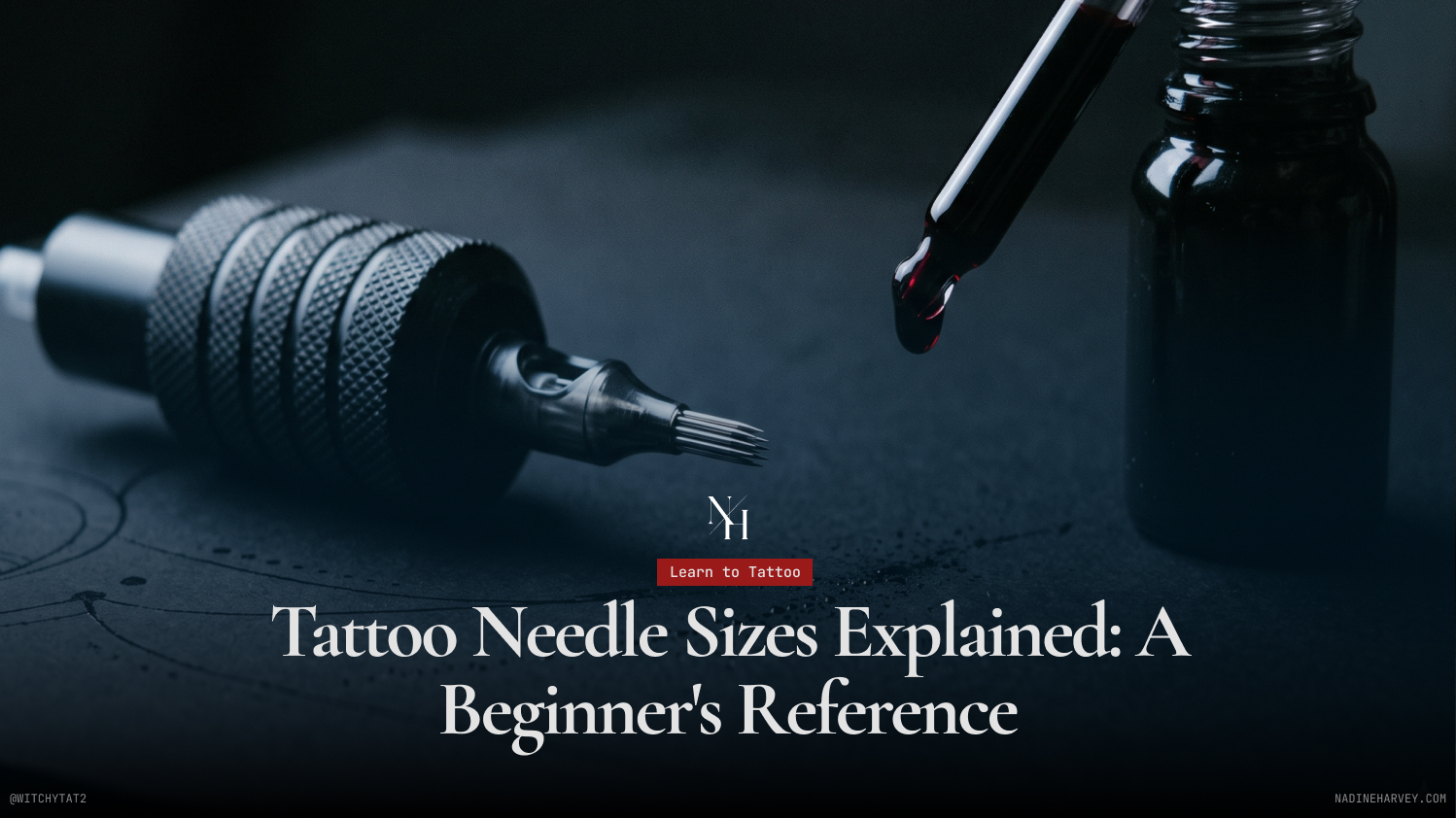
The code on a tattoo needle box looks confusing at first. You see something like 1207RL and it means nothing. That gap leaves many first-time clients unsure about what will happen to their skin.
This guide fixes that. You will learn how to read a needle code in one example. You will see how diameter, count, and taper change your lines. You will also learn how these choices affect pain, healing, and how your tattoo looks years later. Tattoos are now mainstream, with about 32% of US adults wearing at least one. The tool behind them deserves a clear explanation.
A tattoo needle code lists three things in order: diameter, needle count, and configuration. Take 1207RL as the example. The 12 is the diameter, which is a #12 needle at 0.35mm. The 07 is the count, so seven needles. The RL is the grouping, a round liner. Read left to right and the code makes sense.
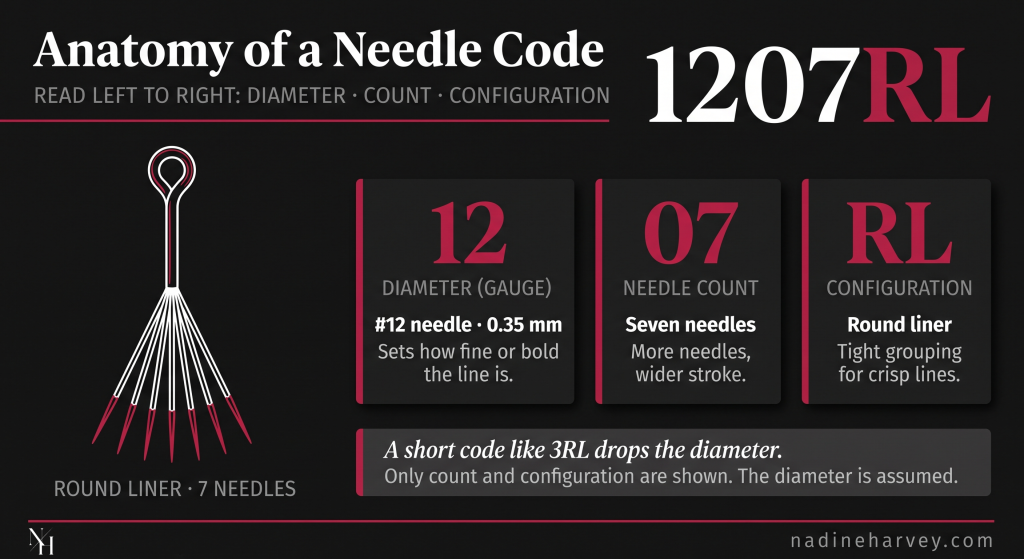
Most boxes follow this pattern. The standard code puts diameter first, then count, then the letters. The letters describe the shape of the grouping.
Try one more. A 0803RS breaks down like this.
So a 0803RS is a thin, three-needle round shader. It suits small, soft shading.
Some artists use a short code like 3RL or 7RL. Here the diameter is assumed, so only count and grouping show. A few supplier pages online also mislabel groupings. If a page calls M1 a flat, ignore it. M1 is a magnum.
Diameter is the thickness of a single needle. Artists also call it gauge. A smaller diameter makes finer lines and slower ink flow. A larger diameter makes bolder lines and lays more ink. Diameter is the first thing that shapes how delicate or heavy your tattoo looks.
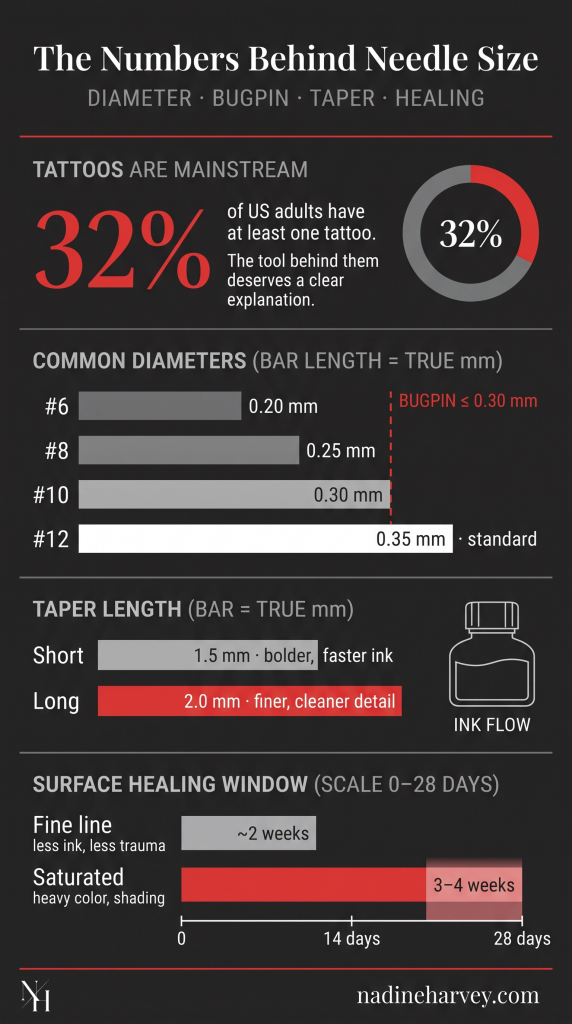
The four common diameters are easy to remember. The #12 measures 0.35mm and the #6 measures 0.20mm. Smaller numbers are not thinner. Larger gauge numbers mean thicker needles.
| Gauge | Diameter | Common Use |
|---|---|---|
| #6 | 0.20mm | Very fine detail and micro work |
| #8 | 0.25mm | Fine lines and soft shading |
| #10 | 0.30mm | Detail and smooth shading |
| #12 | 0.35mm | Standard lines, bold work, color packing |
You will hear the word bugpin often. It is not a brand. Any needle at 0.30mm or smaller counts as bugpin. These thin needles suit fine detail, dotwork, and smooth shading. They also ask for more passes to build the same result.
Count is how many needles sit in the grouping. Configuration is how they are arranged. Together they decide the job. A tight round grouping lines. A looser round grouping shades. A wide magnum fills large areas. More needles make a wider stroke. Fewer needles give finer control.
The letters on the box tell you the grouping. Each grouping exists for a specific job.
| Code | Name | Best For |
|---|---|---|
| RL | Round liner | Crisp lines and detail |
| RS | Round shader | Soft shading and small fills |
| F | Flat | Shapes and geometric work |
| M1 | Weaved magnum | Shading and blends |
| M2 | Stacked magnum | Solid color packing |
| RM / CM | Curved magnum | Soft blends on curved skin |
Liners and shaders can look similar in the box. The difference is spacing. Liners sit tight for sharp lines. Shaders sit looser to let ink flow for soft fills.
Curved magnums have a gentle arch at the tip. This helps them spread ink evenly and stay gentler on the skin. They work well for soft shading on curved areas like the inner arm.
Taper is the length of the sharpened point. It is the spec most beginners miss. A longer taper releases ink slowly and gives finer, cleaner detail. A shorter taper releases more ink at once for bolder lines and faster fills. Taper changes how the same needle feels and performs in the skin.
Taper comes in real measurements. A standard short taper runs about 1.5mm, a long taper about 2.0mm, and extreme tapers go longer. Small changes here make a real difference.
“For fine line, I reach for a single needle with a long taper. It lets the ink settle into a clean line without pushing too much in.” Nadine Harvey, Tattoo Artist
Picture two artists lining the same design.
Neither is better. The design decides which one fits.
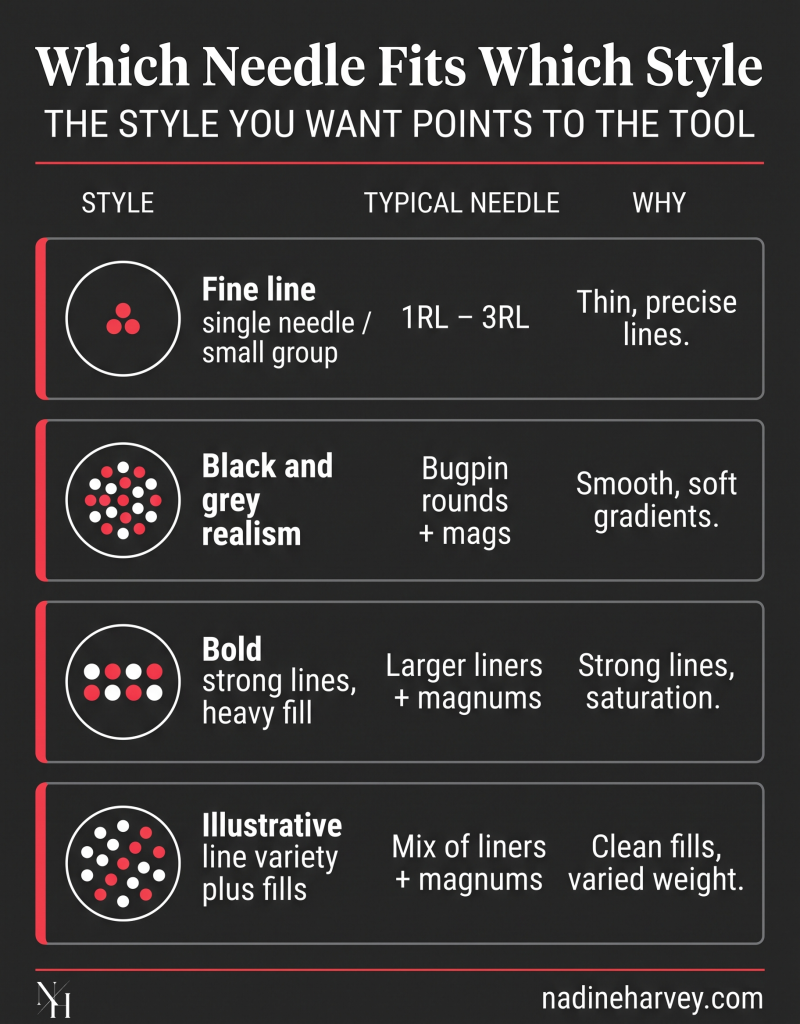
Different styles need different needles. Fine line work uses a single needle or a tiny grouping. Black and grey realism leans on bugpin rounds and magnums for smooth gradients. Bold traditional work uses larger liners and magnums for strong lines and heavy saturation. The style you want points straight to the tools your artist reaches for.
Fine line is the clearest case. It uses a single needle or a very small grouping, often 1RL or 3RL, with a light hand.
| Style | Typical Needle | Why |
|---|---|---|
| Fine line | 1RL to 3RL | Thin, precise lines |
| Black and grey realism | Bugpin rounds and magnums | Smooth, soft gradients |
| Bold traditional | Larger liners and magnums | Strong lines and saturation |
| Illustrative | Mix of liners and magnums | Line variety plus clean fills |
I draw every design by hand before ink touches skin. The drawing tells me what the needle needs to do. My process is simple.
“I pick the needle after the drawing is done, never before. The design sets the line weight, and the line weight sets the needle.” Nadine Harvey, Tattoo Artist
You can see how these choices play out across my tattoo portfolio, where fine line and realism sit side by side.
Needle size plays a part in comfort, but it is not the whole story. Thinner needles and smaller groupings cause less trauma per pass. That often means a lighter feel and quicker surface healing. Still, placement, session length, and the artist’s hand matter more than the number on the box.
Healing time shifts with the work. Fine line pieces often heal on the surface in about two weeks, while heavily saturated work takes three to four weeks. Less ink and less trauma mean a shorter window.
Do not judge pain by needle size alone. These factors carry more weight.
Needle choice shapes how a tattoo looks in ten years, not just on day one. Thin needles and light saturation give delicate results that fade faster. Larger needles and heavier saturation hold bolder for longer. This is why the same design can age very differently depending on how it was built.
Fine line work carries this trade-off. Less ink sits in the skin, so lines soften into lighter gray over time. That is not a flaw. It is how the style ages.
“With black and grey, I build shading in slow passes with bugpin magnums. That patience is what keeps the gradient smooth years later.” Nadine Harvey, Tattoo Artist
A blowout is ink spreading under the skin past the line. It shows as a soft, blurred shadow. Small groupings and shallow work raise the risk when the hand is not precise. This is why artist skill matters most with delicate styles.
A tattoo is a real investment. The average session in North America runs around $262. Building it for the long version protects that spend. My work is drawn and placed to last, not to chase a trend. You can read more about that approach on my about page.
Needle safety is simple and non-negotiable. Reputable studios use single-use sterile needles for every client, then dispose of them. Sterile tools and clean supplies protect you from infection. When you book, you have every right to ask how a studio handles needles, ink, and hygiene.
Ink safety matters too. The FDA has not approved any pigments for injection into the skin, so studio standards are what protect you. Contamination is a real risk. The FDA also reported 18 voluntary ink recalls between 2003 and 2024 tied to microbes. In Europe, the REACH restriction in 2022 banned thousands of hazardous substances from inks.
Bring these to any consultation.
A good artist will answer all of these without hesitation.
You now know how to read a needle code. Diameter sets fineness. Count and configuration set the job. Taper sets ink flow. Together they decide how your tattoo looks, feels, and ages.
You do not need to memorize every code. You just need enough to ask better questions and understand your artist’s choices. That knowledge protects the tattoo you will wear for life. When you are ready to plan a piece, you can start a consultation through my booking page.
It means a #12 diameter needle at 0.35mm, seven needles in the grouping, arranged as a round liner. Read it as diameter, count, then configuration.
Fine line work usually uses a 1RL or 3RL. The small grouping and thin diameter give the precise, delicate lines the style is known for.
Often, yes, since they cause less trauma per pass. But placement, session length, and technique affect comfort more than needle size alone.
A bugpin is any needle at 0.30mm or smaller. Artists use them for fine detail, dotwork, and smooth shading.
Less ink sits in the skin from the start. Over time those thin lines soften into a lighter gray. Good placement and aftercare slow this down.