Learn what defines American Traditional tattoos, how Sailor Jerry shaped the style, what the classic motifs mean, and how to choose a piece that lasts.
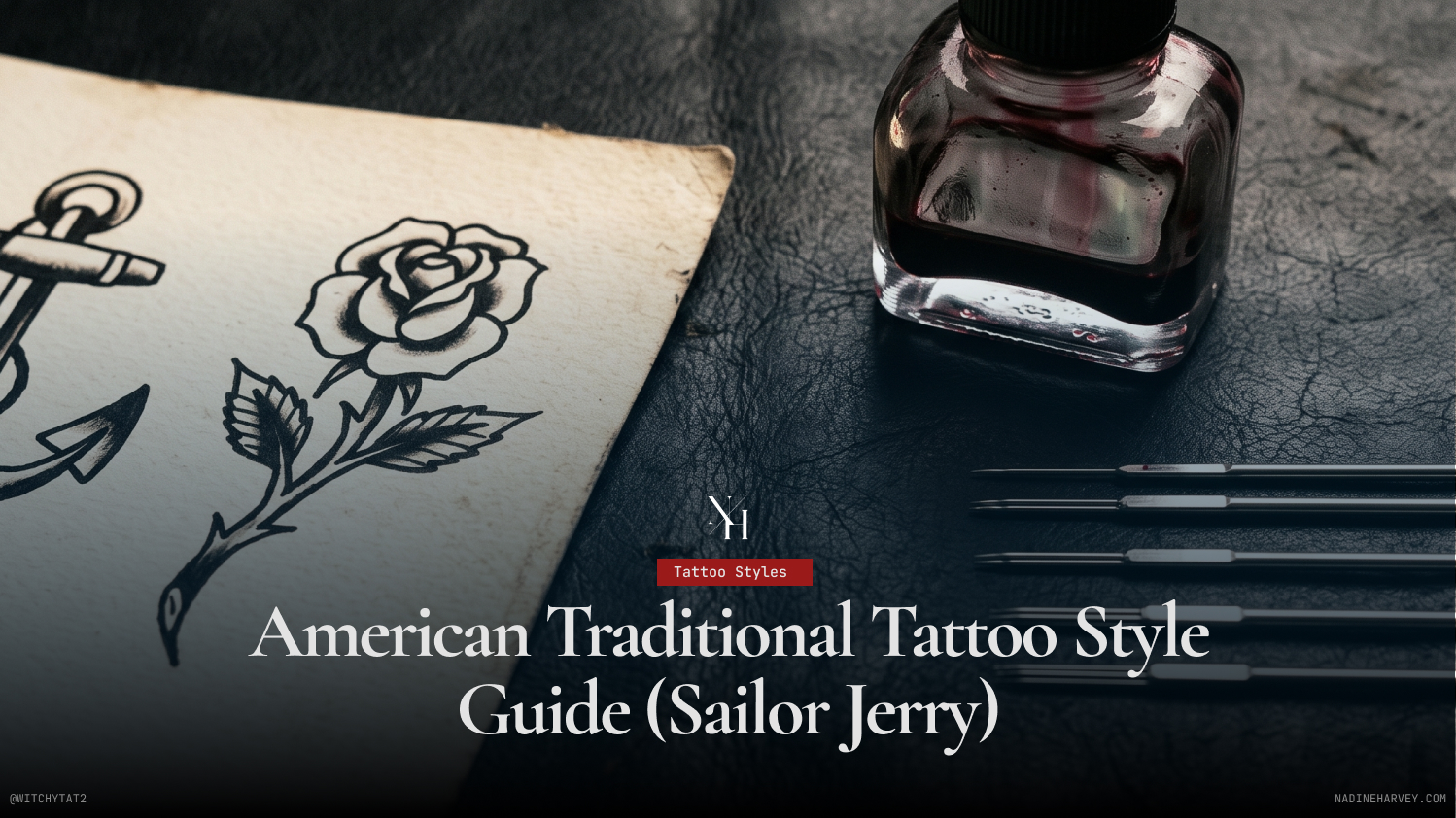
You see the words “American Traditional” and “Sailor Jerry” on flash sheets, feeds, and studio walls. But most people do not know what the style really is or why it lasts.
This guide fixes that. You will learn the core rules, the real history, and what the classic symbols mean. You will also learn how to choose a piece that still looks sharp in thirty years.
An American Traditional tattoo uses bold black outlines, a limited color palette, and simple, iconic imagery. The colors sit flat, with no blending. Common motifs include anchors, swallows, roses, and eagles. The style is also called old school. It stands apart from “new school,” which uses wider color and more shading.
The look is clean and graphic. Every line has a job, and nothing is crowded.
This is not a modern trend. The core traits of the style date back over a century. They came from sailors, soldiers, and working-class clients.
Three rules define the whole look:
These rules keep the design readable. You can spot a traditional piece from across a room.
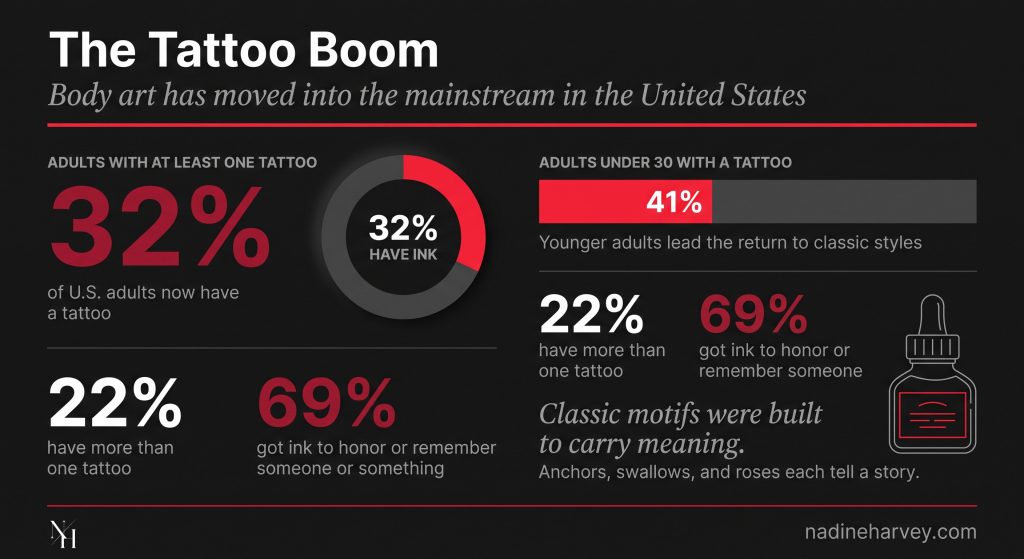
Tattoos are now mainstream, so classic styles are back in demand. About 32% of U.S. adults have a tattoo, and 22% have more than one.
Younger adults lead the way. Some 41% of people under 30 have ink. Traditional work fits this group because it is bold, clear, and personal.
Sailor Jerry was Norman Keith Collins, born in 1911 and died in 1973. He is named as one of the people who started the American Traditional style. He worked out of Honolulu and tattooed thousands of sailors. He blended American imagery with lessons from Japanese masters. His designs still shape tattooing today.
His story is part of why his name carries weight. He was stubborn about quality. His business card line was simple: “My work speaks for itself.”
Collins learned to tattoo young. As a teen, he rode freight trains and hand-poked tattoos along the way.
Later he learned the machine in Chicago. He then joined the Navy and studied tattoo art across the Pacific. You can read more about his life and career in his full biography.
Sailor Jerry did more than draw. He pushed tattooing forward in ways that still matter.
That safety focus set a standard. Clean tools and single-use needles are now basic practice.
American Traditional tattoos age better than most styles because they stay simple and bold. Thick outlines hold their shape as skin changes. Flat, saturated color resists fading. There is little fine detail to blur. The old mantra is “bold will hold.” It means strong lines and solid color keep a tattoo clear for decades.
Fine, delicate work can soften over the years. Bold work fights that. It was built for the long version.
This is the practical heart of the style. It is also why I plan traditional pieces with aging in mind.
Skin moves, stretches, and ages. Ink spreads a little over time. Thin lines can merge and lose their edge.
Bold outlines leave room for that shift. The design still reads clearly, even years later. That is the whole point.
The line does most of the work here. A heavy outline gives the design its frame.
Placement matters too. Bold designs need enough open space to stay clear. Over eight years of tattooing, I have learned to size traditional work for the body part, not just the sketch.
“I size every traditional piece for the body part first, then the design. That is what keeps bold lines clean at year ten.” Nadine Harvey, Tattoo Artist
You can see how this plays out across my tattoo portfolio.
Classic traditional motifs carry set meanings built over generations. An anchor means stability. A swallow means safe return and loyalty. A rose means love, with beauty and pain together. An eagle means freedom and strength. These meanings are a starting point, not a rule. Your own story can shape the design.
Meaning is a big reason people choose these images. In one Pew survey, honoring or remembering someone was the top reason for a tattoo, cited by 69% of tattooed adults.
Here is a quick guide to the most common symbols.
The sea shaped the whole style. These images came straight from sailor life:
Other classics carry meanings of love and grit:
A skilled artist can bend these classics to fit you. The history gives the design roots. Your life gives it meaning.
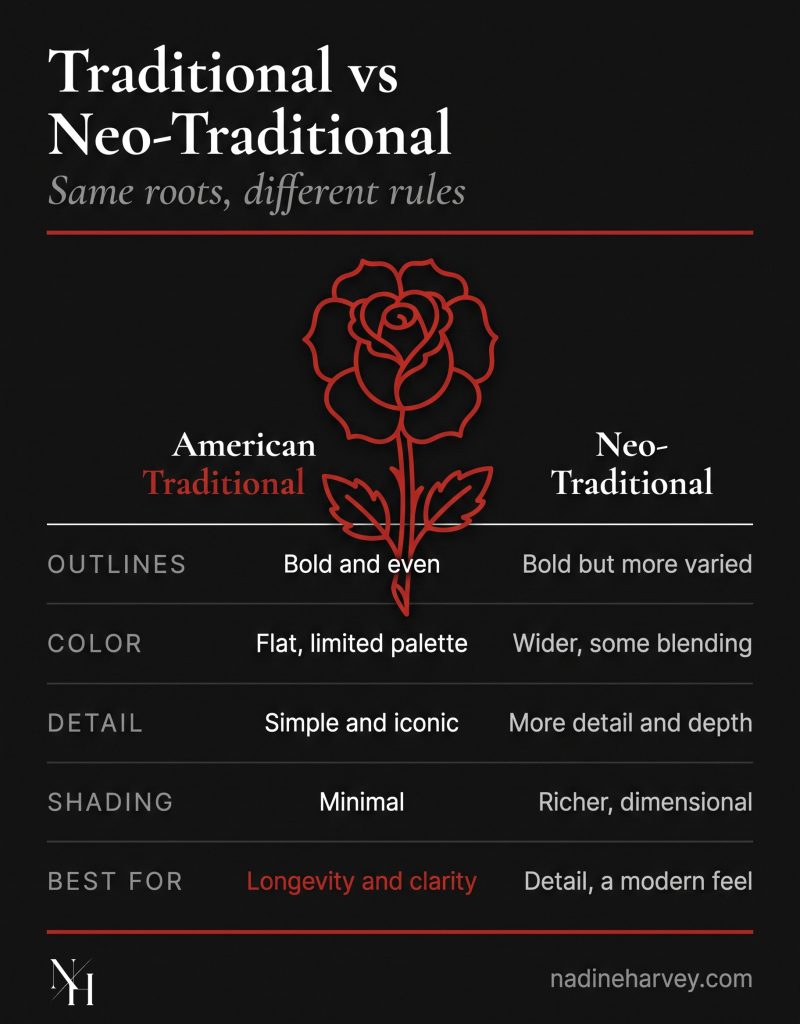
Traditional and neo-traditional share the same roots, but they follow different rules. Traditional sticks to bold lines, flat color, and simple imagery. Neo-traditional keeps the bold base but adds more detail, more color, and richer shading. Traditional favors clarity and long life. Neo-traditional favors depth and a more painterly look.
People mix these two up all the time. The table below makes the line clear.
| Feature | American Traditional | Neo-Traditional |
|---|---|---|
| Outlines | Bold and even | Bold but more varied |
| Color | Flat, limited palette | Wider palette, some blending |
| Detail | Simple and iconic | More detail and depth |
| Shading | Minimal | Richer and dimensional |
| Best for | Longevity and clarity | Detail and a modern feel |
Think about what you value most. Want a piece that stays sharp with little fuss? Traditional is the safe pick.
Want more depth and a painterly look? Neo-traditional may fit better. Just know it holds more fine detail that softens over time.
Flash means a pre-drawn design you pick off the sheet. Custom means a one-off design made for you. Flash is faster, often cheaper, and rooted in tattoo history. Custom takes longer and costs more, but it is fully yours. Both are valid. The right choice depends on your budget, timeline, and how personal you want the piece to be.
Flash is core to this style’s history. Sailor Jerry’s shop walls were covered in it. Picking flash connects you to that tradition.
Custom work goes another way. It starts with your story and turns it into one design.
| Option | Who It Fits | Key Strength | Watch Out For |
|---|---|---|---|
| Flash | First-timers and classic fans | Fast, proven, lower cost | Less personal to you |
| Custom | Collectors and storytellers | Fully yours | Longer wait, higher cost |
Flash shines when you love a classic image as it is. It also helps if you want a shorter wait and a set price.
Small classics like a swallow or a rose work great as flash. They are timeless for a reason.
Custom fits when you have a story to tell. Maybe you want to blend two motifs or fit a piece to a scar.
“I draw every custom piece by hand before any needle touches skin. That step is where your story becomes the design.” Nadine Harvey, Tattoo Artist
You can start that process on my booking page.
A traditional tattoo that ages well starts with the right artist and a smart plan. Choose someone fluent in the style. Pick flash or custom. Talk through size and placement. Check the studio’s safety practices. Then follow aftercare closely. Bold work rewards good choices at every step.
The style is forgiving over time, but only if the basics are right. Rushing any step can cost you.
Follow this simple process.
“Judge an artist by healed work, not fresh photos. Fresh ink always looks sharp. Healed ink tells the truth.” Nadine Harvey, Tattoo Artist
Safety starts with the artist. It also helps to know the basics as a client.
The FDA treats tattoo ink as a cosmetic. In October 2024, the agency released final guidance on preventing ink contamination. Firms ran 18 voluntary ink recalls between 2003 and 2024.
The FDA also notes that tattoos carry real risks like infection and allergic reactions. A careful artist and clean, professional inks lower that risk.
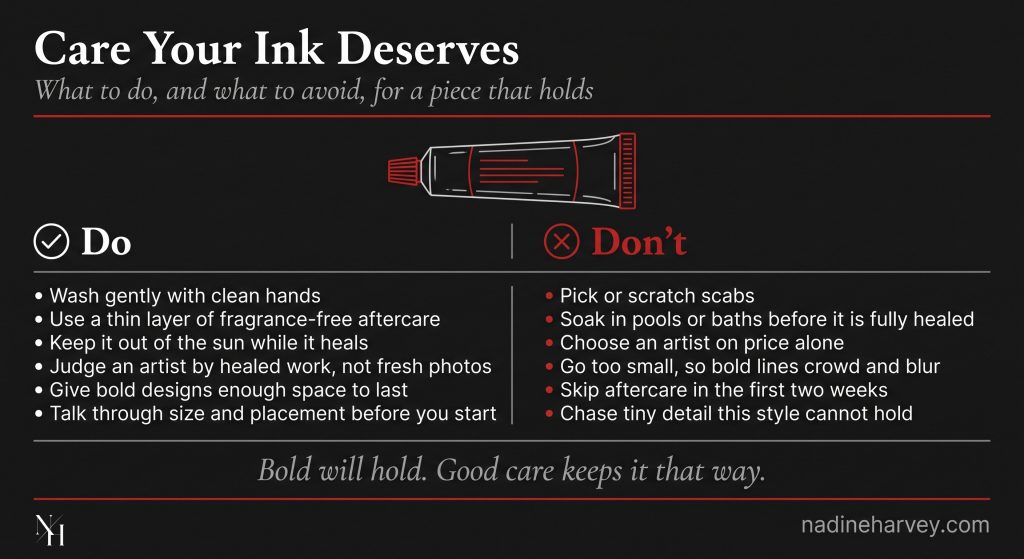
Good aftercare keeps your lines crisp and your color bold. Keep it simple:
A few common mistakes can weaken a great tattoo:
American Traditional lasts because it stays simple, bold, and honest. Sailor Jerry set the rules, and they still work. Bold lines, flat color, and classic motifs make a piece that holds for life.
Start by picking an image that means something to you. Decide if a classic flash design fits, or if your story calls for custom work. Then find an artist who respects the style and works clean.
If you want a traditional piece done with care, learn more about my approach or reach out to plan a consultation. I take limited bookings and draw each design by hand.
The palette is small on purpose. It usually includes red, yellow, green, blue, and black. The colors sit flat, with no blending. This keeps the tattoo bold and readable for decades.
Yes, in most cases. Bold outlines and solid color hold their shape as skin changes. There is little fine detail to blur. This is the meaning behind the “bold will hold” mantra.
They are closely linked. Sailor Jerry helped define American Traditional, so his name is often used for the style. But the tradition also grew through artists like Cap Coleman and Bert Grimm.
It depends on size, placement, and whether you pick flash or custom. Small flash pieces cost less and take less time. Large custom work costs more and needs more sessions.
Yes. Classic meanings are a starting point, not a rule. A good artist can adjust a design or blend motifs. The history gives it roots, and your story makes it yours.